
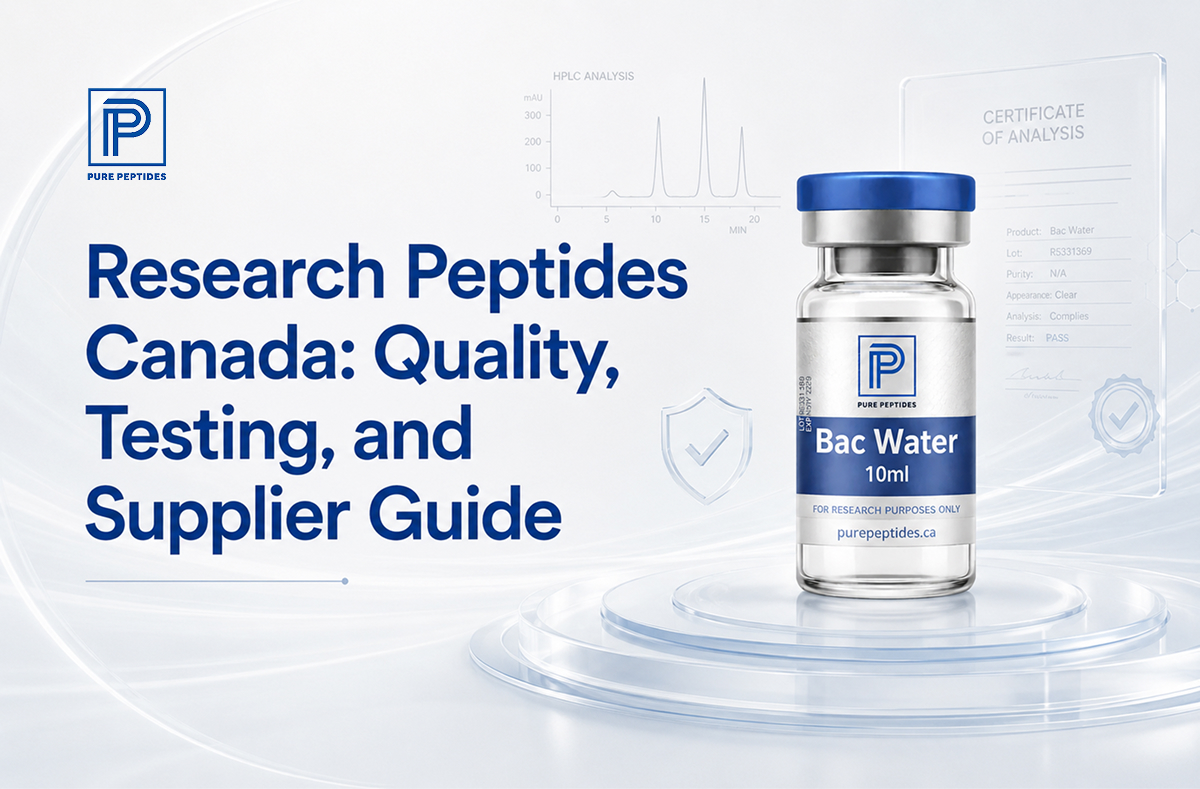
Research Peptides Canada: Quality, Testing, and Supplier Guide


Interest in Research Peptides Canada continues to grow as laboratories and research organizations explore peptides across areas such as molecular signalling, metabolism, cellular repair, mitochondrial biology, and peptide chemistry. However, selecting research materials requires more than comparing product names, prices, or advertised purity percentages.
Peptide identity, analytical testing, batch traceability, storage conditions, and supplier transparency can all influence the reliability of laboratory research.
At Pure Peptides, researchers can explore peptide materials intended for laboratory research while reviewing relevant product information and available analytical documentation.
This guide explains what research peptides are, how researchers evaluate peptide quality, how they interpret Certificates of Analysis (COAs), and what factors they should consider when choosing a research peptide supplier in Canada.
Understanding Research Peptides in Canada
Peptide bonds connect amino acids to form short chains known as peptides. Depending on their sequence and structure, they can participate in biological processes involving receptors, enzymes, cellular communication, metabolism, and other signalling pathways.
Synthetic peptides are therefore widely studied as experimental tools in laboratory environments.
Research applications may include:
- Receptor and ligand studies
- Cellular signalling research
- Metabolic pathway investigation
- Mitochondrial research
- Tissue and cellular biology
- Peptide structure and stability studies
- Analytical method development
In Canada, an important distinction exists between materials supplied for laboratory research and products authorized for therapeutic use.
Researchers should not interpret the phrase “research use only” as evidence that Health Canada or another regulator has approved a peptide as a medicine. Health Canada has specifically warned about unauthorized injectable peptide products sold online and has stated that labelling products “For Research Use Only – Not for Human Consumption” does not automatically exempt them from applicable Canadian regulatory requirements.
For researchers, this makes transparent product positioning and documentation particularly important. A research supplier should clearly identify materials according to their intended laboratory purpose and avoid presenting experimental compounds as approved treatments.
Explore high-quality research peptides with transparent testing and reliable laboratory standards at Pure Peptides
Common Categories of Research Peptides
Researchers can organize research peptides into broad categories according to the biological pathways or scientific questions they investigate.
| Category | Research Focus | Examples |
|---|---|---|
| Metabolic Peptides | Glucose-related signalling, energy metabolism, lipid metabolism, receptor activity, and mitochondrial function | Various metabolic signalling peptides |
| Growth Hormone & Endocrine Peptides | Growth hormone signalling, receptor interactions, signalling duration, molecular modifications, and downstream responses | CJC-1295, Ipamorelin, Tesamorelin, Kisspeptin-related peptides |
| Cellular Repair & Tissue Peptides | Cellular migration, inflammatory signalling, extracellular matrix biology, angiogenesis, and tissue-associated pathways | BPC-157, TB-500-related compounds, KPV, GHK-Cu |
| Mitochondrial & Cellular Aging Peptides | Mitochondrial function, oxidative stress, cellular energy regulation, and metabolic signalling | MOTS-c, SS-31 |
Different peptides can act through distinct mechanisms, even when researchers place them within the same broad category. Therefore, researchers should evaluate each compound individually and interpret findings according to the experimental model and available evidence.
In addition, results from cell or animal studies should not automatically be interpreted as confirmed clinical effects in humans. These distinctions demonstrate why Research Peptides Canada encompasses a broad range of research compounds rather than a single type of laboratory material.
How Peptide Quality Is Evaluated
Peptide quality cannot be determined simply by looking at a vial.
Laboratories rely on analytical methods to investigate whether a sample is consistent with its expected identity and purity.
Two of the most commonly discussed techniques are HPLC and mass spectrometry.
High-Performance Liquid Chromatography (HPLC)
HPLC is commonly used to evaluate chromatographic purity.
During analysis, components within a sample are separated according to their interactions with the chromatographic system. The resulting chromatogram shows detectable peaks representing different components.
A dominant peak may correspond to the intended peptide, while smaller peaks may represent:
- Synthesis-related impurities
- Truncated sequences
- Degradation products
- Other detectable compounds
This allows laboratories to estimate the relative chromatographic purity of the sample.
However, a statement such as “99% purity” should be interpreted carefully. HPLC purity does not automatically establish the total quantity of peptide in the vial, sterility, endotoxin levels, or absence of every possible contaminant.
Mass Spectrometry (MS)
Mass spectrometry provides complementary analytical information.
Rather than primarily measuring chromatographic purity, MS measures mass-related characteristics that can be compared with the expected molecular mass of the peptide.
This can provide evidence supporting peptide identity.
In simplified terms:
HPLC → Composition and relative purity
Mass Spectrometry → Molecular mass and identity support
Using both techniques can therefore provide a more complete analytical picture than relying on either method alone.
Purity vs. Peptide Content
Researchers should also distinguish between purity and content.
A sample can show high chromatographic purity while still containing a different total amount of peptide than expected.
Purity describes the relative proportion of the principal detectable component under specific analytical conditions.
Content refers to the actual quantity of peptide present.
Depending on the intended experiment, additional testing may therefore be appropriate.
Certificates of Analysis and Batch Testing
A Certificate of Analysis (COA) summarizes analytical information associated with a material or production batch.
For researchers comparing Research Peptides Canada, COAs can provide useful information about product quality—but only when the documentation is meaningful and traceable.
A useful peptide COA may include:
- Peptide name
- Lot or batch number
- Test date
- Analytical method
- HPLC purity result
- HPLC chromatogram
- Expected molecular mass
- Observed molecular mass
- Mass spectrometry data
- Laboratory information
Why Batch Numbers Matter
Batch traceability is particularly important.
A generic COA that cannot be connected to the actual peptide being purchased provides limited information.
Batch-specific documentation allows researchers to connect analytical results with the material used in their experiments.
This can also help when comparing results between different peptide batches. If experimental results unexpectedly change, researchers can review whether differences in purity, storage history, preparation, or batch characteristics may have contributed.
What Does Third-Party Testing Mean?
Some research peptide suppliers use independent laboratories to perform analytical testing.
Third-party testing can provide an additional level of verification, but researchers should still examine what was actually tested.
Useful questions include:
- Is the testing laboratory identifiable?
- Does the batch number match the product?
- When was the analysis performed?
- Was HPLC used?
- Was mass spectrometry performed?
- Are chromatograms or spectra available?
A third-party logo alone does not establish peptide quality. The underlying analytical results are what matter.
Peptide Storage and Laboratory Handling
Proper storage is important because peptides can degrade when exposed to unsuitable environmental conditions.
Factors affecting stability may include:
- Temperature
- Moisture
- Light
- Oxygen exposure
- Peptide sequence
- Formulation
- Physical state
- Repeated temperature changes
Many research peptides are supplied as lyophilized powders. Removing water can improve stability, but the material should still be handled according to compound-specific storage instructions.
Handling Lyophilized Peptides
Laboratories should generally minimize unnecessary exposure to moisture, excessive heat, direct light, and environmental contamination.
Researchers should always review product-specific storage information because stability requirements can differ between peptides.
Stability After Reconstitution
Once a peptide enters solution, its stability profile may change significantly.
Factors such as solvent, pH, concentration, temperature, oxidation, container surfaces, and freeze-thaw cycles may influence stability.
For this reason, researchers should follow protocols appropriate to the specific compound rather than assuming that all peptides can be stored or handled identically.
Maintaining records of lot numbers, storage conditions, preparation dates, and experimental use can also improve laboratory traceability.
Choosing a Research Peptide Supplier in Canada
Searching for Research Peptides Canada can produce many suppliers, but researchers should compare them based on evidence rather than marketing language alone.
Several factors deserve particular attention.
1. Look for Analytical Testing
A research peptide supplier should provide meaningful analytical information about its products.
HPLC can provide information about chromatographic purity, while mass spectrometry can provide evidence supporting molecular identity.
Ideally, analytical results should correspond to the batch being supplied.
2. Check Batch Traceability
Look for clearly identified lot or batch numbers.
Traceability allows researchers to associate a specific peptide sample with its analytical documentation and can help identify possible sources of experimental variability.
3. Review the COA Carefully
Do not evaluate a supplier simply because it displays a COA.
Instead, examine what the document actually contains.
Look for:
- Matching batch information
- Testing dates
- Analytical methods
- HPLC results
- Mass spectrometry data
- Identifiable laboratory information
The documentation should help answer scientific questions about the material rather than functioning only as a marketing badge.
4. Evaluate Product Information
A transparent supplier may provide relevant technical information such as:
- Peptide name
- Molecular weight
- Molecular formula
- Purity specification
- Storage guidance
- Batch information
- Analytical documentation
- Research-use designation
Better product documentation can help researchers make more informed purchasing decisions and plan laboratory experiments.
5. Avoid Unsupported Therapeutic Claims
Canadian researchers should be cautious when suppliers present experimental peptides as treatments for weight loss, anti-aging, muscle growth, recovery, or medical conditions.
Researchers should present findings according to the strength and type of available evidence. They should not automatically describe preclinical results from cell cultures or animal studies as established human benefits.
6. Consider Canadian Shipping and Storage
Shipping conditions also matter when purchasing research materials.
Researchers may want to consider whether:
- Products are securely packaged
- Storage instructions are provided
- Materials are protected during transportation
- Batch identification remains clear upon arrival
- Appropriate shipping procedures are used when required
Quality control should continue from analytical testing through delivery and laboratory storage.
Explore quality-tested research peptides with clear product information and laboratory-focused standards at Pure Peptides
Why Quality Matters in Peptide Research
Reliable experimental research depends on controlling variables.
If researchers do not know the identity, purity, or storage history of the peptide being studied, uncertainty is introduced before the experiment begins.
Differences between samples may result from:
- Purity variation
- Peptide degradation
- Incorrect concentration
- Synthesis-related impurities
- Storage conditions
- Preparation methods
- Batch variation
Researchers cannot eliminate every experimental variable through analytical testing, but these methods can provide greater confidence in the identity and quality of the material being investigated.
When evaluating Research Peptides Canada, researchers should assess quality through documentation, traceability, and analytical evidence rather than relying solely on price or advertised purity percentages.
Researchers can explore the Pure Peptides catalogue to compare available research compounds and review relevant product information before selecting materials for laboratory investigation.
SEE MORE:
- What Are Research Peptides? Types, Characteristics, and Laboratory Applications
- Peptide Synthesis Process: Production, Purification, and Quality Control
- Peptide Purity Explained: Testing Methods and Research Significance
- Peptide Certificate of Analysis: How to Read and Evaluate a COA
- Peptide Storage and Handling Guidelines for Laboratory Research
- Types of Research Peptides: Classification and Laboratory Applications
- Peptide Batch Testing: Purity, Identity, and Quality Control
FAQ About Research Peptides Canada
What are research peptides?
Research peptides are peptide materials used for laboratory and scientific investigation. They may be studied in areas such as molecular signalling, metabolism, cellular biology, mitochondrial function, and peptide chemistry.
How is peptide purity tested?
HPLC is commonly used to evaluate chromatographic purity. It separates detectable components within a sample and allows researchers to estimate the relative proportion associated with the principal component.
How is peptide identity tested?
Mass spectrometry is commonly used to provide molecular mass information that can support peptide identity. Researchers can compare observed mass-related data with the expected molecular mass of the peptide.
What should a peptide COA include?
A useful COA may include the peptide name, batch number, testing date, analytical method, HPLC results, mass spectrometry results, and relevant laboratory information.
Does 99% HPLC purity mean the vial contains 99% peptide?
Not necessarily. HPLC purity generally describes the relative chromatographic composition detected under specific analytical conditions. It does not automatically establish total peptide content, sterility, or the absence of every possible impurity.
Why is batch testing important?
Batch testing connects analytical results with a specific production lot. This improves traceability and helps researchers investigate possible material-related differences between experiments.
How should research peptides be stored?
Storage requirements depend on the individual peptide. Temperature, moisture, light, oxidation, formulation, and physical state can all affect stability. Researchers should follow compound-specific storage information.
What should I look for when choosing a research peptide supplier in Canada?
Prioritize transparent product information, batch traceability, meaningful analytical testing, clear COAs, appropriate storage guidance, and responsible research-use positioning.
Final Thoughts
Choosing Research Peptides Canada should involve more than comparing prices or advertised purity percentages.
Researchers should evaluate peptide identity, HPLC purity, mass spectrometry results, batch traceability, Certificates of Analysis, storage requirements, and supplier transparency. Together, these factors provide a stronger foundation for reproducible laboratory research.
A reliable supplier should make it easier—not harder—to understand what is being purchased and how the material has been evaluated.
Explore Pure Peptides to compare research peptides, product specifications, and available analytical documentation for your next laboratory project.
Disclaimer: This content is provided for educational and scientific research purposes only. Research peptides are intended for laboratory use only and are not intended for human consumption or medical use.
Really useful overview of the research peptide landscape in Canada. I liked that the article provides local context rather than treating the topic as the same across every market. The discussion around quality standards and responsible research would be interesting to explore in more detail.