
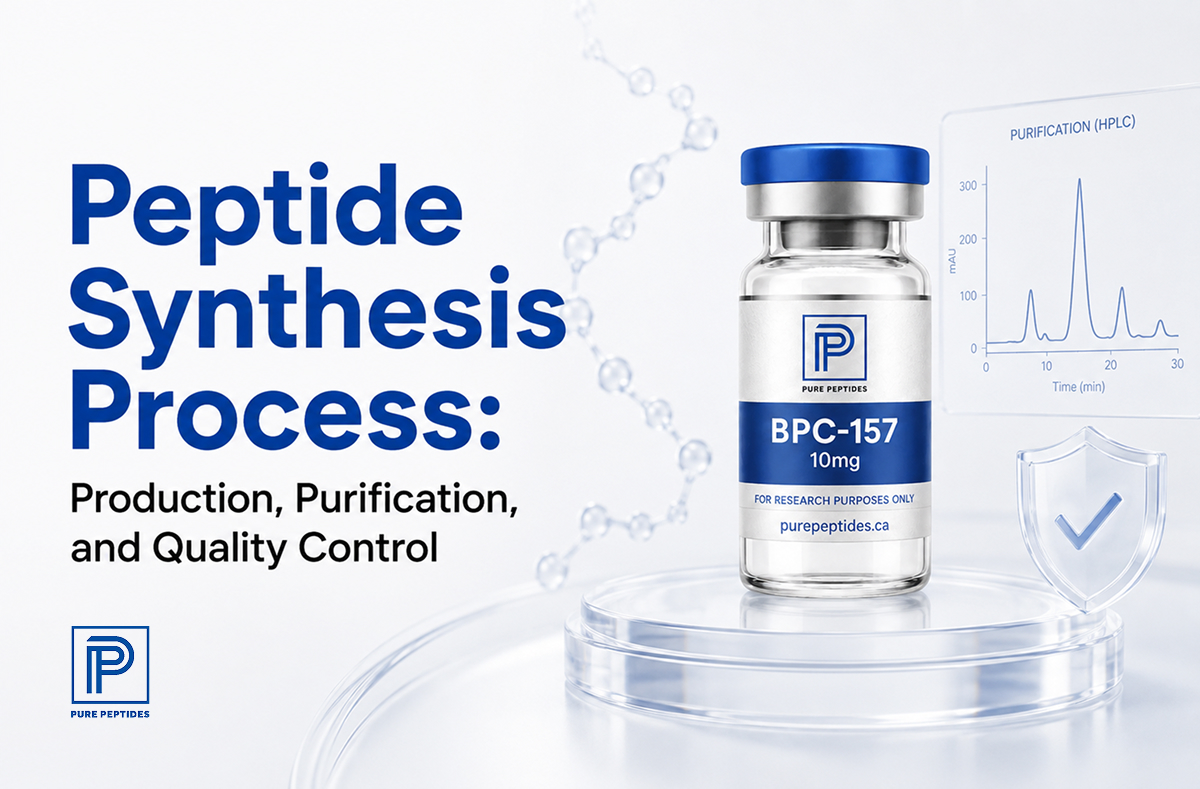
Peptide Synthesis Process: Production, Purification, and Quality Control


Peptide synthesis is an important technique in biochemical, pharmaceutical, and molecular research. It allows researchers to create defined amino-acid sequences for investigating receptors, enzymes, cellular signalling, protein interactions, metabolism, and other biological mechanisms.
The peptide synthesis process involves several controlled stages, including amino-acid coupling, chain assembly, cleavage, purification, and analytical testing. Each step can influence the identity, purity, and consistency of the final research material.
Understanding these stages is particularly useful when evaluating research peptides. Purity percentages alone do not provide a complete picture of quality; peptide identity, analytical documentation, batch consistency, and appropriate storage are also important.
This guide explains how researchers synthesize, purify, and test research peptides while highlighting key quality considerations for laboratories and researchers in Canada.
What Is Peptide Synthesis?
Peptide synthesis is the controlled process of joining amino acids together through peptide bonds to produce a defined amino-acid sequence.
Amino acids contain multiple reactive functional groups. Therefore, synthesis requires careful control to ensure reactions occur at the intended positions. Researchers commonly use chemical protecting groups to temporarily block specific reactive sites while allowing the desired peptide bond to form.
A typical peptide synthesis process includes:
- Selecting the target peptide sequence
- Preparing protected amino acids
- Sequential amino-acid coupling
- Removing temporary protecting groups
- Repeating coupling and deprotection cycles
- Cleaving the completed peptide
- Purifying the crude material
- Testing identity and purity
Chemical synthesis allows researchers to produce naturally occurring peptide sequences as well as modified peptides designed for specific experiments.
Scientists can also substitute or chemically modify individual amino acids to investigate how structural changes affect receptor binding, stability, or other molecular properties.
Explore quality-tested research peptides with clear product information and laboratory-focused standards at Pure Peptides
Solid-Phase Peptide Synthesis Explained
Researchers widely use solid-phase peptide synthesis (SPPS) to produce research peptides.
In SPPS, researchers keep the growing peptide attached to an insoluble resin and add amino acids sequentially. Researchers then remove excess reagents and reaction by-products through washing without isolating the peptide after each step.
The basic cycle involves:
Deprotection → amino-acid coupling → washing → deprotection → next coupling
Researchers repeat this process until they assemble the complete amino-acid sequence.
Fmoc-Based SPPS
A commonly used strategy is Fmoc solid-phase peptide synthesis.
Fmoc, or 9-fluorenylmethoxycarbonyl, temporarily protects the amino group involved in chain extension. Before adding the next amino acid, researchers remove the Fmoc group to expose the reactive amino group.
Side chains containing reactive functional groups may require additional protecting groups. Researchers keep these groups in place during chain assembly and generally remove them during the final cleavage stage.
Because SPPS uses repeatable reaction cycles, laboratories can automate the process while maintaining considerable control over the peptide sequence.
Amino Acid Coupling and Chain Assembly
Chain assembly is a central part of the peptide synthesis process.
A peptide bond forms between the amino group of one amino acid and the carboxyl group of another. During chemical synthesis, researchers typically activate the incoming amino acid with appropriate coupling chemistry to promote efficient bond formation.
The activated amino acid reacts with the growing resin-bound peptide. After the coupling reaction, researchers remove excess reagents and by-products through washing.
Researchers then remove the temporary protecting group to expose the next reactive amino group.
This cycle repeats until the target sequence is complete.
Why Coupling Efficiency Matters
Each coupling step needs to proceed efficiently.
If one reaction is incomplete, some peptide chains may fail to incorporate the intended amino acid. These incomplete chains can continue through subsequent cycles, producing deletion sequences.
This becomes increasingly important as peptides become longer because synthesis errors can accumulate across multiple reaction cycles.
Certain sequences may therefore require optimized conditions, additional coupling cycles, or specialized synthesis strategies.
Peptide Cleavage and Purification
After chain assembly, laboratories separate the peptide from the solid resin through cleavage. The crude peptide then undergoes purification and, commonly, lyophilization.
| Stage | Process | Key Details |
|---|---|---|
| Cleavage From the Resin | Separates the completed peptide from the solid resin | Conditions depend on the resin, protecting groups, and peptide sequence. In many Fmoc-based workflows, acidic conditions also remove side-chain protecting groups. |
| Crude Peptide Formation | Produces the material collected after cleavage | Crude material may contain the target peptide, truncated or deletion sequences, side-reaction products, residual reagents, and protecting-group-related impurities. |
| Peptide Purification | Removes unwanted components from the crude material | Laboratories widely use RP-HPLC to separate compounds according to their chromatographic interactions and collect the target peptide fraction. |
| Lyophilization | Converts purified peptide fractions into dry material | Freeze-drying removes water and volatile solvents under reduced pressure and controlled temperature, producing material suitable for peptide-specific storage conditions. |
Consequently, purification plays an important role after cleavage because crude peptide can contain several synthesis-related impurities. However, purification may become more challenging when unwanted sequences have chemical properties similar to those of the target peptide.
Identity and Purity Testing
Analytical testing helps determine whether a peptide corresponds to its intended molecular identity and whether detectable impurities remain.
Two commonly used analytical techniques are HPLC and mass spectrometry.
HPLC Purity Analysis
Analytical HPLC separates components within a sample and produces a chromatogram.
Researchers can use the resulting data to assess:
- Relative peptide purity
- Major sample components
- Synthesis-related impurities
- Potential degradation products
However, HPLC purity alone does not prove that the principal peak represents the intended peptide.
Mass Spectrometry
Mass spectrometry (MS) provides molecular-mass information and commonly helps researchers verify peptide identity.
The measured molecular mass can be compared with the theoretical mass expected from the target amino-acid sequence.
Therefore, HPLC and MS provide complementary information:
HPLC evaluates sample purity, while mass spectrometry supports molecular identity verification.
Using both methods provides more useful characterization than relying on a purity percentage alone.
Certificate of Analysis
A Certificate of Analysis (COA) can provide batch-specific analytical information.
Depending on the testing program, documentation may include:
- Peptide identity
- Batch or lot number
- Purity result
- Analytical method
- Molecular mass
- Testing information
Batch-specific documentation improves traceability and helps researchers evaluate materials before incorporating them into experiments.
Quality Control in Peptide Production
Quality control involves more than achieving a particular purity percentage.
For laboratory research, several characteristics can influence experimental reliability.
Sequence Identity
The material should correspond to the intended amino-acid sequence. Analytical techniques such as mass spectrometry can support identity verification.
Purity
Purity indicates the relative amount of the intended peptide compared with detectable impurities under specified analytical conditions.
Different laboratory applications may require different purity specifications.
Batch Consistency
Variation between batches can affect experimental reproducibility. Consistent production methods and batch-level analytical documentation make it easier for researchers to compare results across different experiments.
Storage Stability
Peptides can degrade when exposed to unsuitable environmental conditions.
Factors affecting stability may include:
- Temperature
- Moisture
- Oxygen
- Light
- Solution pH
- Repeated freeze-thaw cycles
Storage requirements vary between peptides, so researchers should follow compound-specific information rather than assuming universal conditions.
Explore quality-tested research peptides with clear product information and laboratory-focused standards at Pure Peptides
Common Challenges in Peptide Synthesis
Although modern synthesis methods provide substantial control over peptide production, several challenges can affect the final material.
Incomplete Coupling
Amino-acid coupling may occasionally fail to reach completion.
Incomplete reactions can create deletion sequences missing one or more amino acids. These impurities can become increasingly significant as peptide length increases.
Peptide Aggregation
Growing peptide chains can interact and aggregate while attached to the resin.
Aggregation can reduce access to reactive sites and lower coupling efficiency, particularly with certain longer or hydrophobic sequences.
Difficult Amino-Acid Sequences
Not all peptides are equally easy to synthesize.
Hydrophobic sequences, longer chains, and sequences prone to secondary structure may require modified synthesis conditions or specialized strategies.
Side Reactions
Unwanted chemical reactions can occur during coupling, deprotection, or cleavage.
These reactions may generate modified peptide species that must subsequently be separated during purification.
Purification Challenges
Some synthesis-related impurities can have properties very similar to the intended peptide.
A deletion sequence differing by only one amino acid, for example, may behave similarly during chromatography. This can make separation more demanding.
Peptide Length
Longer peptides require more synthesis cycles, increasing the opportunity for incomplete reactions and accumulated impurities.
For larger molecular targets, researchers may use alternative strategies such as synthesizing smaller peptide fragments and joining them through chemical ligation.
Peptide Synthesis and Research in Canada
Canadian researchers should distinguish laboratory research materials from products authorized for therapeutic use.
Health Canada regulates health products according to their intended use, presentation, claims, and applicable Canadian requirements. A peptide being available for laboratory research does not mean it has been authorized as a drug or therapeutic product.
This distinction has received increased attention in Canada. Health Canada has emphasized that simply describing a peptide as “for research use only” does not automatically exempt a product from drug regulations if it is marketed or represented for therapeutic use.
For legitimate laboratory applications, researchers should focus on factors such as peptide identity, purity, analytical documentation, traceability, and appropriate handling.
These characteristics are also important when comparing research peptide suppliers. Clear product information and batch-specific analytical data can help laboratories select materials appropriate for their experimental requirements.
For a deeper understanding of peptide quality and sourcing, read our guide: Research Peptides Canada: Quality, Testing, and Supplier Guide.
FAQ About the Peptide Synthesis Process
What is the peptide synthesis process?
The peptide synthesis process involves assembling amino acids into a defined sequence. Major stages include amino-acid coupling, chain assembly, cleavage, purification, identity verification, and purity testing.
What is solid-phase peptide synthesis?
Solid-phase peptide synthesis is a method in which the growing peptide remains attached to a solid resin while amino acids are added sequentially. This simplifies washing and enables repeated synthesis cycles.
Why are protecting groups necessary?
Protecting groups temporarily block reactive functional groups so that peptide bonds form at the intended locations. They are removed at specific stages of synthesis.
How are synthesized peptides purified?
Reversed-phase HPLC is commonly used to separate the intended peptide from deletion sequences, side products, and other synthesis-related impurities.
How is peptide identity confirmed?
Mass spectrometry is commonly used to determine whether the measured molecular mass is consistent with the theoretical mass of the intended peptide.
Is high HPLC purity enough to confirm peptide quality?
No. HPLC purity provides useful information about detectable sample components but does not independently confirm molecular identity. Identity testing and other analytical information should also be considered.
Why are longer peptides more difficult to synthesize?
Longer peptides require more reaction cycles, creating additional opportunities for incomplete coupling, aggregation, side reactions, and accumulated impurities.
Final Thoughts
The peptide synthesis process involves several interconnected stages, from amino-acid coupling and chain assembly to cleavage, purification, and final analytical testing.
Solid-phase peptide synthesis provides an efficient way to construct defined sequences, while techniques such as RP-HPLC help purify the resulting material. HPLC and mass spectrometry then provide complementary information about purity and molecular identity.
For laboratory researchers, understanding these processes makes it easier to evaluate peptide quality and determine whether research materials meet specific experimental requirements.
Researchers can explore Pure Peptides to review research-focused peptide products and available product information for laboratory applications.
Disclaimer: This content is provided for educational and scientific research purposes only. Research peptides are intended for laboratory use only and are not intended for human consumption or medical use.
Really interesting overview of the peptide synthesis process. I liked how the article breaks down what can be a fairly technical subject into steps that are easier to follow. The discussion of how synthesis affects peptide quality and consistency was particularly useful.
I found this explanation helpful for understanding what actually goes into producing a research peptide. The step-by-step approach makes the chemistry much less intimidating for someone who is new to the field. I’d be interested in learning more about the purification and quality-control stages after synthesis.
Really interesting breakdown of the peptide synthesis process. I liked how the article makes the different stages easier to understand without oversimplifying the science. The connection between synthesis methods and the consistency of the final peptide was particularly interesting.