
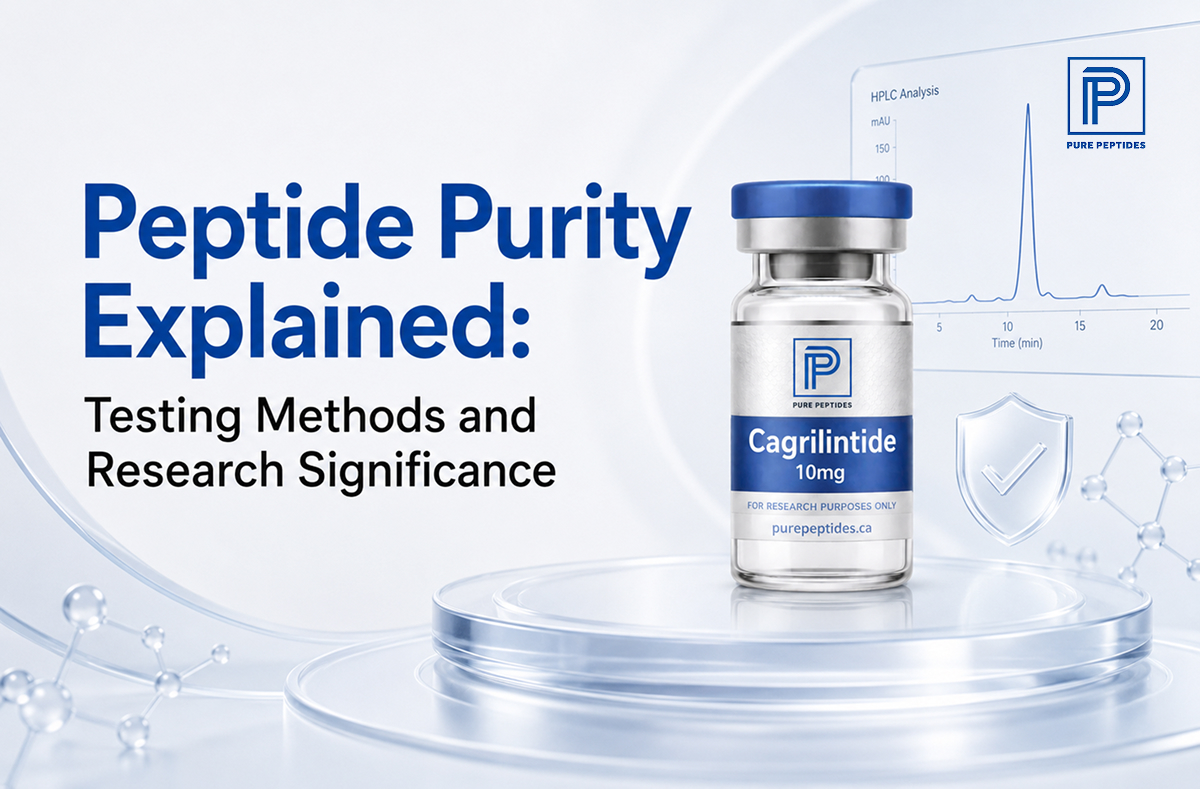
Peptide Purity Explained: Testing Methods and Research Significance


Peptide purity is an important quality factor in biochemical and laboratory research. When researchers study peptide interactions with receptors, enzymes, cells, or signalling pathways, impurities can introduce variables that affect experimental results.
However, peptide purity does not simply confirm that a sample contains the correct peptide. It describes the relative proportion of the target peptide compared with detectable impurities under specific analytical conditions.
Therefore, researchers commonly use high-performance liquid chromatography (HPLC) to evaluate purity and mass spectrometry (MS) to support molecular identity. Understanding these measurements helps laboratories evaluate peptide materials and interpret Certificates of Analysis (COAs).
This guide explains what peptide purity means, how laboratories measure it, why it matters, and how researchers can interpret analytical results.
What Does Peptide Purity Mean?
Peptide purity describes the proportion of the target peptide relative to detectable peptide-related impurities under defined analytical conditions.
During this process, manufacturers assemble amino acids into a target sequence.Although modern synthesis methods provide substantial control, incomplete reactions and chemical changes can create unwanted molecular species.
A peptide sample may contain:
- The intended peptide
- Truncated or deletion sequences
- Modified peptide variants
- Synthesis-related by-products
- Degradation products
Afterward, laboratories can use HPLC to separate detectable components and generate a chromatographic profile.
For example, a reported value of 98% HPLC purity generally means the principal peptide peak represents approximately 98% of the relevant integrated chromatographic peak area under the specified test conditions.
However, it does not necessarily mean that exactly 98% of the total vial mass consists of the target peptide. Other components, including water, counterions, or residual solvents, may not appear in the same calculation.
Explore quality-tested research peptides with clear product information and laboratory-focused standards at Pure Peptides
Why Purity Matters in Laboratory Research
Reliable research requires scientists to control experimental variables. Peptide quality represents one of those variables.
Impurities may affect experimental results if they interact with biological targets, interfere with an assay, or alter the effective amount of target peptide.
Experimental Reproducibility
Researchers need consistent materials to reproduce experiments accurately.
For example, different peptide batches may contain different impurity profiles. As a result, two laboratories following similar protocols could potentially observe different results if their research materials differ substantially.
Batch-specific analytical testing helps researchers evaluate this variability.
Experimental Concentration
Many laboratory protocols require specific peptide concentrations.
As a result, when peptide-related impurities are present, the nominal amount of material may not exactly represent the amount of target peptide. This becomes especially relevant in experiments that require precise quantitative measurements.
Stability
In addition, peptide purity can change during storage.
Temperature, moisture, oxygen, light, and solution conditions may promote chemical degradation. Monitoring analytical profiles can therefore help researchers evaluate peptide stability over time.
Peptide Purity vs Molecular Identity
Importantly, purity and molecular identity describe different characteristics of a peptide sample.
Understanding this distinction is essential when interpreting analytical results.
Peptide Purity
Purity analysis evaluates how much of the detectable sample corresponds to the principal peptide component compared with other detectable components.
HPLC commonly provides this information.
A chromatogram with one dominant peak may indicate high chromatographic purity. However, that result alone does not prove that the dominant peak represents the intended peptide.
Molecular Identity
Identity testing determines whether the analyzed material corresponds to the intended peptide.
Therefore, researchers commonly use mass spectrometry to support this assessment. MS measures molecular mass, which scientists can compare with the theoretical mass calculated from the target amino-acid sequence.
In practical terms:
HPLC → evaluates chromatographic purity
Mass spectrometry → supports molecular identity
Overall, using both methods gives researchers a more complete analytical picture than relying on a purity percentage alone.
How HPLC Measures Peptide Purity
High-performance liquid chromatography is one of the most common analytical methods for evaluating peptide purity. Laboratories frequently use reversed-phase HPLC (RP-HPLC) for peptide analysis.
How RP-HPLC Works
During analysis, a peptide sample passes through a chromatographic column.
During this process, different components interact with the stationary and mobile phases according to their chemical properties.
As a result, the target peptide and impurities may leave the column at different retention times.
Then, a detector records these components as peaks on a chromatogram.
The chromatogram generally displays:
- Retention time on the horizontal axis
- Detector response on the vertical axis
Researchers integrate the relevant peaks and compare their areas to estimate chromatographic purity.
For example, if the principal peak accounts for approximately 99% of the relevant integrated peak area, the laboratory may report approximately 99% HPLC purity.
Limitations of HPLC
HPLC provides valuable information, but it does not describe every component within a peptide sample.
Depending on the analytical method, an HPLC purity result may not directly quantify:
- Water content
- Counterions
- Inorganic salts
- Residual solvents
- Exact peptide content by vial mass
Testing conditions such as the column, mobile-phase gradient, detection wavelength, and peak-integration method can also influence results.
Researchers should therefore interpret HPLC purity within the context of the analytical method used.
Explore quality-tested research peptides with clear product information and laboratory-focused standards at Pure Peptides
Common Impurities and Degradation Products
Peptide impurities can develop during synthesis, purification, processing, or storage.
Deletion and Truncated Sequences
Peptide synthesis involves adding amino acids sequentially.
If a coupling reaction remains incomplete, some chains may fail to incorporate an amino acid. Continued synthesis can then produce deletion sequences.
Incomplete chain assembly may also generate shorter, truncated peptides.
These impurities can sometimes resemble the target peptide chemically, making purification more challenging.
Modified Peptide Species
Chemical reactions during synthesis or processing may alter individual amino-acid residues and create modified peptide species.
These structural changes can affect the molecule’s analytical or biological properties.
Degradation Products
Peptides can degrade after production when environmental conditions promote chemical changes.
Potential contributing factors include:
- Elevated temperatures
- Moisture
- Oxygen exposure
- Light
- Unsuitable solution conditions
- Repeated freeze-thaw cycles
Because peptide sequences differ in stability, researchers should follow compound-specific storage guidance.
Importantly, two peptide samples with the same stated purity percentage can still contain different impurities. The purity number alone does not describe the complete impurity profile.
How to Interpret Peptide Purity Results
Researchers should evaluate peptide purity within the broader analytical context rather than focusing exclusively on the highest percentage.
Check the Analytical Method
First, determine how the laboratory measured purity.
For research peptides, RP-HPLC commonly provides chromatographic purity results. A percentage without information about the testing method provides limited context.
Look for Identity Data
A high HPLC purity result does not replace identity testing.
When relevant to the research protocol, researchers should look for complementary data such as mass spectrometry results.
Review Batch-Specific Documentation
Analytical results should ideally correspond to the batch used in the experiment.
A Certificate of Analysis may include:
- Peptide name
- Batch or lot number
- HPLC purity
- Molecular-mass data
- Analytical methods
- Testing information
Batch-specific documentation improves traceability and makes it easier to connect experimental findings with the material used.
Consider the Research Application
The appropriate purity specification depends on the experiment.
Different applications may have different requirements based on assay sensitivity, research objectives, and analytical methodology. Researchers should therefore select materials according to their experimental protocols rather than assuming that one purity threshold fits every application.
Peptide Purity and Research in Canada
Canadian researchers should distinguish analytical quality from regulatory authorization.
Health Canada regulates health products according to their intended use, presentation, claims, and applicable Canadian requirements. A high peptide purity result does not mean that Health Canada has reviewed or authorized a research peptide for therapeutic use.
Health Canada has also emphasized that describing a product as “for research use only” does not automatically exempt it from drug regulations when a company markets or represents it for therapeutic purposes.
For laboratory applications, researchers should focus on characteristics relevant to scientific work, including:
- Peptide identity
- Purity results
- Analytical methods
- Batch traceability
- COA availability
- Appropriate storage information
Together, these factors provide a more useful assessment of research materials than a purity percentage alone.
Researchers can explore Pure Peptides to review available research peptide products and product-specific information for laboratory applications.
For a deeper understanding of peptide quality and sourcing, read our guide: Research Peptides Canada: Quality, Testing, and Supplier Guide.
FAQ About Peptide Purity
What does peptide purity mean?
Peptide purity describes the relative proportion of the target peptide compared with detectable peptide-related impurities under defined analytical conditions.
Is 99% peptide purity the same as 99% peptide content?
No. A 99% HPLC result usually refers to chromatographic peak area under specific testing conditions. It does not necessarily mean that the target peptide accounts for 99% of the total vial mass.
How do laboratories test peptide purity?
Laboratories commonly use reversed-phase HPLC to separate the target peptide from detectable impurities and calculate relative chromatographic peak areas.
Does HPLC confirm peptide identity?
Not by itself. HPLC primarily evaluates chromatographic purity. Researchers commonly use mass spectrometry to provide molecular-mass information that supports peptide identity.
What causes peptide impurities?
Incomplete coupling, truncated sequences, chemical side reactions, processing conditions, and degradation can contribute to peptide impurities.
What should researchers check on a peptide COA?
Researchers should review the batch or lot number, purity result, analytical method, molecular-mass or identity information when available, and relevant testing details.
Final Thoughts
Peptide purity is an important consideration when evaluating materials for laboratory research, but the purity percentage represents only one part of peptide characterization.
HPLC helps researchers evaluate chromatographic purity, while mass spectrometry provides complementary information about molecular identity. Researchers should also consider batch-specific documentation, analytical methods, impurity profiles, and appropriate storage conditions.
Understanding these factors can support better material selection, experimental consistency, and more reliable interpretation of laboratory data.
Researchers can explore Pure Peptides to review research-focused peptide products and available information for laboratory applications.
Disclaimer: This content is provided for educational and scientific research purposes only. Research peptides are intended for laboratory use only and are not intended for human consumption or medical use.
Really useful overview of peptide purity and why it matters in research. I liked that the article goes beyond simply mentioning a purity percentage and explains why consistency and characterization are also important. It would be interesting to see a practical example of how researchers evaluate a peptide sample.
Appreciate the research-focused approach to peptide purity. It’s useful to understand that a stated purity level is only one part of assessing the overall quality of a research material. A follow-up explaining how purity, identity and analytical testing work together would be very informative.
Really useful overview of peptide purity and its importance in research. I liked that the article points out that purity is more than just a number and that proper characterization also matters when evaluating a research sample. It would be interesting to see a practical example of how different testing results are interpreted.