
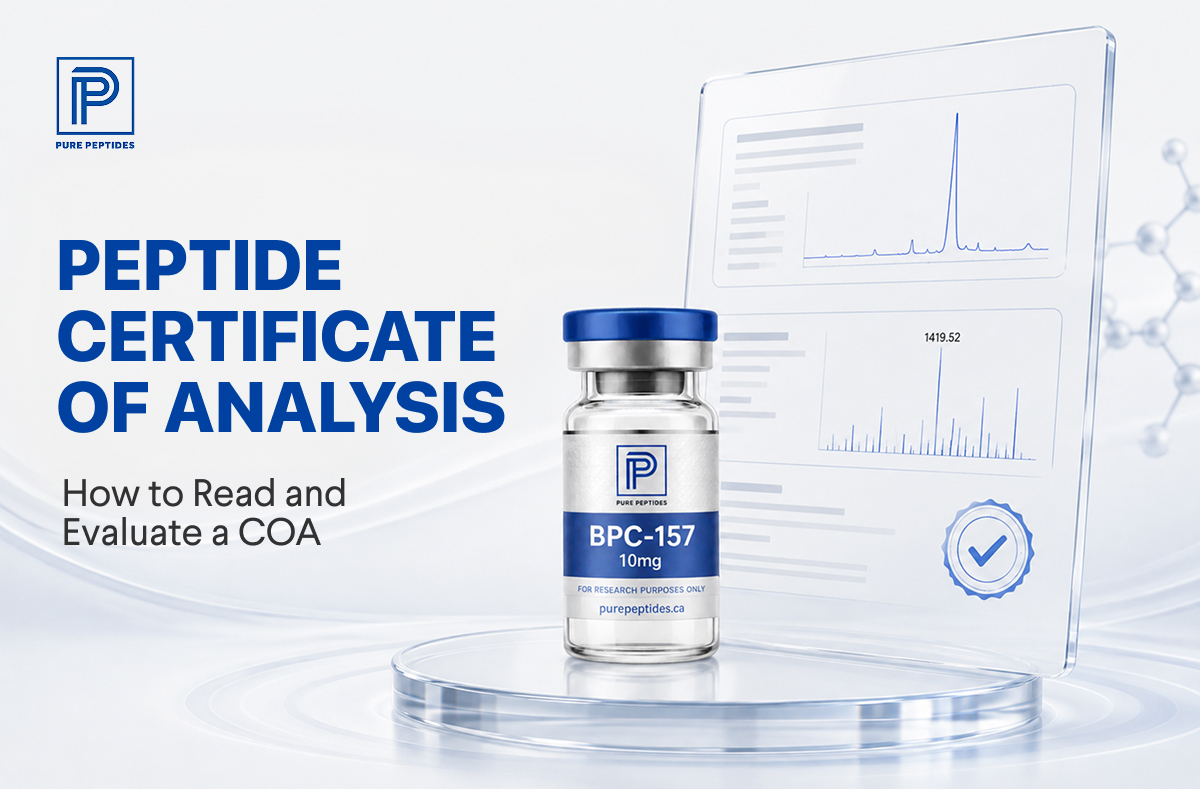
Peptide Certificate of Analysis: How to Read and Evaluate a COA


A peptide certificate of analysis (COA) helps researchers evaluate the analytical characteristics of a peptide before using it in laboratory studies. A useful COA can show product identity, batch information, purity results, testing methods, and molecular-mass data.
However, a high purity percentage alone does not provide a complete assessment. Therefore, researchers should understand what each test measures and confirm that the report corresponds to the specific peptide batch.
This guide explains how to read a peptide COA, interpret HPLC and mass spectrometry results, and recognize documentation that may require closer review.
What Is a Peptide Certificate of Analysis?
A peptide certificate of analysis is a document that reports analytical results for a peptide product or production batch. A manufacturer, supplier, or independent laboratory may issue the report after testing.
For example, a useful COA should help researchers answer:
- Which peptide did the laboratory test?
- Which batch does the report cover?
- What testing methods were used?
- What purity did the analysis show?
- Does the data support the expected molecular identity?
- When did testing occur?
The table below summarizes the main information to check:
| COA Element | What to Look For |
|---|---|
| Product name | Matches the peptide |
| Batch/Lot number | Matches the supplied material |
| HPLC result | Reports chromatographic purity |
| Mass spectrometry | Supports molecular identity |
| Test date | Indicates when testing occurred |
| Laboratory details | Identifies the testing source |
However, a COA provides analytical evidence, and researchers still need to determine whether the material meets the requirements of their specific protocol.
Explore quality-tested research peptides with clear product information and laboratory-focused standards at Pure Peptides
Product and Batch Identification
First, start with the product and batch information before reviewing purity.
Product Identification
The report should clearly identify the peptide tested. Depending on the COA, it may also include the amino-acid sequence, molecular formula, or theoretical molecular mass.
As a result, these details help researchers confirm that the report refers to the intended compound.
Batch or Lot Number
The batch number links the analytical results to the physical research material.
Therefore, the lot number on the COA should ideally match the batch information supplied with the peptide.
If the numbers do not match, the report may describe a different production lot.
Testing Date
In addition, the testing date shows when the laboratory performed the analysis. This information can provide useful context when reviewing the report, especially for stability-sensitive materials.
Understanding Purity and Identity Results
Importantly, purity and molecular identity are related but distinct measurements.
Peptide Purity
Purity describes the proportion of the main peptide component relative to other detectable components under specified analytical conditions.
For this reason, laboratories commonly use reversed-phase high-performance liquid chromatography (RP-HPLC) to evaluate peptide purity.
For example, a result of ≥98% HPLC purity generally indicates that the principal peak accounts for at least 98% of the relevant integrated chromatographic peak area under the test conditions.
However, this does not necessarily mean that 98% of the total vial mass consists of the target peptide.
Molecular Identity
In contrast, identity testing asks whether the analyzed material corresponds to the intended peptide.
Mass spectrometry commonly supports identity verification by measuring molecular mass. Researchers can compare the observed result with the theoretical mass expected from the amino-acid sequence.
| Method | What It Primarily Shows |
|---|---|
| HPLC | Chromatographic purity |
| Mass spectrometry | Molecular-mass information supporting identity |
Therefore, researchers should avoid treating an HPLC purity percentage as proof of peptide identity.
Reading HPLC and Mass Spectrometry Data
A peptide certificate of analysis may include summary results as well as chromatograms or mass spectra.
How to Read HPLC Data
An HPLC chromatogram typically displays:
- X-axis: Retention time
- Y-axis: Detector response
- Major peak: Usually associated with the principal component
- Smaller peaks: May indicate impurities or degradation products
Next, laboratories calculate chromatographic purity by comparing integrated peak areas.
A dominant peak can support high chromatographic purity, but researchers should also consider the analytical conditions. Column chemistry, mobile-phase gradient, detection wavelength, and integration settings can influence results.
In addition, HPLC does not necessarily quantify water, salts, counterions, or every residual solvent. Therefore, chromatographic purity should not automatically be interpreted as total peptide content by vial mass.
How to Read Mass Spectrometry Data
Mass spectrometry measures ions according to their mass-to-charge ratio (m/z).
Researchers compare the resulting molecular-mass information with the expected mass of the target peptide. A result consistent with the theoretical value supports molecular identity.
However, multiple peaks in a mass spectrum do not automatically mean multiple peptides are present because peptides can produce different charge states.
Overall, HPLC and MS provide complementary information about a peptide sample.
Explore quality-tested research peptides with clear product information and laboratory-focused standards at Pure Peptides
How to Verify Laboratory and Testing Information
Afterward, researchers should check where the testing came from and whether the report connects clearly to the material.
Laboratory Information
A COA may come from an internal quality-control laboratory or an independent testing facility.
Useful information can include:
- Laboratory name
- Sample or report number
- Testing date
- Analytical method
- Report approval or signature, when applicable
If a supplier advertises independent testing, the documentation should identify the external laboratory clearly enough to support that claim.
Batch-Specific Testing
The report should ideally correspond to the specific production lot.
For example:
Product batch: PP-0826-04
COA batch: PP-0826-04
Consequently, matching identifiers improve traceability and help researchers connect analytical results directly to their research material.
When available, reviewing chromatograms or mass spectra can provide additional context beyond summary values.
Peptide COAs in the Canadian Research Context
Canadian researchers should distinguish analytical documentation from regulatory authorization.
Health Canada regulates health products according to factors such as intended use, product claims, and applicable Canadian requirements. Therefore, a COA showing high peptide purity does not indicate that Health Canada has authorized the material for medical or therapeutic use.
Instead, for laboratory research, a COA primarily provides analytical and traceability information.
Researchers should focus on whether the documentation supports the characteristics relevant to their experiment, including:
- Correct peptide identity
- Appropriate purity
- Batch traceability
- Suitable analytical methods
Therefore, this distinction prevents researchers from interpreting laboratory testing as evidence of regulatory approval.
Common Warning Signs on a Peptide COA
Nevertheless, researchers do not need to treat every missing detail as proof of poor quality. However, certain issues deserve closer review.
| Warning Sign | Why It Matters |
|---|---|
| No batch or lot number | Weakens traceability |
| Purity without a testing method | Makes the result difficult to interpret |
| No identity information | Purity alone does not confirm the peptide |
| Mismatched batch numbers | COA may describe different material |
| No testing date | Limits testing context |
| Unidentified testing source | Reduces transparency |
| Same generic COA across batches | Provides little batch-specific evidence |
Furthermore, researchers should be cautious with documents that prominently display “99% purity” without identifying the analytical method.
Importantly, professional-looking formatting is not analytical evidence. Instead, researchers should focus on traceable results and appropriate testing methods.
Quick Peptide COA Checklist
Before evaluating a research peptide, use these five checks:
1. Confirm the product
Does the COA identify the correct peptide?
2. Match the batch
Does the lot number correspond to the supplied material?
3. Check HPLC data
Does the report identify the purity result and analytical method?
4. Review identity testing
Does mass spectrometry or another appropriate technique support molecular identity?
5. Verify testing information
Can you identify when and where the analysis occurred?
These checks provide a practical way to evaluate a peptide certificate of analysis without relying on the purity percentage alone.
For a deeper understanding of peptide quality and sourcing, read our guide: Research Peptides Canada: Quality, Testing, and Supplier Guide.
FAQ About Peptide Certificates of Analysis
What is a peptide certificate of analysis?
A peptide COA reports analytical information for a peptide or production batch. It may include product identification, lot number, purity, molecular-mass data, and testing information.
What should a peptide COA include?
Look for the peptide name, batch number, purity result, analytical method, identity information, testing date, and laboratory details.
Does 99% HPLC purity confirm peptide identity?
No. HPLC primarily evaluates chromatographic purity. Researchers need complementary identity testing, such as mass spectrometry, to evaluate whether the material is consistent with the intended peptide.
Why does the batch number matter?
The batch number connects analytical results to the material used in an experiment. A mismatched batch number may indicate that the COA describes a different production lot.
Is third-party testing important?
In addition, independent testing can provide additional verification. However, researchers should still evaluate the analytical method, batch information, laboratory details, and actual results rather than relying only on a “third-party tested” claim.
Does a COA mean Health Canada approved the peptide?
No. However, a COA only documents analytical testing and does not represent Health Canada authorization for therapeutic or medical use.
Final Thoughts
A peptide certificate of analysis helps researchers evaluate peptide identity, purity, and batch traceability.
Therefore, rather than focusing only on a headline purity percentage, check whether the COA matches the product and batch, identifies the analytical methods, and includes appropriate purity and molecular-identity information.
Researchers looking for laboratory-focused materials can explore Pure Peptides and review available product information when selecting peptides for research applications.
Disclaimer: This content is provided for educational and scientific research purposes only. Research peptides are intended for laboratory use only and are not intended for human consumption or medical use.
Really useful explanation of peptide certificates of analysis. I liked how the article highlights the importance of reviewing analytical documentation rather than relying only on a supplier’s stated specifications. A practical example showing how to read the main sections of a COA would be especially helpful.
I found this guide to peptide certificates of analysis really helpful. The explanation of why purity, identity and analytical data matter makes a technical document much easier to understand. A practical example of how to review a COA from start to finish would be a great addition.
Really appreciated the focus on analytical documentation rather than simply taking a stated purity percentage at face value. Understanding what the different sections of a peptide COA actually represent is useful when evaluating research materials. I’d be interested in seeing more about how researchers identify reliable versus incomplete documentation.