
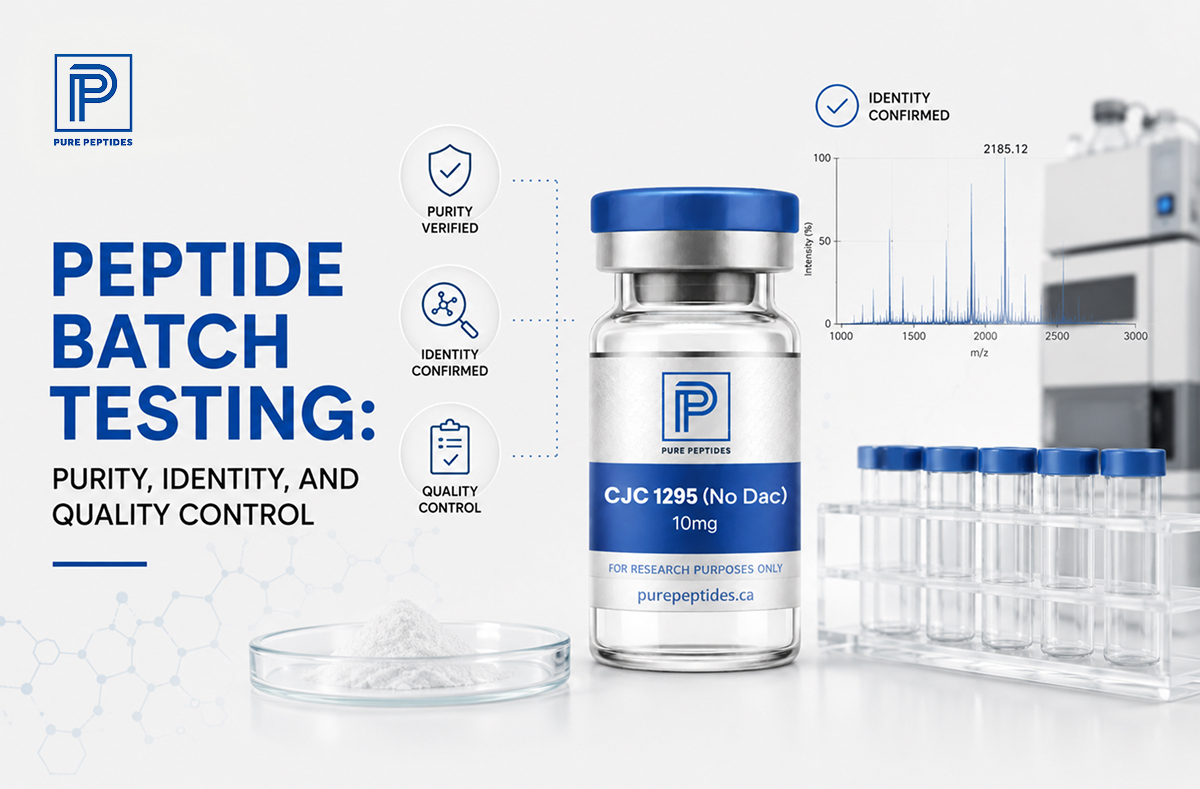
Peptide Batch Testing: Purity, Identity, and Quality Control


Peptide batch testing is an important part of laboratory quality control. Instead of relying on general product specifications, researchers can review analytical results from a specific production lot to evaluate its purity, molecular identity, and consistency.
Two methods commonly used for peptide characterization are high-performance liquid chromatography (HPLC) and mass spectrometry (MS). HPLC evaluates chromatographic purity, while MS provides molecular-mass information that supports peptide identity.
For laboratories, batch-specific testing also improves traceability. Researchers can connect experimental results to the exact material used rather than assuming that every production lot has an identical analytical profile.
What Is Peptide Batch Testing?
Peptide batch testing involves analyzing material from an individual production lot against defined analytical specifications.
Testing may evaluate:
- Peptide purity
- Molecular identity
- Peptide-related impurities
- Appearance or other physical characteristics
- Additional specifications relevant to the research material
Therefore, the exact testing program depends on the peptide and its intended laboratory application.
| Test or Record | Primary Purpose |
|---|---|
| HPLC | Evaluates chromatographic purity |
| Mass spectrometry | Supports molecular identity |
| Batch/Lot number | Links results to specific material |
| COA | Summarizes analytical results |
| Test date | Records when analysis occurred |
Therefore, batch-specific results provide more useful information than a generic purity claim that researchers cannot connect to a particular production lot.
Explore quality-tested research peptides with clear product information and laboratory-focused standards at Pure Peptides
Why Individual Batch Testing Matters
Manufacturers may use the same synthesis and purification procedures across production runs. However, individual batches can still show differences in their analytical profiles.
For example, variations may develop during synthesis, cleavage, purification, processing, or storage.
Experimental Consistency
As a result, research reproducibility depends partly on consistent materials.
For example, if two batches contain different levels or types of peptide-related impurities, those differences may introduce additional experimental variables.
Testing individual batches helps researchers identify these differences before incorporating new material into a study.
Traceability
Batch testing also connects analytical data to the material used in an experiment.
If researchers record the lot number alongside experimental results, they can later review the corresponding analytical documentation when investigating unexpected findings or repeating a study.
Consequently, batch traceability supports more organized and reproducible laboratory workflows.
HPLC Testing for Peptide Purity
High-performance liquid chromatography is one of the most common methods used in peptide batch testing.
Laboratories frequently use reversed-phase HPLC (RP-HPLC) to separate the principal peptide component from detectable peptide-related impurities.
How HPLC Works
First, the laboratory introduces a peptide sample into the chromatographic system. The sample passes through a column where different components interact differently with the stationary and mobile phases.
As a result, these components may leave the column at different retention times. A detector records them as peaks on a chromatogram.
Next, researchers can examine:
- The principal peptide peak
- Retention time
- Secondary peaks
- Integrated peak areas
- Reported purity
For example, if the principal peak represents approximately 98% of the relevant integrated chromatographic area, the laboratory may report approximately 98% HPLC purity.
However, HPLC purity does not necessarily mean that 98% of the total vial mass consists of the target peptide. Components such as water, counterions, salts, or some residual materials may not contribute to the same calculation.
Therefore, researchers should interpret the result specifically as chromatographic purity under the reported analytical conditions.
Mass Spectrometry for Molecular Identity
HPLC primarily evaluates purity. In contrast, mass spectrometry helps researchers assess molecular identity.
During MS analysis, an instrument measures ions according to their mass-to-charge ratio (m/z). Researchers can compare the resulting molecular-mass information with the theoretical value expected from the target peptide sequence.
This distinction is important:
| HPLC | Mass Spectrometry |
|---|---|
| Evaluates chromatographic purity | Supports molecular identity |
| Separates detectable components | Measures mass-to-charge ratios |
| Reveals secondary peaks | Evaluates expected molecular mass |
| Does not independently confirm identity | Does not replace purity analysis |
For this reason, laboratories often use HPLC and MS as complementary methods.
However, a high HPLC purity result alone does not establish that the principal component is the intended peptide. Likewise, a matching molecular mass does not provide a complete purity profile.
Together, the two methods provide a more informative analytical picture.
Batch Consistency and Documentation
Analytical results become more useful when researchers can connect them to a clearly identified production lot.
In addition, a batch-specific Certificate of Analysis (COA) may contain:
- Product name
- Batch or lot number
- Purity result
- Analytical method
- Molecular-mass data
- Testing date
- Laboratory information
Why the Batch Number Matters
The lot number on the analytical documentation should correspond to the research material being evaluated.
For example:
Material received: Batch PP-0826-07
Analytical report: Batch PP-0826-07
As a result, matching identifiers connect the testing data directly to the material.
In contrast, analytical results from an earlier production lot provide limited evidence about the characteristics of a newer batch.
Therefore, researchers should prioritize batch-specific documentation when evaluating materials for laboratory studies.
Explore quality-tested research peptides with clear product information and laboratory-focused standards at Pure Peptides.
In-House vs Third-Party Testing
Peptide manufacturers or suppliers may perform testing internally or use an independent laboratory.
Nevertheless, neither approach automatically guarantees better results. Instead, researchers should evaluate the quality and transparency of the analytical information.
| In-House Testing | Third-Party Testing |
|---|---|
| Conducted by an internal laboratory | Conducted by an external laboratory |
| Supports routine quality control | Provides independent verification |
| Can allow faster batch analysis | Separates testing from the supplier |
| Should include identifiable methods | Should clearly identify the tested batch |
In-House Testing
For instance, a qualified internal laboratory can efficiently perform routine batch testing.
Nevertheless, documentation should clearly identify the analytical methods, results, and relevant batch information.
Third-Party Testing
Independent testing can provide an additional level of verification because an external laboratory performs the analysis.
However, a “third-party tested” claim alone provides limited information.
Researchers should look for the laboratory name, report or sample number, batch identification, analytical method, testing date, and actual results.
Ultimately, transparent analytical evidence matters more than whether testing occurs internally or externally.
Peptide Batch Testing in Canada
Canadian researchers should distinguish laboratory quality testing from regulatory authorization.
Health Canada uses batch controls, specifications, analytical procedures, and identity testing within its Good Manufacturing Practices framework for regulated drugs. These principles illustrate the importance of traceability and analytical quality control, although research-only peptide materials do not automatically fall under the same requirements.
Importantly, a high HPLC purity result or matching mass spectrum does not indicate that Health Canada has authorized a research peptide for therapeutic use.
Therefore, researchers should use peptide batch testing to evaluate laboratory-material characteristics such as purity, identity, and consistency rather than interpreting analytical results as evidence of medical approval.
Researchers can explore Pure Peptides to review available research-focused peptide products and relevant product information.
Quick Batch Testing Checklist
Before selecting a peptide batch for laboratory research, check:
1. Batch identification
Does the analytical documentation match the lot supplied?
2. Purity testing
Does the report provide HPLC or another appropriate purity result?
3. Identity testing
Does MS or another analytical method support the expected molecular identity?
4. Testing information
Are the analytical method and testing date available?
5. Documentation
Can researchers connect the results clearly to the material used in the experiment?
Overall, this approach provides a more complete assessment than relying on a single purity percentage.
For a deeper understanding of peptide quality and sourcing, read our guide: Research Peptides Canada: Quality, Testing, and Supplier Guide.
FAQ About Peptide Batch Testing
What is peptide batch testing?
Peptide batch testing analyzes material from an individual production lot to evaluate characteristics such as purity and molecular identity.
Why should individual peptide batches be tested?
Different production lots can have different analytical profiles. Therefore, batch-specific testing improves traceability and helps researchers control material-related experimental variables.
How does HPLC test peptide purity?
HPLC separates detectable components within a sample. Laboratories can compare integrated chromatographic peak areas to estimate the relative purity of the principal peptide component.
How does mass spectrometry verify peptide identity?
Mass spectrometry measures mass-to-charge ratios. Researchers compare the resulting molecular-mass information with the theoretical mass expected from the peptide sequence.
Is third-party testing better than in-house testing?
Not necessarily. Independent testing provides external verification, while qualified internal laboratories can perform effective routine testing. The analytical methods, batch identification, and transparency of the results matter more.
What should researchers check in batch documentation?
Researchers should review the product name, lot number, purity result, analytical method, molecular-identity information, and testing date.
Does batch testing mean a peptide is approved in Canada?
No. Batch testing characterizes research material and does not represent Health Canada authorization for medical or therapeutic use.
Final Thoughts
Peptide batch testing helps researchers evaluate the purity, identity, and consistency of individual production lots.
HPLC provides chromatographic purity information, while mass spectrometry supports molecular identity. Meanwhile, batch-specific documentation connects these analytical results to the material used in an experiment.
Rather than relying on generic purity claims, researchers should prioritize transparent analytical results and clear batch traceability when selecting materials for laboratory studies.
Researchers can explore Pure Peptides for research-focused peptide products and available product information.
Disclaimer: This content is provided for educational and scientific research purposes only. Research peptides are intended for laboratory use only and are not intended for human consumption or medical use.
Really useful overview of peptide batch testing. I liked the focus on consistency between batches, since a single test result doesn’t necessarily tell the whole story about the reliability of research materials. It would be interesting to see a practical example of how researchers compare results across different batches.
I found the discussion of batch-to-batch quality particularly helpful. It’s easy to focus on the stated specifications of a peptide without considering whether those characteristics remain consistent across production batches. A follow-up explaining which analytical tests are commonly repeated for each batch would be very informative.
Appreciate the research-focused approach to batch testing. Understanding how purity, identity and other quality-control measures are checked across individual batches gives useful context for evaluating research materials. I’d be interested in seeing a checklist of the key data researchers should compare when reviewing multiple peptide batches.