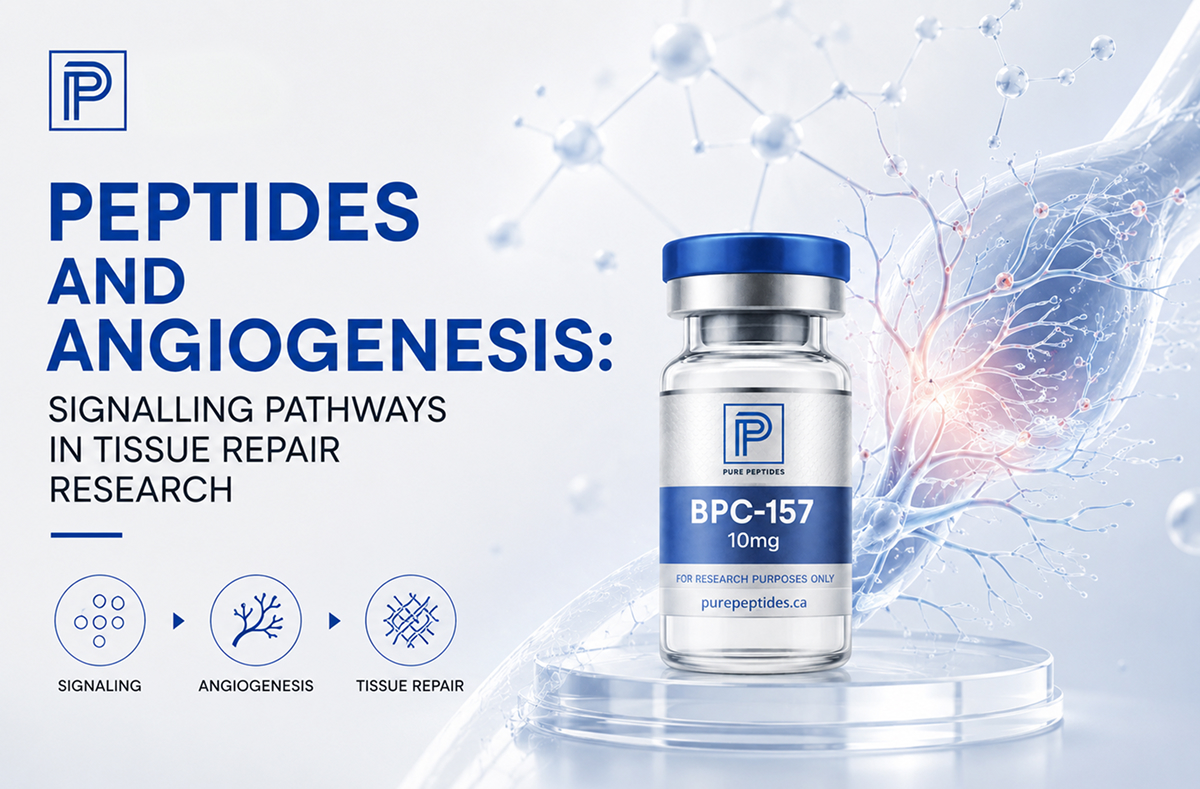
Peptides and Angiogenesis: Signalling Pathways in Tissue Repair Research


Research into peptides and angiogenesis examines how peptide-related pathways may influence vascular signalling, endothelial behaviour, and tissue remodelling. Angiogenesis—the formation of new blood vessels from existing vascular networks—is relevant to tissue research because vascular development supports oxygen delivery, nutrient exchange, and cellular communication.
Several peptides, including thymosin beta-4 (Tβ4), BPC-157, and GHK-Cu, have been investigated in experimental models involving vascular or tissue-remodelling pathways. However, these compounds differ substantially in molecular structure, proposed mechanisms, and evidence quality. Therefore, researchers should evaluate each peptide according to its specific pathway and experimental endpoint.
What Is Angiogenesis?
Angiogenesis describes the formation of new vascular structures from existing blood vessels. It differs from vasculogenesis, which involves blood-vessel formation from precursor cells, particularly during development.
The process generally follows several coordinated stages:
Angiogenic signalling → endothelial activation → migration and proliferation → vascular organization
As a result, endothelial cells respond to molecular signals and can subsequently migrate, proliferate, and organize into new vascular structures.
Researchers use several endpoints to evaluate this process:
| Research Endpoint | What Researchers Measure |
|---|---|
| Endothelial migration | Movement of vascular cells |
| Cell proliferation | Expansion of endothelial populations |
| Tube formation | Vessel-like organization |
| VEGF activity | Angiogenic signalling |
| Vascular sprouting | Formation of vascular branches |
| Microvessel density | Tissue-level vascularization |
Therefore, researchers often combine molecular and structural endpoints when evaluating angiogenesis.
Explore quality-tested research peptides with clear product information and laboratory-focused standards at Pure Peptides
The Role of Angiogenesis in Tissue Repair
Tissue remodelling creates changing metabolic and structural demands. As a result, vascular responses become important components of many experimental repair models.
In addition, new vascular structures can support oxygen and nutrient exchange while facilitating communication between different cell populations.
Nevertheless, angiogenesis represents only one component of tissue remodelling. Other relevant processes include:
- Fibroblast activity
- Extracellular-matrix turnover
- Collagen organization
- Cellular proliferation and migration
- Inflammatory signalling
- Structural remodelling
For this reason, researchers generally evaluate vascular changes alongside cellular and structural endpoints rather than using angiogenesis alone as evidence of tissue repair.
How Peptides May Influence Vascular Signalling
The relationship between peptides and angiogenesis involves several possible mechanisms rather than a universal peptide pathway.
Angiogenic Signalling
For example, some peptides may influence growth-factor pathways associated with endothelial migration, proliferation, or survival.VEGF-related signalling represents one of the best-known examples.
Cytoskeletal Regulation
Endothelial cells must change shape and migrate before organizing into vascular structures. Consequently, peptides that influence actin dynamics may affect angiogenic behaviour through cytoskeletal regulation.
Extracellular-Matrix Interactions
Migrating endothelial cells continuously interact with the extracellular matrix (ECM). Changes in cell adhesion, matrix remodelling, or related signalling may therefore influence vascular organization.
Importantly, these mechanisms can overlap within the same experimental model.
VEGF and Related Angiogenic Pathways
Vascular endothelial growth factor (VEGF) is a central regulator of angiogenesis.
VEGF interacts with receptors on endothelial cells, particularly VEGFR2. Activation of VEGFR2 can influence migration, proliferation, survival, and vascular permeability.
A simplified pathway is:
VEGF → VEGFR2 → intracellular signalling → endothelial response
Furthermore, downstream processes may include PI3K/Akt and nitric oxide-related signalling. However, VEGF operates alongside extracellular-matrix, cytoskeletal, and other vascular signals.
For example, Canadian researchers affiliated with the University of Toronto studied thymosin beta-4 delivery through collagen-chitosan hydrogels. Their experimental work examined endothelial migration and vascularization, illustrating how peptide signalling can be investigated alongside biomaterial-based delivery systems.
Thus, VEGF measurements become more informative when researchers evaluate them alongside functional vascular endpoints.
Explore quality-tested research peptides with clear product information and laboratory-focused standards at Pure Peptides
Peptides Studied in Angiogenesis Models
Different peptides enter angiogenesis research through different biological pathways. Consequently, their evidence should be evaluated separately.
| Research Peptide | Angiogenesis-Related Interest | Evidence Context |
|---|---|---|
| Thymosin beta-4 | Actin, endothelial migration, vascularization | Substantial preclinical research |
| BPC-157 | Vascular signalling and endothelial responses | Primarily preclinical |
| GHK-Cu | Matrix and tissue-remodelling pathways | Experimental/preclinical |
| TB-500 | Associated with Tβ4-related biology | Direct evidence more limited |
Thymosin Beta-4
Tβ4 has a well-developed experimental connection to vascular biology.
In particular, as an actin-binding peptide, Tβ4 contributes to cytoskeletal regulation. Researchers have also investigated it in models involving endothelial migration, extracellular-matrix remodelling, and vascular development.
This combination of actin regulation and endothelial activity makes Tβ4 particularly relevant when researchers investigate how cellular movement contributes to angiogenesis.
BPC-157
BPC-157 has been studied in preclinical vascular and tissue-response models.
Experimental literature has explored nitric oxide-related pathways, VEGF-associated signalling, endothelial activity, fibroblast responses, and vascular remodelling.
Therefore, BPC-157 research provides a different mechanistic perspective from the actin-centred pathways associated with Tβ4.
GHK-Cu
GHK-Cu is a copper-binding tripeptide better known for experimental research involving extracellular-matrix regulation, skin biology, and tissue remodelling.
Its angiogenesis-related evidence differs from the more established vascular literature surrounding Tβ4. Accordingly, researchers should avoid assuming that every peptide associated with tissue remodelling has the same angiogenic activity.
What About TB-500?
TB-500 is frequently discussed alongside thymosin beta-4. However, much of the mechanistic literature associated with TB-500 comes from research involving full-length Tβ4 or defined Tβ4-derived sequences.
Researchers should therefore verify the molecular identity of the material studied before applying Tβ4 findings directly to TB-500.
Designing Peptide Angiogenesis Experiments
Experimental design strongly affects what researchers can conclude about peptides and angiogenesis.
For instance, endothelial-cell assays can isolate migration or tube formation, whereas tissue and animal models capture interactions among multiple biological systems.
| Experimental Model | Useful Endpoint |
|---|---|
| Endothelial culture | Migration and proliferation |
| Tube-formation assay | Vascular organization |
| Biomaterial model | Peptide delivery and cell interaction |
| Tissue model | Microvascular development |
| Animal model | Integrated vascular response |
Researchers should document important variables such as peptide identity, purity, concentration, exposure duration, cell type, and assay conditions.
Moreover, combining VEGF measurements with migration, tube formation, or tissue-level vascularization provides stronger evidence than relying on a single marker.
This approach also improves comparisons between studies because researchers can distinguish changes in molecular signalling from functional vascular responses.
Limitations of Current Angiogenesis Research
Several limitations affect the interpretation of peptide angiogenesis studies.
First, much of the evidence remains preclinical. Cell and animal models provide valuable mechanistic information, but their results cannot automatically predict human outcomes.
Second, angiogenesis is context-dependent. Vascular growth participates in normal biological processes but also occurs in pathological conditions. Therefore, increased angiogenic activity should not automatically be characterized as beneficial.
Third, experimental protocols vary. Differences in peptide concentration, exposure duration, models, and measured endpoints can make direct comparisons difficult.
Finally, evidence must remain compound-specific. Findings involving Tβ4, for example, should not automatically be attributed to TB-500 or another peptide without confirming molecular identity.
These limitations make standardized experimental design particularly important when comparing different peptide-related vascular pathways.
Peptides and Angiogenesis Research in Canada
Canadian researchers have contributed directly to peptide-related vascular research. Notably, University of Toronto investigators have examined Tβ4 using collagen-chitosan biomaterials in experimental vascularization models.
At the same time, laboratory research must remain separate from therapeutic authorization.
Health Canada has warned about unauthorized injectable peptide products marketed for human use, including compounds such as BPC-157 and TB-500. Consequently, experimental angiogenesis findings do not establish authorization, clinical effectiveness, or human safety.
For laboratory research, investigators should prioritize molecular identity, analytical purity, batch documentation, appropriate experimental design, and applicable Canadian requirements.
For laboratory-focused peptide information, explore Pure Peptides.
Explore tissue repair pathways, angiogenesis, and current scientific evidence in Peptides in Tissue Repair Research: Mechanisms, Applications, and Evidence.
FAQ About Peptides and Angiogenesis
What is angiogenesis?
Angiogenesis is the formation of new vascular structures from existing blood vessels. It involves coordinated endothelial activation, migration, proliferation, and organization.
Why is angiogenesis important in tissue repair research?
Vascular networks contribute to oxygen delivery, nutrient exchange, and cellular communication. Therefore, researchers often investigate angiogenesis alongside other tissue-remodelling processes.
How may peptides influence angiogenesis?
Depending on the peptide, researchers may investigate VEGF-related signalling, nitric oxide pathways, cytoskeletal regulation, endothelial migration, or extracellular-matrix interactions.
Which peptides are studied in angiogenesis models?
Research includes thymosin beta-4, BPC-157, GHK-Cu, and related experimental peptides. However, their mechanisms and levels of supporting evidence differ.
What role does VEGF play in angiogenesis?
VEGF is an important regulator of endothelial behaviour. Through receptors such as VEGFR2, it participates in signalling associated with migration, proliferation, survival, and vascular permeability.
Is peptide angiogenesis research clinically established?
Not broadly. Evidence varies by compound, while many experimental peptide findings remain primarily preclinical.
Final Thoughts
Research into peptides and angiogenesis helps scientists examine how different molecular mechanisms influence endothelial behaviour, vascular signalling, and tissue remodelling.
Tβ4 provides an established experimental model involving actin regulation and vascular biology, while BPC-157 and GHK-Cu enter this research area through different pathways. Therefore, each peptide requires compound-specific evaluation.
Ultimately, stronger experiments should combine molecular and functional vascular endpoints, use clearly characterized peptide materials, and distinguish preclinical observations from clinical conclusions.
For laboratory-focused peptide information, visit Pure Peptides.
Disclaimer: This content is provided for educational and scientific research purposes only. Research peptides are intended for laboratory use only and are not intended for human consumption or medical use.
Really interesting overview of peptides and angiogenesis research. I liked how the article explains the biological processes involved without presenting preliminary findings as established medical outcomes. It would be interesting to see more detail on which pathways researchers are currently investigating.
I found this article helpful for understanding why peptides have attracted attention in angiogenesis research. The research-focused explanation provides useful context around the mechanisms being studied while acknowledging that more evidence is needed. A comparison of findings from laboratory models and human studies would make an interesting follow-up.
Appreciate the balanced approach to this topic. There is a lot of simplified information about peptides and blood-vessel research online, so having the underlying science explained clearly makes it easier to put different claims into perspective. I’d be interested in seeing a follow-up on the current limitations and unanswered questions in this area.