
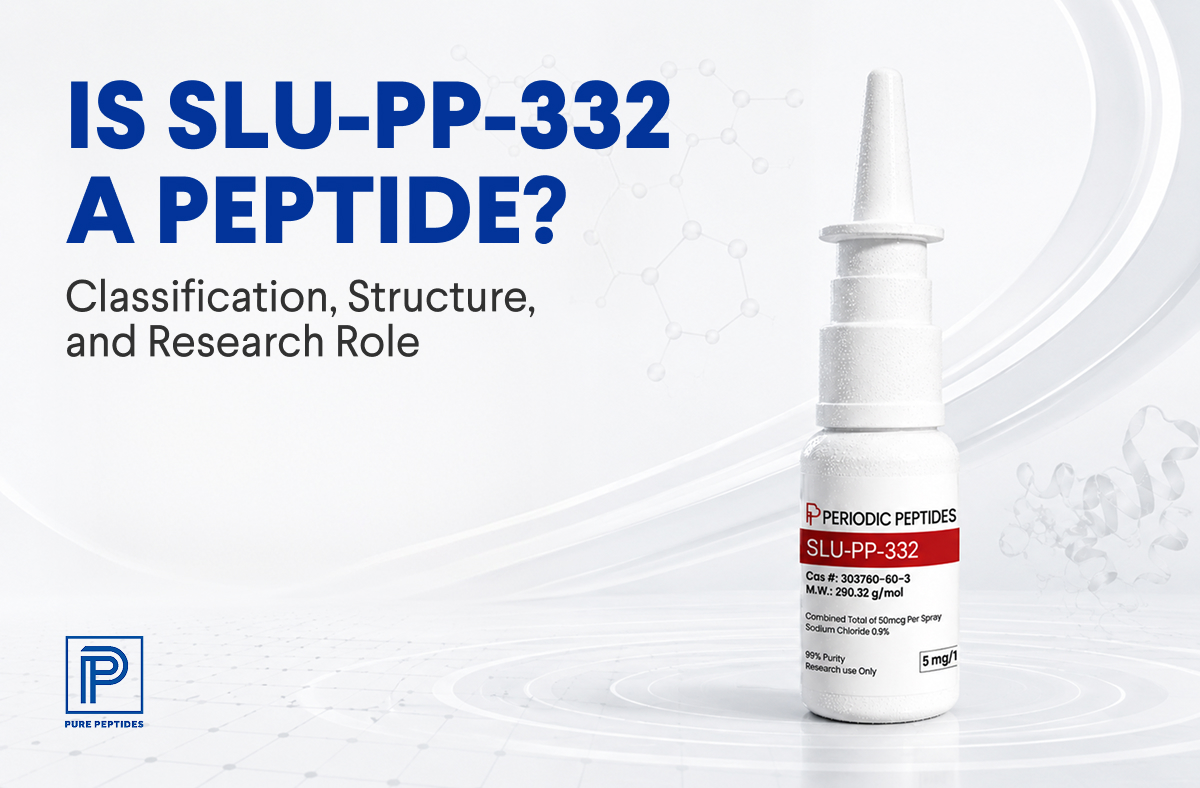
Is SLU-PP-332 a Peptide? Classification, Structure, and Research Role


The question “is SLU-PP-332 a peptide?” often arises because this experimental compound appears in discussions involving metabolism, mitochondrial function, skeletal muscle, and other areas that also feature research peptides. However, similarity in research applications does not mean two compounds share the same chemical classification.
The answer is clear: SLU-PP-332 is not a peptide. Researchers classify it as a synthetic small-molecule agonist of estrogen-related receptors (ERRs). Unlike peptides, which contain amino acids connected by peptide bonds, SLU-PP-332 has a small-molecule chemical structure.
Understanding this distinction helps researchers interpret experimental findings, select appropriate laboratory methods, and avoid confusing peptide signalling with nuclear-receptor pharmacology.
For researchers comparing emerging metabolic compounds, Pure Peptides provides laboratory-focused information and research resources designed to support informed scientific investigation.
What Is SLU-PP-332?
SLU-PP-332 is an experimental synthetic small molecule developed for research into estrogen-related receptor signalling. Scientists have investigated it primarily in preclinical models involving oxidative metabolism, mitochondrial activity, skeletal muscle, and energy expenditure.
The estrogen-related receptor family includes ERRα, ERRβ, and ERRγ. In particular, these proteins belong to the nuclear receptor superfamily and help regulate transcriptional programs involved in cellular energy metabolism.
Despite their name, ERRs differ from conventional estrogen receptors. Instead, they participate in distinct regulatory pathways rather than functioning as conventional estrogen-responsive receptors.
Researchers have characterized SLU-PP-332 as a pan-ERR agonist, although metabolic research has placed particular emphasis on ERRα. Therefore, scientists can use the compound as an experimental tool to examine how ERR activation changes metabolic gene programs.
| Research Feature | Current Classification |
|---|---|
| Compound type | Synthetic small molecule |
| Main research targets | ERRα, ERRβ, ERRγ |
| Pharmacological role | ERR agonist |
| Major study areas | Mitochondrial function, oxidative metabolism, skeletal muscle |
| Peptide classification | No |
| Evidence level | Primarily preclinical |
This classification places SLU-PP-332 within small-molecule nuclear-receptor research, rather than conventional peptide biology.
Explore compound details, research specifications, and laboratory-focused information for SLU-PP-332 5mg.
What Defines a Peptide?
To understand is SLU-PP-332 a peptide, researchers first need a clear definition of a peptide.
Specifically, a peptide consists of amino acids joined through peptide bonds. These bonds form between the carboxyl group of one amino acid and the amino group of another, producing an amino-acid chain.
The sequence, length, and structure of that chain influence how a peptide behaves biologically. For example, peptides can function as signalling molecules, receptor ligands, hormones, or experimental research tools.
Research compounds such as BPC-157 and MOTS-c belong to peptide-related research because their structures derive from amino-acid sequences. GHK-Cu, meanwhile, consists of the GHK tripeptide complexed with copper.
However, a compound does not become a peptide simply because researchers study it alongside peptides or investigate similar biological pathways. Chemical structure determines the classification.
This principle provides the clearest way to distinguish SLU-PP-332 from peptide-based compounds.
Why SLU-PP-332 Is Not Classified as a Peptide
Structurally, SLU-PP-332 does not contain the amino-acid chain and peptide backbone that define peptides. Instead, it belongs to the broader category of synthetic organic small molecules.
Therefore, the difference between SLU-PP-332 and a peptide is fundamental rather than semantic.
| Feature | Research Peptides | SLU-PP-332 |
|---|---|---|
| Structural basis | Amino-acid sequence | Small organic molecule |
| Peptide backbone | Present | Absent |
| Chemical category | Peptide | Small molecule |
| Research targets | Vary by peptide | Estrogen-related receptors |
| Relevant biology | Depends on peptide | ERR-regulated transcription |
| Primary classification | Peptide research | Nuclear-receptor research |
Researchers may still encounter SLU-PP-332 alongside peptides in discussions of mitochondrial function or metabolic signalling. Nevertheless, shared research areas do not indicate shared chemistry.
For this reason, describing SLU-PP-332 simply as a “research peptide” would be chemically inaccurate.
SLU-PP-332 as a Synthetic ERR Agonist
Rather than treating SLU-PP-332 as a peptide, researchers can understand its scientific role more accurately through ERR pharmacology.
ERRs are nuclear receptors that regulate transcription. In particular, these receptors participate in metabolic gene networks associated with mitochondrial activity, oxidative metabolism, and cellular energy use.
ERR signalling also interacts with transcriptional regulators such as PGC-1α, an important coactivator involved in mitochondrial biogenesis and oxidative metabolic programs. Consequently, pharmacological activation of ERR pathways gives researchers a way to investigate coordinated changes in cellular energy regulation.
Preclinical SLU-PP-332 research has explored endpoints related to:
- mitochondrial respiration and oxidative metabolism;
- skeletal-muscle metabolic characteristics;
- energy expenditure;
- ERR-regulated gene expression;
- endurance-related outcomes in animal models.
These research areas have contributed to descriptions of SLU-PP-332 as an experimental “exercise mimetic.” However, researchers should interpret this term carefully.
In this context, “exercise mimetic” refers to selected molecular and metabolic characteristics observed in experimental models. It does not mean that the compound reproduces the complete physiological effects of exercise, which also involve cardiovascular function, mechanical loading, neuromuscular activity, endocrine responses, and systemic adaptations.
Peptides vs Small-Molecule Research Compounds
Peptides and small molecules can influence overlapping biological systems. However, researchers should treat them as distinct experimental classes.
Peptides use amino-acid-based structures. Their sequence and conformation can strongly influence receptor interactions, stability, and biological activity.
Small molecules have different chemical architectures. Depending on their physicochemical properties, some can interact with intracellular proteins, enzymes, or nuclear receptors.
SLU-PP-332 provides a useful example. Its research role centers on pharmacological activation of ERRs rather than peptide-based signalling.
Key Experimental Differences
| Research Consideration | Peptides | Small Molecules |
|---|---|---|
| Structural characterization | Amino-acid sequence is central | Molecular chemical structure is central |
| Target type | Highly variable | Highly variable |
| Analytical approach | May include peptide-specific methods | Small-molecule analytical methods |
| Stability factors | Sequence and peptide degradation matter | Depends on chemical structure |
| Example | MOTS-c | SLU-PP-332 |
Therefore, researchers should select analytical methods, experimental controls, and interpretation frameworks according to the actual chemical class of the compound.
This approach becomes especially important when comparing compounds that influence similar metabolic pathways through different mechanisms.
Explore compound details, research specifications, and laboratory-focused information for SLU-PP-332 5mg.
Why Accurate Compound Classification Matters
Correctly answering “is SLU-PP-332 a peptide?” does more than resolve a terminology question. Accurate classification affects several stages of scientific research.
First, it helps researchers understand mechanism. Calling SLU-PP-332 a peptide could incorrectly suggest peptide-receptor signalling. In contrast, its primary research role involves ERR pharmacology and downstream transcriptional regulation.
Second, classification supports appropriate experimental design. Researchers can choose analytical methods, controls, and characterization techniques that match a small molecule rather than automatically applying peptide-specific assumptions.
Moreover, accurate terminology improves interpretation of scientific literature. Two compounds may influence mitochondrial metabolism while reaching that endpoint through completely different molecular mechanisms.
Finally, classification helps prevent preclinical findings from being overstated. Current SLU-PP-332 evidence comes primarily from molecular, cellular, and animal research. Although these models provide valuable mechanistic information, they do not establish equivalent efficacy, safety, or metabolic effects in humans.
Canadian Research Context
For researchers in Canada, compound classification and regulatory status represent separate questions.
Health Canada can authorize specific clinical trials involving investigational health products under applicable regulatory requirements. However, authorization of an individual clinical study does not equal general market authorization.
Current evidence does not establish SLU-PP-332 as a Health Canada-approved metabolic treatment. Consequently, Canadian discussions should describe the compound according to its experimental status and avoid presenting preclinical observations as established clinical applications.
Explore how key peptides interact with metabolic pathways and signalling systems in our guide: Peptides in Metabolic Signalling Research: Pathways, Compounds, and Evidence.
FAQ About SLU-PP-332 Classification
Is SLU-PP-332 a peptide?
No. SLU-PP-332 is not a peptide. It is a synthetic small-molecule ERR agonist.
What makes a compound a peptide?
A peptide consists of amino acids connected by peptide bonds. Therefore, researchers classify peptides primarily according to their chemical structure rather than the biological pathway they affect.
Why does SLU-PP-332 appear in discussions about research peptides?
SLU-PP-332 and some peptides appear in overlapping fields such as metabolic and mitochondrial research. However, shared research applications do not make them chemically equivalent.
What does SLU-PP-332 target?
Researchers have characterized SLU-PP-332 as a pan-ERR agonist involving ERRα, ERRβ, and ERRγ. Metabolic research has particularly emphasized ERRα.
Is SLU-PP-332 an estrogen?
No. The term “estrogen-related receptor” can create confusion. However, ERRs differ from conventional estrogen receptors, and SLU-PP-332 itself is not estrogen.
Why do researchers study SLU-PP-332?
Researchers use the compound to investigate ERR-regulated metabolic signalling. In particular, preclinical studies have examined mitochondrial respiration, oxidative metabolism, skeletal-muscle characteristics, energy expenditure, and endurance-related endpoints.
Is SLU-PP-332 approved for human use in Canada?
Current evidence does not establish SLU-PP-332 as a Health Canada-approved metabolic treatment. Researchers should therefore distinguish experimental findings from authorized clinical applications.
Final Thoughts
So, is SLU-PP-332 a peptide? No. SLU-PP-332 is a synthetic small-molecule ERR agonist, while peptides consist of amino-acid sequences connected through peptide bonds.
The distinction matters because chemical class influences experimental design, analytical methods, mechanism interpretation, and evaluation of scientific evidence. Although researchers may study SLU-PP-332 and peptides within overlapping areas of metabolic biology, the compounds belong to fundamentally different chemical categories.
For researchers exploring peptide biology alongside emerging metabolic research compounds, Pure Peptides provides research-focused information and laboratory resources to support informed scientific investigation.
Disclaimer: This content is provided for educational and scientific research purposes only. Research peptides are intended for laboratory research only and are not intended for human consumption or medical use.