
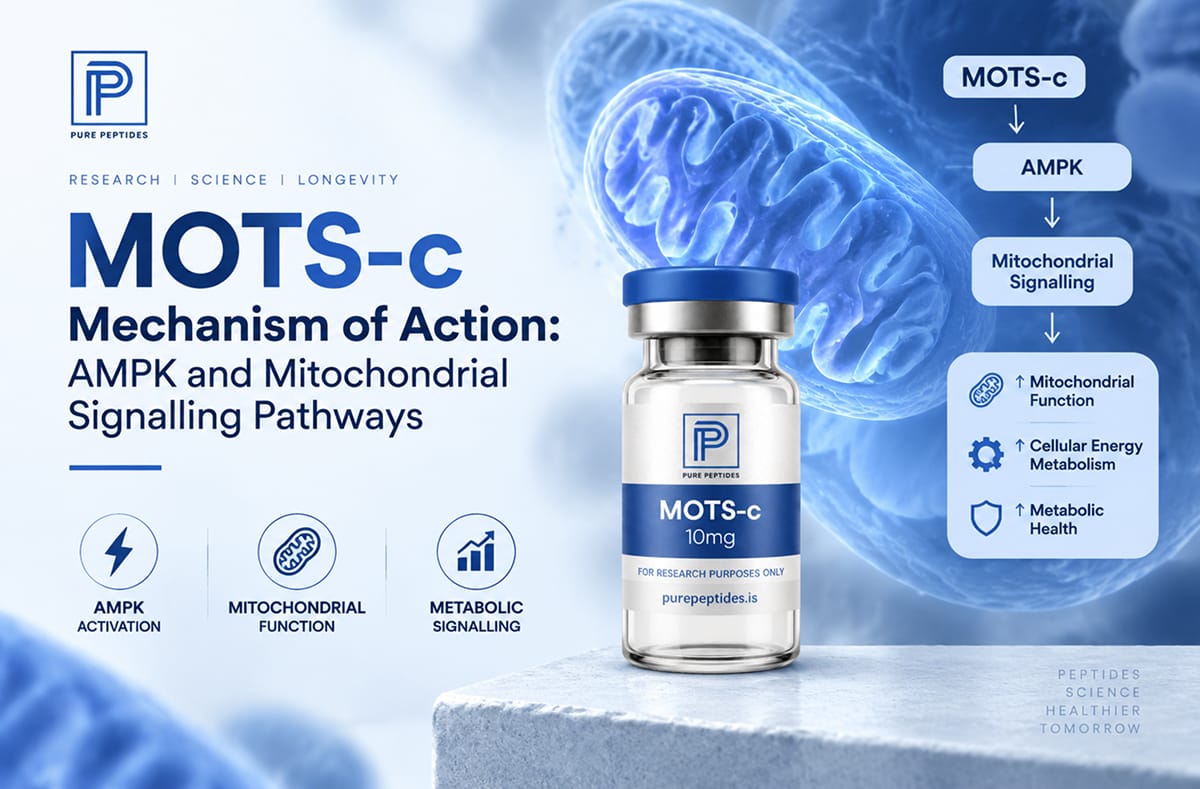
MOTS-c Mechanism of Action: AMPK and Mitochondrial Signalling Pathways


MOTS-c mechanism of action research focuses on how this mitochondrial-derived peptide may connect mitochondrial activity with cellular energy regulation, metabolic signalling, and stress responses. Unlike conventional proteins encoded by nuclear DNA, MOTS-c originates from a short open reading frame within mitochondrial DNA.
Researchers have investigated MOTS-c in relation to AMPK signalling, glucose metabolism, skeletal muscle responses, oxidative stress, and nuclear gene regulation. However, these mechanisms involve several interconnected pathways rather than one simple response. Therefore, researchers continue to examine how experimental conditions influence MOTS-c activity.
For Canadian researchers, scientific evidence should remain separate from regulatory status. Health Canada has identified MOTS-C among unauthorized injectable peptide products and states that unauthorized products have not undergone the same assessment for safety, effectiveness, and quality as authorized health products.
Pure Peptides provides research-focused peptide products and educational resources for laboratories investigating mitochondrial signalling, metabolism, and cellular pathways.
Understanding the Proposed Mechanism of MOTS-c
MOTS-c is a 16-amino-acid mitochondrial-derived peptide encoded within the mitochondrial 12S ribosomal RNA region. Its mitochondrial origin provides an important starting point for understanding its proposed biological activity.
Researchers investigate how metabolic conditions may influence MOTS-c production, distribution, and signalling. In particular, experimental research has connected MOTS-c with energy-sensing pathways and cellular responses to metabolic stress.
A simplified model is:
Metabolic stress → MOTS-c signalling → AMPK-related pathways → cellular adaptation
However, this sequence represents a research framework rather than a complete mechanism. Tissue type, metabolic state, peptide concentration, and other signalling molecules can influence the resulting cellular response.
Furthermore, researchers have examined whether MOTS-c can move between cellular compartments under specific conditions. This finding has increased interest in communication between mitochondrial and nuclear signalling.
Explore the product specifications for mitochondrial peptide research with MOTS-c 10mg.

AMPK Activation and Cellular Energy Regulation
AMP-activated protein kinase, or AMPK, acts as an important cellular energy sensor. When energy conditions change, AMPK helps coordinate pathways involved in energy production and consumption.
MOTS-c research has examined connections between the peptide and AMPK-related signalling. Early experimental work suggested that MOTS-c can influence pathways involving the folate cycle and de novo purine biosynthesis, with downstream effects associated with AMPK activation.
| Mechanism | Research Significance |
|---|---|
| AMPK signalling | Cellular energy sensing |
| Folate metabolism | Proposed upstream pathway |
| Purine biosynthesis | Metabolic research target |
| Energy balance | Regulation of cellular resources |
| Stress adaptation | Response to metabolic challenges |
Importantly, AMPK activation does not explain every reported effect associated with MOTS-c. Instead, it represents one component of a broader signalling network.
Consequently, researchers examine AMPK-related responses alongside other molecular and cellular measurements.
Glucose Metabolism and Skeletal Muscle Signalling
Glucose metabolism represents another important area of MOTS-c mechanism of action research. Skeletal muscle consumes substantial amounts of glucose, making it a useful model for investigating metabolic signalling.
Researchers have examined MOTS-c in relation to glucose handling, insulin sensitivity, and metabolic adaptation. In addition, exercise provides a useful research context because studies have measured circulating MOTS-c following different exercise conditions.
A simplified pathway is:
Exercise or metabolic stress → mitochondrial response → MOTS-c signalling → metabolic adaptation
| Research Model | Main Question |
|---|---|
| Muscle cells | How does MOTS-c influence cellular metabolism? |
| Animal models | What metabolic responses occur in living systems? |
| Exercise studies | How do MOTS-c levels respond to physiological stress? |
| Metabolic models | How does MOTS-c relate to glucose regulation? |
However, changes in circulating MOTS-c do not automatically establish a direct metabolic effect. Therefore, researchers need controlled experiments to determine whether MOTS-c contributes directly to an observed response.
Mitochondrial Stress and Adaptive Responses
Mitochondria respond continuously to changes in nutrients, energy demand, and cellular stress. As a result, researchers investigate whether mitochondrial-derived peptides help coordinate cellular adaptation.
Experimental studies have linked MOTS-c with energy-sensing pathways such as AMPK. Moreover, research has examined its potential relationship with oxidative stress, gene regulation, and cellular responses to metabolic challenges.
A simplified framework is:
Cellular stress → mitochondrial response → MOTS-c activity → adaptive signalling
Nevertheless, biological responses can vary according to cell type, nutrient availability, mitochondrial function, and experimental conditions.
For this reason, researchers must distinguish between MOTS-c responding to cellular stress and MOTS-c directly causing a particular adaptive response.
Nuclear Translocation and Gene Regulation
One notable finding in MOTS-c research involves its potential movement from the mitochondria into the nucleus under metabolic stress.
Experimental research has reported that MOTS-c can translocate to the nucleus and influence nuclear gene expression through an AMPK-dependent mechanism. Researchers have also examined its relationship with stress-responsive transcription factors, including NRF2, particularly in studies involving antioxidant response elements.
This finding provides an important perspective on the MOTS-c mechanism of action. Rather than limiting mitochondrial-derived peptides to mitochondrial functions, researchers can examine them as possible mediators of mitochondrial-to-nuclear communication.
| Nuclear Research Area | Research Focus |
|---|---|
| Nuclear translocation | MOTS-c movement under stress |
| AMPK | Energy-sensitive signalling |
| NRF2 | Stress-responsive transcription |
| Antioxidant response | Regulation of stress-related genes |
| Mitonuclear communication | Mitochondrial and nuclear signalling |
However, nuclear translocation does not mean that MOTS-c controls all stress-related gene activity. Instead, researchers continue to examine which genes respond and under what conditions.
Explore the product specifications for mitochondrial peptide research with MOTS-c 10mg.
Limitations of Current Mechanistic Evidence
Although research has identified several potential pathways, the complete MOTS-c mechanism of action remains unresolved.
First, researchers continue to investigate the molecular targets responsible for different biological responses. AMPK-related signalling provides an important research pathway, but it may not explain every observed effect.
Second, experimental models can produce different results. Cell cultures, animal models, and human studies provide different types of evidence. Consequently, findings from one model cannot automatically establish the same mechanism in another.
Third, human evidence remains more limited than preclinical research. Human studies provide useful information about circulating MOTS-c and physiological responses, but they do not necessarily establish molecular causation.
Long-term effects also require further investigation. Researchers still need to clarify questions involving peptide stability, tissue distribution, dose-response relationships, and sustained cellular effects.
The Canadian regulatory context adds another consideration. Health Canada has warned about unauthorized injectable peptide products, including products identified as MOTS-C. Therefore, research availability should not be interpreted as regulatory approval or authorization for human use.
Overall, current evidence supports continued investigation while leaving several mechanistic questions open.
Explore cellular pathways, mitochondrial signalling, and current evidence in Peptides in Longevity Research: Cellular Pathways, Compounds, and Evidence.
FAQ About MOTS-c mechanism of action
What is the MOTS-c mechanism of action?
The MOTS-c mechanism of action refers to proposed cellular pathways through which this mitochondrial-derived peptide may influence energy regulation, metabolic signalling, and stress responses. Researchers have particularly investigated AMPK-related signalling and nuclear responses.
How is MOTS-c related to AMPK?
Experimental research has linked MOTS-c with AMPK-related signalling. Because AMPK acts as a cellular energy sensor, this relationship provides an important area for investigating metabolic responses.
Does MOTS-c affect glucose metabolism?
MOTS-c has been investigated in relation to glucose metabolism, insulin sensitivity, and metabolic adaptation. However, current evidence does not establish MOTS-c as a proven treatment for metabolic disorders.
Why is skeletal muscle important in MOTS-c research?
Skeletal muscle plays a major role in glucose and energy metabolism. Therefore, researchers use muscle cells and exercise models to investigate MOTS-c-related metabolic signalling.
Can MOTS-c enter the nucleus?
Experimental research has reported that MOTS-c can translocate to the nucleus under metabolic stress. Researchers have linked this process with AMPK-dependent signalling and stress-responsive gene regulation.
What is NRF2’s role in MOTS-c research?
NRF2 is a stress-responsive transcription factor. Researchers have examined its relationship with MOTS-c, particularly in studies involving antioxidant response pathways.
Is the MOTS-c mechanism fully understood?
No. Researchers have identified several potential pathways, but questions remain regarding molecular targets, tissue-specific activity, peptide stability, and translation from experimental models to humans.
Is MOTS-c approved for human use in Canada?
Research status does not automatically indicate regulatory authorization. Health Canada has identified MOTS-C among unauthorized injectable peptide products and warns about the risks associated with unauthorized products.
Final Thoughts
The MOTS-c mechanism of action provides researchers with a useful model for studying communication between mitochondria and broader cellular systems. Current research has focused on AMPK-related signalling, glucose metabolism, skeletal muscle responses, cellular stress, and nuclear gene regulation.
At the same time, these pathways remain under investigation. AMPK activation and nuclear translocation represent important research findings, but they do not provide a complete explanation of MOTS-c biology.
For laboratories studying mitochondrial signalling, cellular metabolism, and stress-response pathways, Pure Peptides provides research-focused compounds and educational resources for scientific investigation.
Disclaimer: This content is provided for educational and scientific research purposes only. Research peptides are intended for laboratory research only and are not intended for human consumption or medical use.

The explanation of MOTS-c’s proposed mechanism of action is quite interesting, particularly the connection between mitochondrial signalling and cellular metabolism. Breaking down these pathways provides useful context for understanding why MOTS-c is being investigated in metabolic research.
I found the molecular perspective on MOTS-c useful for understanding how researchers investigate mitochondrial-derived peptides. The discussion of proposed signalling pathways alongside current evidence makes a complex topic much easier to follow.
The mechanism-focused approach provides a helpful introduction to MOTS-c research. I especially appreciate the distinction between proposed biological mechanisms and findings that have been established through research, as this helps keep the discussion grounded.