
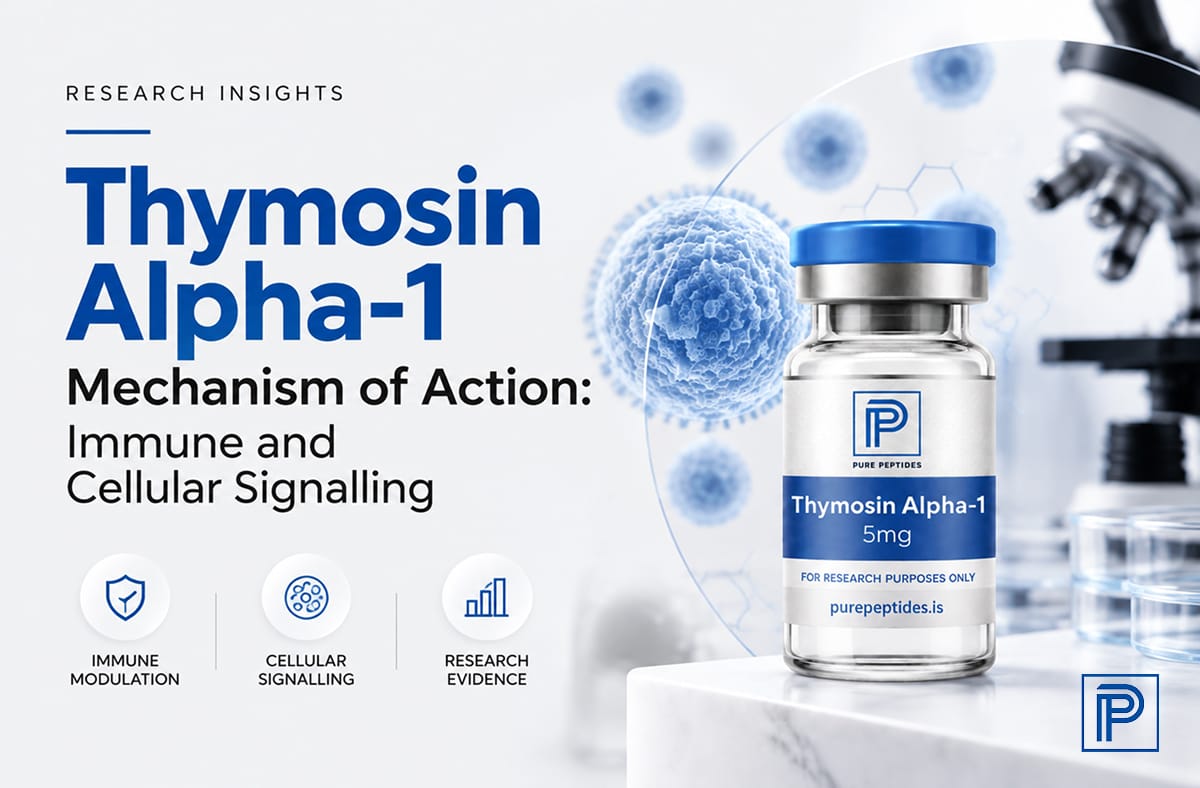
Thymosin Alpha-1 Mechanism of Action: Immune and Cellular Signalling


Thymosin Alpha-1 mechanism of action has become an important topic in peptide research because scientists continue investigating how this molecule interacts with immune signalling networks and cellular communication pathways. In particular, researchers study this peptide to understand how small biological molecules may influence complex immune-related processes.
Unlike compounds that primarily participate in metabolic reactions, Thymosin Alpha-1 is a peptide that researchers examine for its relationship with immune regulation and cellular signalling. Furthermore, current research focuses on how this peptide may interact with immune cells, receptors, and molecular pathways involved in biological communication.
Therefore, understanding the Thymosin Alpha-1 mechanism requires examining multiple research areas, including innate immune signalling, adaptive immune responses, Toll-like receptor pathways, and cytokine communication. Although experimental studies have provided valuable insights, researchers continue investigating the exact molecular interactions involved.
For researchers in Canada and other scientific communities, mechanistic evidence must be evaluated carefully. Consequently, laboratory findings should be interpreted according to research models, experimental conditions, and available scientific data.
Pure Peptides provides research-focused compounds and educational resources for laboratories studying peptide biology, immune signalling, molecular mechanisms, and cellular pathways.
Understanding the Proposed Mechanism of Thymosin Alpha-1
The Thymosin Alpha-1 mechanism of action involves several proposed biological pathways that researchers continue to investigate. As a 28-amino-acid peptide, Thymosin Alpha-1 provides scientists with a model for studying how peptide molecules interact with immune-related systems.
Specifically, researchers examine how this peptide may influence cellular communication through interactions with immune cells and signalling molecules. Moreover, studies investigate whether Thymosin Alpha-1 contributes to the regulation of immune responses through multiple interconnected pathways.
The proposed mechanisms generally involve:
| Research Area | Proposed Role |
|---|---|
| Immune signalling | Investigation of peptide interactions with immune pathways |
| Cellular communication | Study of molecular signals between cells |
| Receptor activity | Examination of possible molecular interactions |
| Cytokine pathways | Research into immune communication signals |
Furthermore, researchers recognize that immune signalling involves highly complex networks. Therefore, the biological activity observed in one experimental model may not represent all possible mechanisms in broader biological systems.
Additionally, current research does not describe Thymosin Alpha-1 as acting through a single pathway. Instead, scientists continue exploring how multiple signalling networks may contribute to observed biological responses.
Learn more about the broader scientific background of this peptide through “Thymosin Alpha-1 Research: Immune Signalling and Current Evidence”
Innate Immune Signalling Pathways
Innate immune signalling represents one of the major areas investigated within the Thymosin Alpha-1 mechanism of action.
The innate immune system provides an early biological response to environmental challenges through coordinated signalling pathways. Consequently, researchers study how peptides such as Thymosin Alpha-1 may interact with cells involved in these early communication processes.
In particular, experimental studies have examined possible relationships between Thymosin Alpha-1 and innate immune cells, including:
- Monocytes
- Macrophages
- Dendritic cells
- Natural killer cells
Moreover, researchers investigate how peptide interactions may influence cellular communication signals. These studies often focus on understanding molecular responses rather than establishing direct clinical outcomes.
| Innate Immune Component | Research Focus |
|---|---|
| Macrophages | Investigation of cellular signalling responses |
| Dendritic cells | Study of immune communication pathways |
| Natural killer cells | Examination of immune-related activity |
| Signalling molecules | Analysis of molecular interactions |
However, innate immune pathways contain numerous regulatory mechanisms. Therefore, researchers must consider multiple biological factors when interpreting findings related to Thymosin Alpha-1.
As research continues, scientists aim to clarify how peptide signalling contributes to broader immune communication networks.
Explore cellular signalling research with Thymosin Alpha-1 5mg
T-Cell Maturation and Adaptive Immune Responses
Another important area within the Thymosin Alpha-1 mechanism of action involves adaptive immune research, particularly T-cell-related pathways.
T cells play an essential role in adaptive immunity because they help coordinate targeted biological responses. Therefore, researchers investigate whether Thymosin Alpha-1 may influence aspects of T-cell development, communication, or activation within experimental models.
Additionally, studies have examined the relationship between thymic peptides and immune cell maturation. Since the thymus naturally contributes to T-cell development, researchers continue exploring how thymus-derived molecules may participate in immune signalling.
| Research Area | Scientific Focus |
|---|---|
| T-cell development | Studying cellular maturation pathways |
| Adaptive immunity | Examining immune communication |
| Peptide signalling | Investigating molecular interactions |
| Cellular responses | Understanding biological mechanisms |
Furthermore, researchers compare different immune models to better understand how Thymosin Alpha-1 interacts with adaptive immune pathways.
Nevertheless, current evidence remains dependent on the experimental system used. Cell-based studies, animal models, and human research may provide different perspectives on the same biological question.
Toll-Like Receptor Signalling Under Investigation
Toll-like receptors (TLRs) are important components of innate immune signalling because they help cells recognize molecular patterns and activate communication pathways.
Within Thymosin Alpha-1 mechanism research, scientists investigate possible connections between this peptide and Toll-like receptor-related pathways. Specifically, researchers examine whether Thymosin Alpha-1 may influence signalling processes involving immune cell receptors.
| Pathway Component | Research Interest |
|---|---|
| Toll-like receptors | Investigation of receptor-mediated signalling |
| Immune cells | Study of cellular communication responses |
| Molecular messengers | Analysis of signalling interactions |
Moreover, Toll-like receptor pathways involve multiple downstream signals. As a result, researchers study individual molecular events rather than assuming a single mechanism explains all biological observations.
Additionally, findings from experimental models require careful interpretation. A signalling response observed in laboratory conditions may provide valuable information, but further research is needed to understand its broader biological significance.
Cytokine Regulation and Cellular Communication
Cytokines act as important communication molecules that allow cells to exchange biological information. Therefore, cytokine regulation represents another significant area within the study of Thymosin Alpha-1 mechanism of action.
Researchers examine how Thymosin Alpha-1 may interact with cytokine-related pathways and cellular communication networks. In particular, studies investigate patterns of molecular signalling between immune cells.
Furthermore, peptide research helps scientists understand how small molecules can influence complex communication systems.
| Cytokine Research Area | Investigation Focus |
|---|---|
| Cytokine signalling | Study of cellular communication |
| Immune regulation | Examination of biological responses |
| Molecular pathways | Understanding signalling networks |
| Cellular interactions | Researching communication between cells |
However, cytokine networks are highly interconnected. Therefore, changes observed in one signalling pathway may involve multiple biological processes.
Consequently, researchers continue examining how Thymosin Alpha-1 interacts with broader cellular communication systems rather than focusing on a single molecular event.
Explore cellular signalling research with Thymosin Alpha-1 5mg
Limitations of Current Mechanistic Evidence
Although research on the Thymosin Alpha-1 mechanism of action continues to expand, several limitations remain.
First, many mechanistic findings come from laboratory and preclinical models. Therefore, researchers must carefully evaluate how experimental results translate between different biological systems.
Additionally, immune signalling involves numerous interconnected pathways. Because of this complexity, identifying one specific mechanism can be challenging.
| Research Limitation | Explanation |
|---|---|
| Model differences | Results may vary between experimental systems |
| Pathway complexity | Multiple signals interact simultaneously |
| Human evidence | Additional research continues to develop |
| Mechanistic uncertainty | Some biological interactions remain under investigation |
Furthermore, research conditions can influence outcomes. Factors such as experimental design, biological environment, and measurement methods may affect observed results.
In Canada, researchers must also distinguish scientific evidence from regulatory considerations. Consequently, laboratory findings should be interpreted within appropriate scientific and regulatory frameworks.
Ultimately, continued investigation will help researchers better understand how Thymosin Alpha-1 interacts with immune and cellular signalling pathways.
Explore cellular pathways, mitochondrial signalling, and current evidence in Peptides in Longevity Research: Cellular Pathways, Compounds, and Evidence.
FAQ About Thymosin Alpha-1 mechanism
What is the Thymosin Alpha-1 mechanism of action?
The Thymosin Alpha-1 mechanism of action refers to the proposed biological pathways through which this peptide may interact with immune signalling and cellular communication systems.
Which pathways are studied in Thymosin Alpha-1 research?
Researchers study pathways involving innate immune signalling, T-cell responses, Toll-like receptors, and cytokine communication.
Does Thymosin Alpha-1 work through one pathway?
No. Current research suggests that multiple signalling pathways may contribute to its biological activity.
Why are Toll-like receptors studied in Thymosin Alpha-1 research?
Researchers investigate Toll-like receptors because they play an important role in immune cell communication and signalling.
What role do cytokines have in Thymosin Alpha-1 research?
Cytokines act as communication molecules between cells, so researchers study their relationship with peptide signalling pathways.
Is the mechanism of Thymosin Alpha-1 fully understood?
No. Researchers continue investigating its molecular interactions and biological pathways.
What research models are used to study Thymosin Alpha-1 mechanisms?
Scientists use cellular studies, animal models, and human research to examine different aspects of peptide biology.
Final Thoughts
The Thymosin Alpha-1 mechanism of action represents an important area within peptide and immune signalling research. Through studies of innate immunity, adaptive immune pathways, receptor signalling, and cytokine communication, researchers continue exploring how this peptide interacts with biological systems.
Furthermore, current evidence highlights the complexity of immune signalling networks. Because multiple pathways can interact simultaneously, researchers evaluate Thymosin Alpha-1 through carefully designed experimental approaches.
Ultimately, continued research will provide deeper insights into peptide-based signalling mechanisms and the molecular interactions associated with Thymosin Alpha-1.
Pure Peptides supports research-focused exploration of peptides and molecular compounds used in laboratory studies involving immune signalling, cellular communication, and biological pathways.
Disclaimer: This content is provided for educational and scientific research purposes only. Research peptides are intended for laboratory research only and are not intended for human consumption or medical use.
The explanation of the proposed mechanism of Thymosin Alpha-1 is quite helpful, especially the connection between the peptide and different immune signaling pathways. Breaking down the biology step by step makes the current research easier to understand.
I found the discussion of Thymosin Alpha-1 and immune signaling particularly interesting. Understanding the proposed molecular interactions provides useful context for interpreting why this peptide continues to be investigated in immunological research.
This article does a good job of highlighting that understanding a peptide’s mechanism requires looking at the underlying biological pathways. I also appreciate the distinction between proposed mechanisms and findings that have been supported by research evidence.