
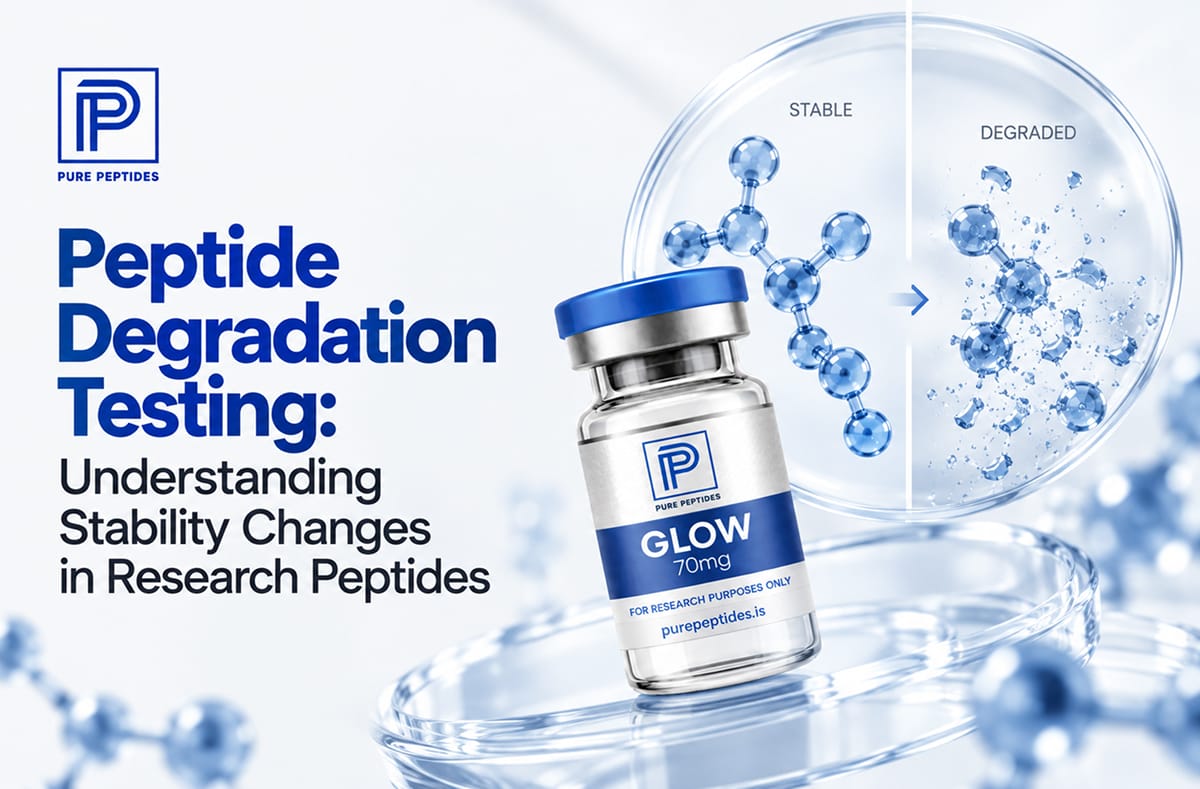
Peptide Degradation Testing: Understanding Stability Changes in Research Peptides


Research peptides can change over time, even when they initially meet analytical specifications. Temperature, moisture, oxygen, light, pH, and handling may influence stability. Therefore, researchers need more than a single purity result when evaluating material quality.
Peptide degradation testing examines these changes under controlled conditions. Instead of asking only whether a peptide is pure at one point, researchers study how its profile develops over time. As a result, degradation testing can reveal stability trends, possible degradation pathways, and changes relevant to analytical interpretation.
Explore quality-focused research peptides for your laboratory needs at Pure Peptides.
What Is Peptide Degradation Testing?
Peptide degradation testing evaluates changes that occur under defined environmental or experimental conditions. In practice, researchers compare samples collected at different time points or after controlled stress exposure.
Importantly, degradation is not a single reaction. Peptides may undergo oxidation, deamidation, hydrolysis, peptide-bond cleavage, isomerization, or aggregation.
Researchers may monitor:
- Chromatographic purity
- Molecular mass
- Peptide content or assay
- New degradation peaks
- Related substances
- Physical changes
- Trends across testing intervals
| Stability Attribute | What It Helps Evaluate |
|---|---|
| Purity profile | Changes in chromatographic composition |
| Molecular mass | Modified molecular species |
| Assay or content | Amount of intact peptide |
| Degradation products | New or increasing related substances |
| Physical characteristics | Aggregation or other changes |
| Time-point comparison | Stability trends |
Therefore, degradation testing provides a time-dependent view of peptide quality.
Explore quality-tested research peptides with clear product information and laboratory-focused standards at Pure Peptides.
Why Do Researchers Study Peptide Degradation?
Researchers study degradation because analytical characteristics may not remain unchanged indefinitely. Over time, environmental exposure or molecular instability can alter a peptide.
For example, an initially strong purity result may later be accompanied by new peaks, lower intact-peptide content, or altered molecular mass. Consequently, researchers must determine whether these differences reflect degradation or another factor.
Degradation studies can help answer:
- Does the peptide remain chemically consistent?
- Do new degradation peaks appear?
- Does intact peptide content change?
- Which conditions accelerate degradation?
- Can the method separate degraded and intact material?
- Are changes consistent with a plausible pathway?
In addition, these studies can help distinguish initial impurities from compounds that form later. If a secondary peak increases across several time points, for instance, researchers can investigate whether it represents a degradation product.
Health Canada also treats stability as a time-dependent quality concept in regulated drug frameworks. Specifically, stability studies examine changes associated with factors such as temperature, humidity, and light. Although research peptides are different, the analytical principle remains useful for laboratory assessment.
What Factors Can Cause Peptide Degradation?
Peptide stability depends on both the molecule and its environment. Therefore, researchers should not assume that all peptides respond identically.
Temperature
Higher temperatures can accelerate chemical reactions. As a result, heat may increase certain degradation rates. However, the effect depends on the peptide and its physical state.
Moisture
Similarly, moisture can influence molecular mobility and chemical reactions. Moreover, degradation can still occur in solid-state materials. Therefore, lyophilization does not eliminate stability concerns.
Oxygen and Light
Oxidation is a commonly described degradation pathway. For this reason, oxygen exposure may matter during stability studies. Likewise, light can promote photochemical changes in susceptible materials.
pH and Structure
Once a peptide is in solution, pH can alter reaction rates. For example, acidic or alkaline conditions may influence hydrolysis or deamidation. In addition, amino-acid sequence affects susceptibility to modifications. Therefore, stability testing should be peptide-specific.
| Factor | Potential Stability Concern |
|---|---|
| Temperature | Faster chemical reactions |
| Moisture | Increased mobility or hydrolysis |
| Oxygen | Oxidative modification |
| Light | Photochemical degradation |
| pH | Changes in reaction rates |
| Molecular structure | Sequence-specific pathways |
How Are Peptide Stability Changes Evaluated?
Researchers need methods that detect meaningful stability changes. Therefore, studies usually rely on more than one measurement.
First, HPLC can separate components in a sample. Researchers can compare the main peptide peak with smaller peaks that appear over time. However, chromatography alone may not identify the exact structure of every detected substance.
Second, mass spectrometry provides molecular-mass information. As a result, it can help investigate modified molecular species.
A stability review may include:
- Establishing an initial analytical profile.
- Exposing samples to defined conditions.
- Testing samples at selected time points.
- Comparing chromatographic and mass data.
- Evaluating assay, purity, and degradation products.
- Confirming that the method separates degraded from intact material.
More importantly, the method must suit stability assessment. Health Canada describes stability-indicating assays as methods that detect degradation products and distinguish degraded from non-degraded material.
Stress testing can also support this process. For example, regulated frameworks may use heat, humidity, oxidation, photolysis, or acidic and basic conditions. However, the goal is not simply to destroy the material. Instead, controlled stress helps reveal degradation pathways and tests whether procedures can detect them.
Explore quality-tested research peptides with clear product information and laboratory-focused standards at Pure Peptides.
How Does Degradation Testing Support Peptide Quality Assessment?
Degradation testing adds an important element to quality assessment: time. A purity result describes one testing point, whereas stability testing examines change under defined conditions.
Therefore, researchers can build a broader quality picture by combining several attributes.
| Quality Question | Relevant Information |
|---|---|
| Is the expected peptide present? | Identity and molecular mass |
| What is present now? | Purity and impurity profile |
| How much intact peptide remains? | Assay or peptide content |
| Does the material change? | Stability data |
| What changes are forming? | Degradation-product analysis |
| What conditions matter? | Stress or stability studies |
In addition, degradation data can help interpret later laboratory findings. However, stability results should not stand alone. Storage, handling, sample preparation, instrumentation, and experimental design may also affect outcomes. Consequently, strong quality assessment combines stability information with broader laboratory controls.
Review Research Peptides With Quality in Mind
Clear analytical information can make research materials easier to evaluate. Pure Peptides provides research peptides for laboratory and scientific research, with an emphasis on quality transparency.
Therefore, researchers can review the Pure Peptides catalogue when comparing laboratory materials.
Want to better understand peptide purity and testing standards? Explore Advanced Peptide Quality & Testing: Understanding Research Standards, Purity, and Analytical Methods.
FAQs About Peptide Degradation Testing
What is peptide degradation testing?
It evaluates how a peptide changes under defined conditions and over time, including purity, mass, assay, degradation products, and physical characteristics.
What are common peptide degradation pathways?
Reported pathways include oxidation, deamidation, hydrolysis, peptide-bond cleavage, isomerization, and aggregation. However, pathways depend on the peptide and environment.
Does high peptide purity prove stability?
No. Purity represents a sample at a particular testing point. Therefore, time-dependent data are needed to evaluate stability.
Can lyophilized peptides still degrade?
Yes. Chemical reactions can still occur in the solid state. In addition, temperature, moisture, and structure can influence degradation.
Why is HPLC useful in degradation testing?
HPLC separates sample components. As a result, researchers can monitor changes in the main peptide peak and detect additional peaks over time.
How does mass spectrometry support degradation testing?
Mass spectrometry provides molecular-mass information. Therefore, it can complement chromatography when investigating modifications.
What is stress testing?
Stress testing exposes material to controlled challenging conditions to explore degradation pathways and evaluate analytical methods.
Does stability testing mean a peptide is approved for human use in Canada?
No. Analytical testing describes material characteristics. However, regulatory authorization in Canada involves separate requirements and cannot be inferred from stability results.
Final Thoughts
Peptide degradation testing helps researchers understand how research materials change over time. Because temperature, moisture, oxygen, light, pH, and molecular structure can influence stability, a single purity value cannot describe every quality attribute.
Therefore, researchers may combine chromatography, molecular-mass analysis, degradation-product monitoring, and controlled stress studies. In addition, time-point comparisons can reveal trends that one-time testing may miss.
Explore quality-focused research peptides for your laboratory needs at Pure Peptides.
Ultimately, degradation testing supports better material characterization and quality review. For Canadian researchers, laboratory testing should remain separate from regulatory authorization or suitability for human use.
Disclaimer: This content is provided for educational and scientific research purposes only. Research peptides are intended for laboratory research only and are not intended for human consumption or medical use.
This article provides a useful explanation of why degradation testing is important when evaluating peptide stability. I found the discussion of how researchers monitor changes over time particularly helpful for understanding the factors that can affect a peptide sample.
I liked the focus on analytical testing rather than simply assuming that a peptide remains stable under all conditions. Understanding degradation pathways and monitoring analytical changes can provide valuable information when studying peptide quality.
The overview of peptide degradation testing is particularly useful for understanding how stability is evaluated in a laboratory setting. I appreciate the emphasis on monitoring degradation products and interpreting results within the appropriate research context.