
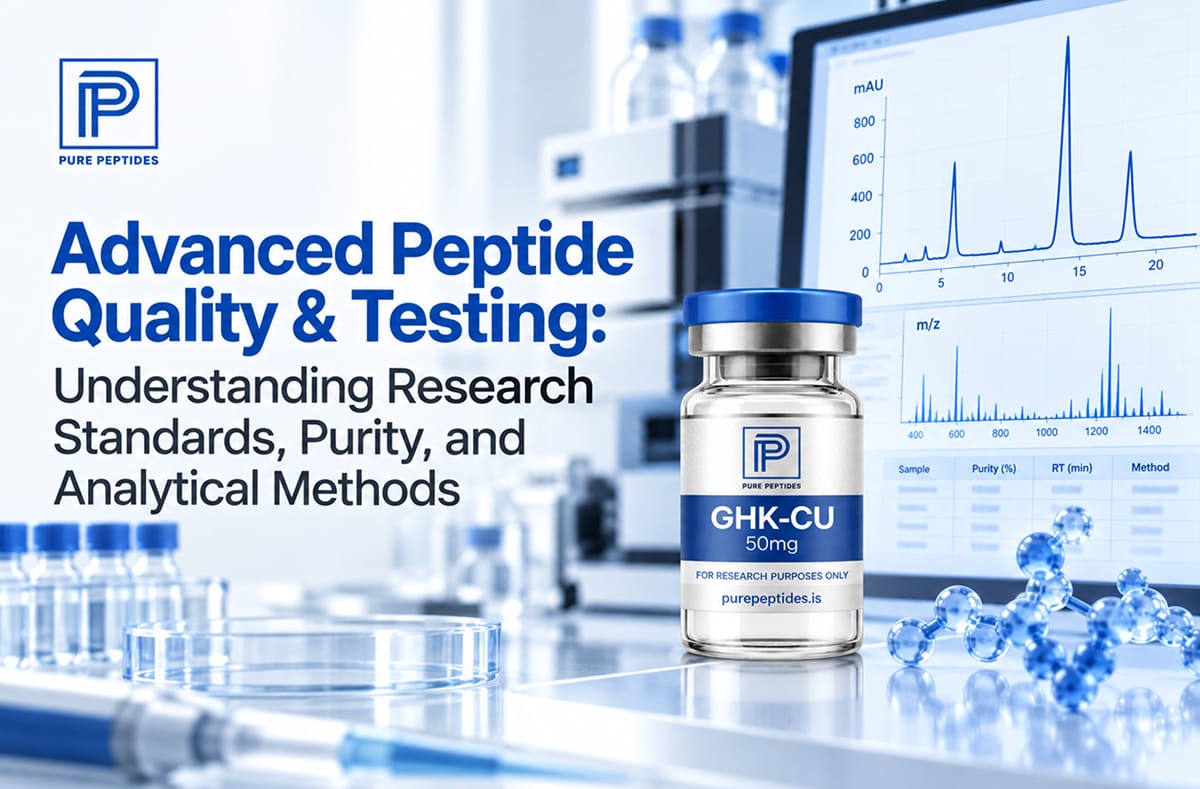
Advanced Peptide Quality & Testing: Understanding Research Standards, Purity, and Analytical Methods


Peptide quality testing is an important part of scientific research because experimental results depend on the identity, purity, concentration, and stability of the material being studied. Therefore, researchers generally evaluate more than a single purity percentage when assessing a research peptide. Pure Peptides focuses on research peptide products and quality-related information to support a more informed approach to peptide research.
In addition, advanced peptide quality testing can include molecular identity, chromatographic purity, molecular mass, concentration, degradation, and batch documentation. Together, these measurements provide a clearer picture of the material and help researchers determine whether it meets the requirements of a specific research model.
In Canada, researchers should also distinguish analytical quality from regulatory status. A laboratory test or certificate of analysis can describe the characteristics of a research material, but it does not establish approval for human use or therapeutic application.
What Is Peptide Quality Testing in Scientific Research?
Peptide quality testing refers to analytical procedures used to evaluate the identity, purity, composition, and other relevant characteristics of a peptide. In research, these tests help scientists determine whether the material corresponds to the expected compound and whether its analytical profile meets predefined specifications.
First, researchers typically confirm peptide identity. Next, they evaluate purity and related substances. Depending on the research requirements, they may also examine molecular mass, concentration, water content, or stability.
However, purity alone does not provide a complete assessment. A peptide can show a high chromatographic purity value while still requiring additional analysis to confirm its identity or molecular characteristics.
| Quality Attribute | What Researchers Evaluate |
|---|---|
| Identity | Whether the material matches the expected peptide |
| Purity | Relative amount of the target peptide |
| Molecular mass | Agreement with the expected molecular weight |
| Concentration | Amount of peptide present |
| Stability | Changes during storage or handling |
| Degradation | Presence of breakdown products |
| Batch documentation | Analytical results for a specific batch |
As a result, researchers generally consider several quality attributes together rather than relying on one measurement.
Explore quality-tested research peptides with clear product information and laboratory-focused standards at Pure Peptides.
How Do Researchers Evaluate Peptide Quality and Purity?
Researchers commonly define specifications for identity, purity, molecular mass, and concentration before evaluating a peptide. HPLC is then used to separate sample components and assess the relative purity of the main peptide peak and detectable related substances. However, HPLC results should be interpreted within the specific analytical conditions used.
Meanwhile, mass spectrometry provides complementary molecular-mass information. Therefore, researchers can compare the observed mass with the expected peptide mass to support identity assessment and develop a more complete analytical profile.
| Method | Primary Purpose |
|---|---|
| HPLC | Chromatographic separation and purity assessment |
| Mass spectrometry | Molecular-mass and identity assessment |
| LC-MS | Combined separation and mass analysis |
| Water-content testing | Measurement of moisture |
| Stability testing | Evaluation of changes over time |
Together, these methods can provide a more complete analytical profile than any single technique.
SEE MORE:
- Peptide Quality Explained: Understanding Research Standards and Quality Control
- Peptide Purity Testing: Methods Used to Evaluate Research Peptide Quality
- Peptide Characterization Techniques: How Researchers Confirm Identity and Structure
- Peptide HPLC Testing: Understanding Purity Analysis and Laboratory Evaluation
What Analytical Methods Are Used to Verify Research Peptides?
Different analytical methods answer different research questions, so researchers often combine techniques when characterizing a peptide. HPLC provides information about chromatographic purity and related compounds, while mass spectrometry provides molecular-mass data that can support peptide identity.
For example, mass spectrometry can help determine whether the main HPLC peak matches the expected molecular mass. Therefore, combining these methods can provide greater confidence in peptide characterization and support a more complete quality assessment.
| Analytical Area | Research Question |
|---|---|
| Chromatographic purity | What proportion of the detected material corresponds to the primary peak? |
| Molecular mass | Does the observed mass match the expected peptide? |
| Identity | Does the analytical profile support the expected compound? |
| Stability | Does the material change under defined conditions? |
| Water content | How much moisture is present? |
| Batch analysis | Do the results correspond to the specific batch? |
Furthermore, reliable testing depends on appropriate analytical procedures, controls, calibration, and predefined acceptance criteria. Therefore, the testing method itself forms an important part of peptide quality evaluation.
Which Factors Influence Peptide Quality and Laboratory Reliability?
Peptide quality can be influenced by several stages, including synthesis, purification, storage, transportation, and laboratory handling. Consequently, researchers should consider the entire material lifecycle when interpreting quality information.
Peptide structure is one important factor. Different sequences and molecular characteristics can influence stability and susceptibility to degradation. In addition, environmental conditions such as temperature, moisture, and light exposure may affect some peptide materials.
Storage and handling are therefore important considerations. Appropriate conditions can help maintain the material’s expected characteristics, while unsuitable conditions may contribute to changes over time.
Batch documentation is equally important because it connects analytical results with a specific material.
| Factor | Potential Research Impact |
|---|---|
| Peptide structure | Can influence stability |
| Purification | Influences impurity profile |
| Temperature | May affect material stability |
| Moisture | Can influence physical characteristics |
| Storage duration | May affect degradation |
| Handling | Can introduce variability |
| Batch documentation | Links results to a specific batch |
Moreover, researchers should determine whether analytical data actually correspond to the batch under investigation. Batch-specific documentation is therefore more informative than relying solely on general product specifications.
Explore quality-tested research peptides with clear product information and laboratory-focused standards at Pure Peptides.
Why Are Testing Standards Important for Research Peptide Evaluation?
Testing standards provide consistent criteria for evaluating peptide materials and making results easier to compare across batches or laboratories. For example, researchers can define specifications for identity, purity, molecular mass, and other relevant characteristics before testing a material.
Furthermore, standardized methods, controls, and documentation can improve research reproducibility. In Canada, researchers should also distinguish laboratory quality assessment from regulatory authorization, because analytical documentation describes a material’s characteristics but does not establish approval for diagnosis, treatment, prevention, or human consumption.
A practical quality review can therefore focus on several questions:
- Does the analytical data support peptide identity?
- Is the reported purity based on an appropriate method?
- Does the molecular mass match the expected compound?
- Are the results specific to the relevant batch?
- Are analytical methods and acceptance criteria documented?
- Are appropriate storage and handling conditions defined?
Ultimately, these factors provide a more meaningful assessment than focusing on a single purity value.
SEE MORE:
FAQs About Advanced Peptide Quality & Testing
What is advanced peptide quality testing?
Advanced peptide quality testing uses analytical methods to evaluate characteristics such as identity, purity, molecular mass, concentration, stability, and batch consistency.
Is a high purity percentage enough to verify a peptide?
No. Purity represents only one quality attribute. Researchers may also require identity confirmation, molecular-mass analysis, concentration measurements, and other relevant tests.
Why is HPLC used for peptide testing?
HPLC separates components within a sample and allows researchers to examine the primary peptide peak and detectable related substances. Therefore, it is useful for chromatographic purity assessment.
What does mass spectrometry add to peptide testing?
Mass spectrometry provides molecular-mass information. Consequently, it can complement HPLC when researchers evaluate peptide identity and composition.
Can storage affect peptide quality?
Yes. Temperature, moisture, light, storage duration, and handling can influence the stability of some peptides. Therefore, appropriate storage remains an important part of research material management.
Does a certificate of analysis prove that a peptide is approved for human use?
No. A certificate of analysis reports analytical results for a particular material or batch. It does not establish regulatory approval, therapeutic efficacy, or authorization for human use.
Final Thoughts
Advanced peptide quality and testing involves more than checking a reported purity percentage. Instead, researchers can evaluate identity, molecular mass, chromatographic purity, stability, and batch-specific documentation together.
Furthermore, techniques such as HPLC and mass spectrometry provide complementary information. When researchers combine appropriate analytical methods with documented procedures and defined specifications, they can develop a clearer understanding of the material used in their experiments. For research-focused peptide information and quality considerations, Pure Peptides provides a dedicated resource for exploring research peptide products and related scientific topics.
For research peptide evaluation in Canada, it is equally important to distinguish analytical quality from regulatory status. Ultimately, reliable peptide research depends on accurate characterization, appropriate documentation, controlled handling, and careful interpretation of analytical results.
Disclaimer: This content is provided for educational and scientific research purposes only. Research peptides are intended for laboratory research only and are not intended for human consumption or medical use.
This article provides a useful look at why advanced testing can be important when evaluating peptide research materials. I particularly liked the focus on using analytical data to verify identity, purity, and consistency rather than relying on product specifications alone.
I found the discussion of advanced analytical methods particularly informative. Combining different testing approaches can provide a more detailed picture of a peptide sample and help researchers interpret quality data with greater context.
The article is a helpful reference for understanding how peptide quality can be assessed beyond a basic purity percentage. I appreciate the emphasis on analytical evidence, testing methodology, and the importance of interpreting results within the appropriate research context.