
LC-MS Peptide Analysis: Advanced Methods for Peptide Identification and Characterization


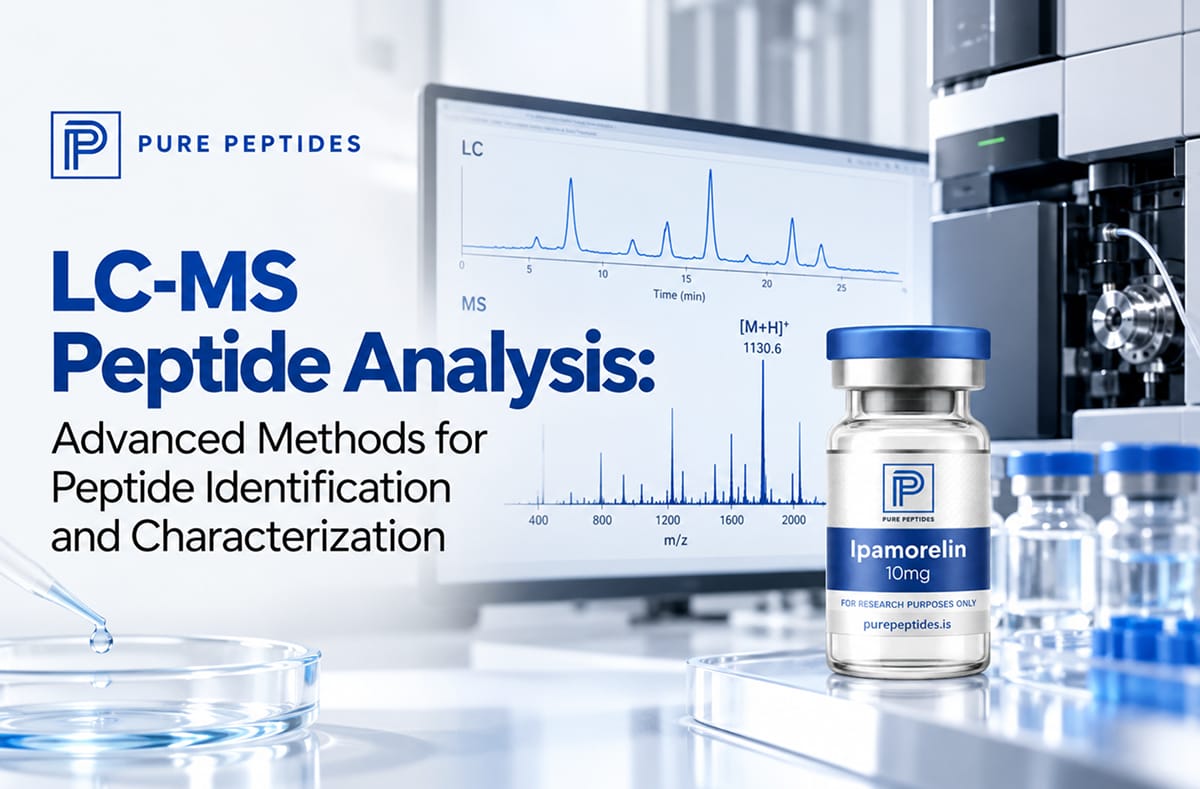
LC-MS peptide analysis combines liquid chromatography with mass spectrometry to examine peptide samples through two complementary processes: separation and molecular detection. Liquid chromatography separates components according to their interactions with the chromatographic system, while mass spectrometry measures their mass-to-charge ratios. As a result, researchers can investigate peptide identity, molecular mass, related components, and sequence-related characteristics within one analytical workflow.
For Pure Peptides, understanding LC-MS can help researchers interpret analytical information when evaluating research materials. In Canada, researchers should also distinguish analytical characterization from regulatory authorization. Analytical testing can describe measurable properties of a material, but it does not independently establish approval for human use.
What Is LC-MS Peptide Analysis?
In simple terms, LC-MS peptide analysis combines liquid chromatography (LC) with mass spectrometry (MS). First, the LC stage separates components within a peptide sample. Then, the separated components enter the mass spectrometer for molecular detection.
Liquid chromatography primarily provides separation and retention-time information, whereas mass spectrometry provides molecular-mass data. Therefore, combining these techniques gives researchers a broader analytical view of a peptide sample.
Researchers can adjust the analytical conditions according to the peptide and research objective. For example, several factors may influence the analytical workflow:
- Sample preparation and concentration
- Chromatographic column selection
- Mobile phase composition
- Flow rate and gradient conditions
- Ionization settings
- Mass spectrometer configuration
- Data-processing parameters
As a result, these factors can influence how effectively the system separates and detects peptide components. Consequently, researchers should consider the complete analytical method when interpreting LC-MS results.
Explore quality-tested research peptides with clear product information and laboratory-focused standards at Pure Peptides.
How Does LC-MS Combine Separation and Molecular Detection?
The main strength of LC-MS comes from connecting chromatographic separation with molecular detection. During liquid chromatography, peptide components interact differently with the stationary and mobile phases. Consequently, different components can elute at different retention times.
The mass spectrometer then analyzes the ions produced from those separated components. Researchers can therefore examine both when a component elutes and what molecular mass it produces.
For example, researchers may observe multiple chromatographic peaks within one sample. The MS data can then provide molecular-mass information for the detected components. As a result, researchers can obtain more analytical context than chromatographic separation alone can provide.
| LC-MS Information | Research Value |
|---|---|
| Retention time | Shows when a component elutes |
| Chromatographic peak | Indicates a detectable component |
| Mass-to-charge ratio | Describes detected ions |
| Molecular mass | Supports molecular characterization |
| Fragment ions | Provide sequence-related information |
However, researchers should interpret LC-MS results according to the analytical method used. Differences in columns, mobile phases, gradients, sample preparation, ionization conditions, and data processing can influence the final results.
How Is LC-MS Used in Peptide Sequence and Identity Analysis?
LC-MS can support peptide identity analysis by combining chromatographic behaviour with molecular-mass information. Researchers can compare the measured molecular mass with the theoretical mass expected for a target peptide.
When the measured value agrees with the expected mass within the relevant analytical tolerance, the result can support the proposed identity. However, molecular-mass agreement alone does not necessarily confirm the complete peptide sequence.
For deeper characterization, researchers may use tandem mass spectrometry, or MS/MS. During this process, selected peptide ions undergo fragmentation, producing smaller ions that researchers can analyze.
Researchers can use MS/MS data to investigate several characteristics:
- Molecular mass of the intact peptide
- Fragmentation patterns
- Sequence-related information
- Potential molecular modifications
- Differences between expected and observed results
Furthermore, these fragment patterns can provide additional sequence-related evidence. In particular, researchers can compare experimental fragmentation data with theoretical or reference spectra to support peptide identification.
| Analytical Approach | Main Information |
|---|---|
| LC separation | Component separation and retention |
| MS | Molecular-mass information |
| LC-MS | Separation plus molecular-mass data |
| MS/MS | Fragmentation information |
| Spectral matching | Supports peptide identification |
| Sequence analysis | Provides sequence-related evidence |
Furthermore, LC-MS can help researchers investigate potential molecular modifications. A mass shift may indicate a modified form, degradation product, or another molecular species. Nevertheless, researchers should not assign a specific modification based only on a mass difference.
What Are the Advantages of LC-MS in Peptide Research?
LC-MS offers several advantages because it combines chromatographic separation with molecular detection. First, liquid chromatography separates components according to their chromatographic properties. Next, mass spectrometry provides molecular-mass information for detected ions.
As a result, researchers can investigate multiple characteristics of a peptide sample through complementary analytical measurements.
Key advantages of LC-MS include:
- Combining chromatographic separation with mass detection
- Providing retention-time information
- Supporting molecular-mass assessment
- Allowing MS/MS fragmentation analysis
- Helping investigate complex peptide samples
- Providing complementary evidence for peptide characterization
| Advantage | Research Value |
|---|---|
| Chromatographic separation | Helps distinguish sample components |
| Molecular-mass measurement | Supports identity assessment |
| MS/MS fragmentation | Provides sequence-related information |
| Retention-time data | Adds chromatographic context |
| Multiple analytical dimensions | Supports broader characterization |
| Complex sample analysis | Helps investigate mixtures |
In addition, LC-MS can complement techniques such as HPLC and standalone mass spectrometry. Therefore, researchers can select analytical methods according to the information they need.
For research environments in Canada, analytical characterization should remain distinct from broader regulatory requirements. Appropriate analytical methods can help establish characteristics of a research material, but individual test results do not establish regulatory authorization.
Explore quality-tested research peptides with clear product information and laboratory-focused standards at Pure Peptides.

What Challenges Exist in LC-MS Peptide Analysis?
The quality of an LC-MS result depends on the complete analytical workflow. Researchers may need to consider several potential sources of analytical variation:
- Sample preparation
- Peptide recovery
- Chromatographic separation
- Ionization efficiency
- Matrix effects
- Instrument configuration
- Calibration
- Data interpretation
For example, sample preparation can affect peptide recovery and sample composition. Similarly, chromatographic conditions influence separation, while ionization behaviour can affect signal intensity.
Furthermore, complex peptide samples may contain components with similar molecular masses or overlapping chromatographic behaviour. In such cases, researchers may need to optimize the method or apply additional analytical techniques.
| Challenge | Potential Effect |
|---|---|
| Sample preparation | Can affect recovery and composition |
| Poor chromatographic separation | Can cause overlapping signals |
| Ionization differences | Can influence signal intensity |
| Matrix effects | Can interfere with detection |
| Similar molecular masses | Can complicate identification |
| Data interpretation | Can affect analytical assignments |
Although LC-MS can provide useful information about sample composition, researchers should not automatically treat it as a complete purity measurement. Instead, they may combine LC-MS with dedicated chromatographic purity testing and other characterization methods.
In Canada, researchers should also keep analytical testing separate from regulatory status. A laboratory result can describe measurable characteristics of a material; however, it does not independently establish approval for human use or therapeutic application.
Want to better understand peptide purity and testing standards? Explore Advanced Peptide Quality & Testing: Understanding Research Standards, Purity, and Analytical Methods.
FAQs About LC-MS Peptide Analysis
What is LC-MS peptide analysis?
LC-MS peptide analysis combines liquid chromatography with mass spectrometry. Researchers use liquid chromatography to separate components and mass spectrometry to obtain molecular-mass information.
What does LC-MS tell researchers about a peptide?
LC-MS can provide retention-time, chromatographic, molecular-mass, and, when MS/MS is used, fragmentation information. Therefore, researchers can evaluate several characteristics within one analytical workflow.
Can LC-MS confirm peptide identity?
LC-MS can provide evidence that supports peptide identity by comparing observed molecular mass and chromatographic information with expected characteristics. However, complete sequence confirmation may require MS/MS or additional analytical techniques.
What is LC-MS/MS?
LC-MS/MS combines liquid chromatography with tandem mass spectrometry. After chromatographic separation, selected peptide ions undergo fragmentation so researchers can examine the resulting fragment patterns.
Can LC-MS detect peptide modifications?
Yes. LC-MS can reveal mass differences that may indicate modifications or other molecular changes. However, researchers generally need additional evidence to determine the specific nature of a modification.
Does LC-MS measure peptide purity?
LC-MS can help researchers investigate sample composition, but it should not automatically serve as the only purity assessment. Researchers may combine LC-MS with chromatographic purity analysis and other characterization methods.
Final Thoughts
Overall, LC-MS peptide analysis combines chromatographic separation with mass spectrometric detection, giving researchers complementary information about peptide samples. The technique can therefore support investigations of molecular identity, molecular mass, retention behaviour, modifications, and sequence-related characteristics.
For Pure Peptides, understanding LC-MS peptide analysis can help researchers interpret analytical information and better understand how peptide identity and characterization are evaluated. In Canada, researchers should also distinguish laboratory characterization from regulatory authorization and consider the complete analytical context when evaluating research materials.
Disclaimer: This content is provided for educational and scientific research purposes only. Research peptides are intended for laboratory research only and are not intended for human consumption or medical use.

This article provides a clear introduction to LC-MS and its role in peptide analysis. I found the combination of chromatographic separation and mass detection particularly interesting because it provides more detailed analytical information about a sample.
I liked the practical explanation of how LC-MS can help researchers examine peptide samples. Looking at both retention behaviour and molecular mass provides useful context when evaluating peptide identity and composition.
The discussion of LC-MS makes peptide analysis easier to understand, especially for readers who are new to analytical techniques. I appreciate the focus on how different types of data can work together to provide a more complete characterization of a research sample.