Peptide HPLC Testing: Understanding Purity Analysis and Laboratory Evaluation


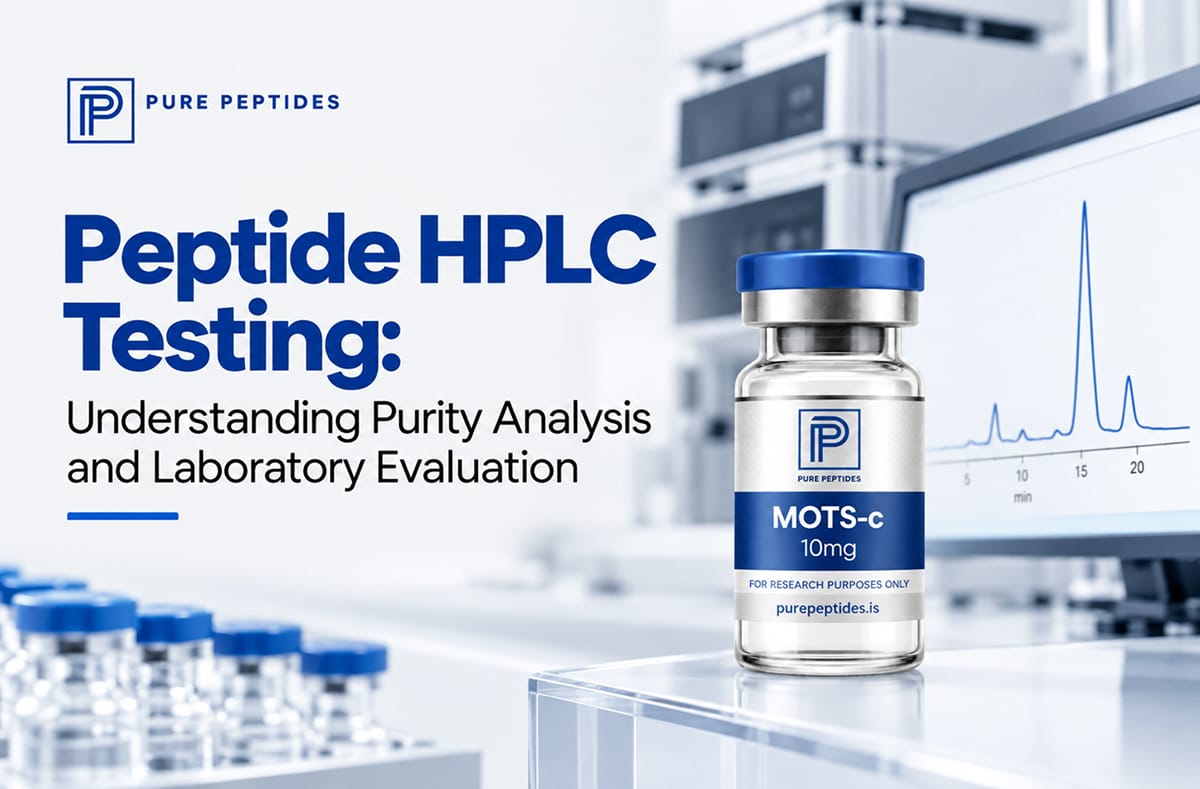
Researchers widely use peptide HPLC testing in laboratory research to evaluate the chromatographic purity of peptide materials. By separating compounds within a sample, high-performance liquid chromatography (HPLC) can help researchers identify the main peptide peak and detect additional components that may require further investigation.
For Pure Peptides, understanding how HPLC works can help researchers interpret peptide quality data more accurately. In Canada, analytical testing and quality documentation are also important considerations when evaluating research materials. However, researchers should interpret an HPLC result as analytical information rather than evidence of regulatory approval or suitability for human use.
What Is HPLC Testing for Peptides?
High-performance liquid chromatography is an analytical technique that separates compounds based on differences in their interactions with a stationary phase and a mobile phase. As a result, researchers can use this separation process to examine the composition of a peptide sample.
During peptide HPLC testing, a prepared sample enters the chromatographic system. As a result, the system produces a chromatogram containing peaks that correspond to detected components.
The primary peptide generally produces a major peak, while additional peaks may indicate related substances, degradation products, or other detectable components.
| HPLC Element | Role in Peptide Analysis |
|---|---|
| Sample | Contains the peptide material being evaluated |
| Column | Separates components within the sample |
| Mobile phase | Carries compounds through the system |
| Detector | Records compounds as they elute |
| Chromatogram | Displays the analytical separation |
| Peak area | Helps assess relative component levels |
| Retention time | Helps characterize chromatographic behaviour |
Researchers may need complementary techniques, such as mass spectrometry, when they need additional evidence about molecular mass or identity.
Explore quality-tested research peptides with clear product information and laboratory-focused standards at Pure Peptides.
How Does HPLC Analyze Peptide Purity?
In practice, HPLC analyzes peptide purity by separating the target peptide from other detectable components. Researchers can then examine the resulting chromatogram and compare the relative areas of the detected peaks. For example, a sample may produce one dominant peak accompanied by several smaller peaks.
More specifically, the reported purity percentage commonly reflects the proportion of the detected chromatographic area associated with the target peak under the specified analytical conditions.
However, this distinction is important: chromatographic purity is not necessarily the same as absolute peptide content.
| HPLC Result | What It Can Indicate |
|---|---|
| Main peak | Major detectable component |
| Minor peaks | Additional detectable components |
| Retention time | Chromatographic behaviour |
| Peak area | Relative contribution to the chromatogram |
| Purity percentage | Relative chromatographic purity |
Consequently, researchers should examine the testing method alongside the reported purity value.
Furthermore, two laboratories can obtain somewhat different results if they use different columns, mobile phases, gradients, sample concentrations, or calculation procedures. Therefore, researchers should avoid comparing purity percentages without considering the analytical conditions behind them.
What Information Does a Peptide HPLC Chromatogram Provide?
A peptide HPLC chromatogram provides a visual representation of the components detected during chromatographic separation. Researchers can examine several characteristics to understand the analytical profile of a sample.
First, one important characteristic is retention time. Researchers can use relative peak areas to estimate the proportion of detected components within the chromatogram.
Peak shape can also provide information about the quality of the separation. A clear and well-resolved peak can make interpretation easier, while overlapping or poorly resolved peaks can complicate analysis.
| Chromatogram Feature | Research Relevance |
|---|---|
| Retention time | Characterizes chromatographic behaviour |
| Peak area | Helps estimate relative component levels |
| Peak shape | Indicates quality of chromatographic separation |
| Main peak | Represents the dominant detected component |
| Additional peaks | May indicate related substances |
| Baseline | Helps assess the overall analytical profile |
Nevertheless, researchers should not assume that every additional peak represents a specific impurity without further characterization. HPLC shows chromatographic separation, but additional analytical methods may be necessary to determine the molecular identity of an unknown component.
Why Is Reverse Phase HPLC Commonly Used for Peptide Analysis?
Researchers commonly use reverse phase HPLC for peptide analysis because it can separate many peptides according to differences in hydrophobicity. In this configuration, the stationary phase is relatively non-polar, while the mobile phase is comparatively more polar.
Furthermore, researchers can adjust the composition of the mobile phase to influence how peptide components interact with the column. Consequently, peptides and related substances can elute at different times.A typical reverse phase peptide method may use a gradient in which the proportion of an organic solvent increases during the run.
| RP-HPLC Feature | Function |
|---|---|
| Non-polar stationary phase | Interacts with hydrophobic regions |
| Polar starting mobile phase | Provides initial separation conditions |
| Organic solvent gradient | Changes elution strength |
| Detector | Records separated components |
| Retention time | Indicates elution behaviour |
Researchers may adjust the column chemistry, solvent composition, gradient, flow rate, temperature, and detection settings to achieve suitable separation.
Furthermore, method development matters because a poorly optimized method may fail to separate closely related components. Therefore, researchers should consider the performance of the specific HPLC method rather than assuming that every RP-HPLC result provides the same level of information.
Explore quality-tested research peptides with clear product information and laboratory-focused standards at Pure Peptides.
What Are the Limitations of HPLC Peptide Testing?
Although HPLC provides valuable information about peptide purity and chromatographic composition, it has several limitations.
First, HPLC primarily describes how components behave within a particular chromatographic system. Therefore, a chromatographic peak does not automatically establish the molecular identity of that component.
Furthermore, the reported purity value depends on the analytical method. Changes in column chemistry, mobile phase, gradient, temperature, detector settings, and sample preparation can influence the resulting chromatogram.
Moreover, some closely related peptide compounds may produce overlapping peaks. In such cases, researchers may need to optimize the method or use an additional analytical technique.
| Limitation | Why It Matters |
|---|---|
| Method dependence | Results depend on analytical conditions |
| Peak overlap | Closely related components may be difficult to separate |
| Limited identity information | HPLC alone may not establish molecular identity |
| Detector response | Different compounds may produce different responses |
| Sample preparation | Preparation can affect the analytical profile |
| Unknown peaks | Additional testing may be needed for identification |
In addition, HPLC purity should not be interpreted as evidence of biological activity, therapeutic effectiveness, or regulatory authorization. For research conducted in Canada, this distinction is particularly important when evaluating materials marketed for laboratory purposes.
Want to better understand peptide purity and testing standards? Explore Advanced Peptide Quality & Testing: Understanding Research Standards, Purity, and Analytical Methods.
FAQs About Peptide HPLC Testing
What is peptide HPLC testing?
In simple terms, peptide HPLC testing is a chromatographic analysis used to separate and evaluate components within a peptide sample. Researchers commonly use it to assess chromatographic purity and identify additional detectable peaks.
What does peptide purity mean in HPLC?
In HPLC analysis, peptide purity generally refers to the relative chromatographic area associated with the target peptide under specified analytical conditions. Therefore, researchers should consider the method when interpreting the reported percentage.
Why is reverse phase HPLC used for peptides?
Reverse phase HPLC can separate peptides based on differences in hydrophobicity. Researchers can adjust chromatographic conditions to improve separation between the target peptide and related components.
Does HPLC confirm peptide identity?
HPLC can provide supporting information about a peptide’s chromatographic behaviour, but it does not necessarily confirm complete molecular identity. Researchers may use mass spectrometry or other techniques for additional confirmation.
What does an additional HPLC peak mean?
An additional peak indicates another detectable component under the selected analytical conditions. However, researchers cannot automatically identify that component from the peak alone.
Is HPLC purity the same as absolute purity?
Not necessarily. HPLC commonly provides chromatographic purity based on detected components and the selected calculation method. Researchers should therefore distinguish chromatographic purity from absolute peptide content.
Final Thoughts
Overall, peptide HPLC testing provides researchers with important information about chromatographic purity and the composition of a peptide sample. By examining retention times, peak areas, peak shapes, and additional detectable components, researchers can better understand the material under evaluation.
Furthermore, reverse phase HPLC offers a practical approach for separating many peptide materials according to their chromatographic properties. However, the resulting purity percentage should always be interpreted alongside the analytical method and testing conditions.
For Pure Peptides, understanding HPLC testing can help researchers evaluate peptide quality information more effectively. When identity or molecular characteristics require further confirmation, complementary techniques such as mass spectrometry can provide additional evidence.
Ultimately, HPLC is a valuable analytical tool, but it represents one part of peptide characterization. Researchers can obtain a more complete analytical profile by considering chromatographic data together with appropriate identity testing, batch documentation, and other relevant quality assessments.
Disclaimer: This content is provided for educational and scientific research purposes only. Research peptides are intended for laboratory research only and are not intended for human consumption or medical use.
This article provides a clear explanation of why HPLC is commonly used when evaluating peptide samples. I found the discussion of chromatographic separation particularly useful for understanding how researchers can assess purity and identify different components within a sample.
I liked the practical overview of HPLC testing and its role in peptide quality assessment. Understanding chromatograms and analytical results provides much more context than simply relying on a stated purity percentage.
The explanation of HPLC makes the testing process much easier to understand, especially for readers who are new to peptide analysis. I appreciate the emphasis on interpreting analytical data within the broader context of peptide identity and quality.