
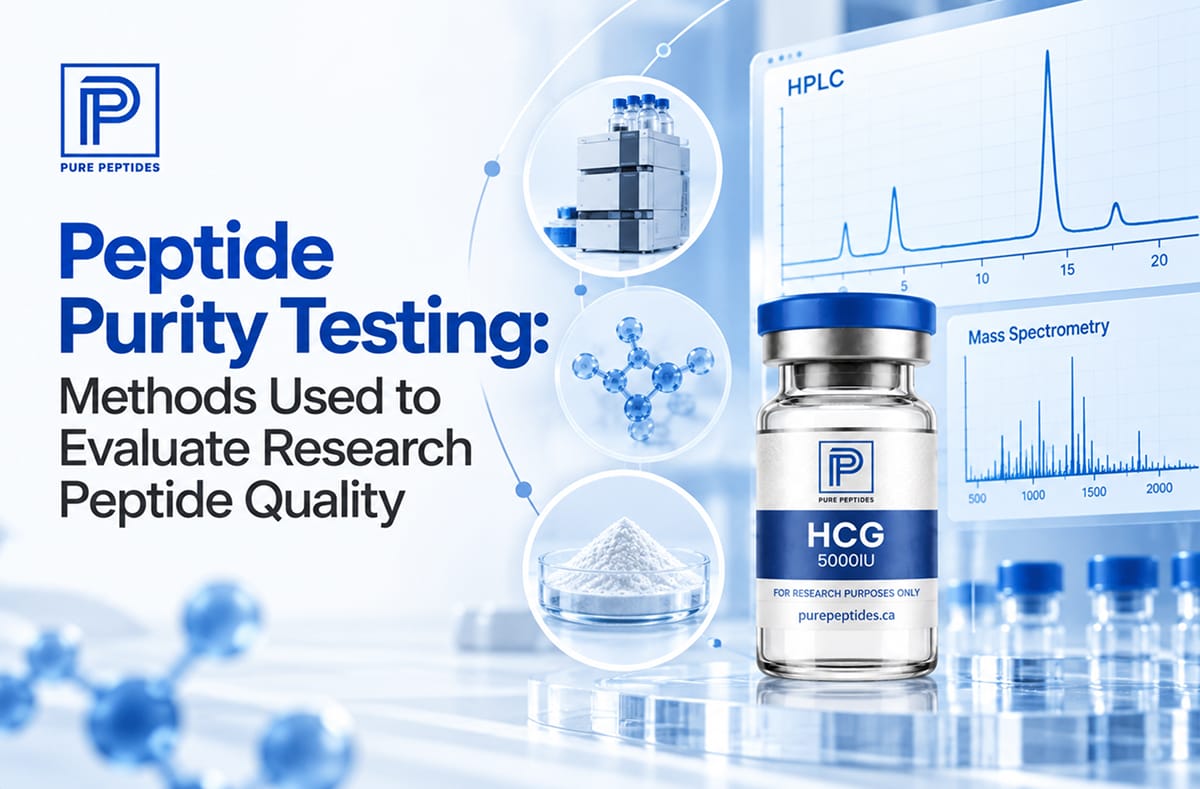
Peptide Purity Testing: Methods Used to Evaluate Research Peptide Quality


Peptide purity testing is an important part of research because the composition of a peptide sample can influence experimental results. However, purity represents only one aspect of peptide quality. Researchers may also evaluate identity, molecular mass, concentration, impurities, stability, and batch documentation.
For Pure Peptides, understanding these parameters helps researchers interpret analytical information more effectively. In Canada, researchers should also distinguish analytical quality from regulatory status. A laboratory test or Certificate of Analysis can describe the characteristics of a research material, but it does not establish approval for human use or therapeutic application.
What Is Peptide Purity Testing and Why Does It Matter?
Peptide purity testing determines the proportion of a sample that corresponds to the target peptide compared with detectable related substances or impurities. Researchers commonly use chromatographic methods to separate these components and evaluate the resulting analytical profile.
Importantly, a purity percentage does not describe every characteristic of a peptide. A sample may show high chromatographic purity while still requiring additional testing to support its identity or molecular mass.
| Quality Attribute | Research Purpose |
|---|---|
| Purity | Estimates the proportion of the target peptide |
| Identity | Supports confirmation of the expected compound |
| Molecular mass | Compares measured and expected mass |
| Concentration | Determines the amount of peptide present |
| Stability | Evaluates changes over time |
| Batch documentation | Connects results to a specific batch |
Therefore, researchers should consider purity together with other analytical characteristics rather than relying on a single value.
Explore quality-tested research peptides with clear product information and laboratory-focused standards at Pure Peptides.
How Is Peptide Purity Measured in Laboratory Research?
For this reason, researchers commonly use high-performance liquid chromatography (HPLC) to evaluate peptide purity. HPLC separates components within a sample according to their chemical properties and produces a chromatogram containing the detected peaks.
Researchers can examine the primary peptide peak and other detectable peaks to assess the chromatographic profile. However, the reported purity value depends on the analytical conditions used. Column selection, mobile phase, sample preparation, and other method parameters can influence separation.
Meanwhile, mass spectrometry provides complementary information by measuring molecular mass. Therefore, researchers can compare the observed mass with the expected peptide mass to support identity assessment.
| Measurement | What It Helps Evaluate |
|---|---|
| HPLC | Chromatographic purity and separation |
| Mass spectrometry | Molecular mass and identity |
| LC-MS | Separation and mass analysis |
| Stability testing | Changes in the analytical profile |
| Water-content testing | Moisture within the material |
Consequently, combining analytical methods can provide a more complete characterization than using one test alone.
What Methods Are Used to Analyze Peptide Purity?
HPLC and mass spectrometry are particularly useful because they answer different analytical questions. HPLC provides information about chromatographic purity, while mass spectrometry provides molecular-mass information.
For example, an HPLC analysis may show one dominant peak alongside smaller peaks. However, the chromatogram alone may not establish the molecular identity of every detected component. Mass spectrometry can provide additional information about the observed molecular mass.
Researchers may also use other tests depending on the peptide and research application.
| Analytical Method | Primary Application |
|---|---|
| HPLC | Purity and chromatographic separation |
| LC-MS | Separation and mass analysis |
| Mass spectrometry | Molecular-mass assessment |
| Stability analysis | Monitoring changes over time |
| Water-content analysis | Measuring moisture |
Furthermore, reliable testing depends on appropriate sample preparation, calibration, controls, analytical procedures, and acceptance criteria. Therefore, researchers should evaluate both the analytical result and the method used to generate it.
How Do Researchers Interpret Peptide Purity Results?
For this reason, a purity result requires context. Researchers typically consider the analytical method, testing conditions, specifications, and batch information before interpreting the reported percentage.
For example, an HPLC result may provide a percentage based on the relative area of detected chromatographic peaks. This information can help researchers evaluate the sample’s chromatographic profile. However, it does not automatically establish molecular identity, absolute peptide content, or the absence of every possible impurity.
Researchers can therefore ask several questions when reviewing a purity result:
- Which analytical method generated the result?
- Does the method adequately separate the target peptide from related substances?
- Does the molecular mass support the expected identity?
- Does the result correspond to the specific batch?
- Are the analytical conditions documented?
- Are acceptance criteria clearly defined?
Batch-specific documentation is particularly useful because it connects analytical results with the material being evaluated.
Consequently, researchers should interpret peptide purity as one part of a broader quality assessment.
Explore quality-tested research peptides with clear product information and laboratory-focused standards at Pure Peptides.
What Factors Can Influence Peptide Purity Analysis?
At the same time, several factors can influence the analytical profile of a peptide. These factors may arise during synthesis, purification, storage, transportation, and laboratory handling.
Peptide structure can affect stability and susceptibility to degradation. In addition, temperature, moisture, light exposure, and storage duration may influence certain peptide materials.
The analytical method itself can also affect the reported result. For example, chromatographic conditions determine how effectively related substances separate from the target peptide. Therefore, researchers should consider the testing method when comparing purity results between batches or laboratories.
| Factor | Potential Influence |
|---|---|
| Peptide structure | Can influence stability |
| Purification | Can affect impurity profile |
| Temperature | May influence degradation |
| Moisture | Can affect material characteristics |
| Storage duration | May affect stability |
| Analytical conditions | Can influence separation |
| Sample preparation | Can affect analytical results |
| Batch variation | May produce differences between samples |
Appropriate controls, documented procedures, and defined acceptance criteria can help researchers interpret these differences more consistently.
Want to better understand peptide purity and testing standards? Explore Advanced Peptide Quality & Testing: Understanding Research Standards, Purity, and Analytical Methods.
FAQs About Peptide Purity Testing
What is peptide purity testing?
Peptide purity testing uses analytical methods to estimate the amount of target peptide relative to detectable related substances and impurities within a sample.
What is HPLC used for in peptide research?
HPLC separates components within a sample and produces a chromatographic profile that researchers can use to evaluate peptide purity.
Is HPLC purity enough to confirm peptide identity?
Not necessarily. HPLC provides chromatographic information, while mass spectrometry can provide molecular-mass information. Researchers may therefore use both methods for broader characterization.
Does a higher purity percentage always mean better research quality?
Not necessarily. Purity is only one quality attribute. Researchers should also consider identity, molecular mass, concentration, stability, analytical methodology, and batch documentation.
Why is mass spectrometry useful for peptide analysis?
Mass spectrometry measures molecular mass and allows researchers to compare the observed value with the expected mass of the peptide.
Can two laboratories report different purity values?
Yes. Differences in analytical conditions, sample preparation, instruments, columns, and reporting criteria can influence the reported result.
Why is batch-specific testing important?
Batch-specific testing connects analytical results to a particular material. Therefore, researchers can determine whether the reported purity applies to the batch they are evaluating.
Does peptide purity testing establish regulatory approval?
No. Analytical testing describes characteristics of a material, while regulatory authorization involves separate requirements. In Canada, researchers should keep analytical characterization separate from regulatory status.
Final Thoughts
Peptide purity testing provides important information about the chromatographic composition of a research material. However, researchers should not treat a single purity percentage as a complete measure of peptide quality.
Instead, identity, molecular mass, impurities, stability, analytical methodology, and batch documentation provide additional context. Furthermore, HPLC and mass spectrometry offer complementary information that can support a more complete characterization.
For Pure Peptides, understanding peptide purity testing can help researchers interpret analytical information when evaluating research materials. In Canada, researchers should also distinguish analytical characterization from regulatory authorization and assess testing results within the appropriate scientific context.
Disclaimer: This content is provided for educational and scientific research purposes only. Research peptides are intended for laboratory research only and are not intended for human consumption or medical use.
This article provides a clear explanation of why peptide purity testing matters in research. I particularly liked the discussion of analytical methods and how testing results can help verify the composition and consistency of a peptide sample.
I found the explanation of peptide purity testing useful, especially the point that a reported purity percentage should be considered alongside the analytical method used. Looking at the testing methodology provides more context when evaluating research materials.
The research-focused approach to peptide purity is helpful for understanding how laboratory samples are evaluated. I appreciate the emphasis on analytical evidence rather than relying solely on product descriptions or stated purity levels.
One of the most useful points here is that peptide purity should be evaluated through analytical testing rather than simply accepting a stated percentage. The explanation helps clarify why reliable testing data matters when comparing research samples.