
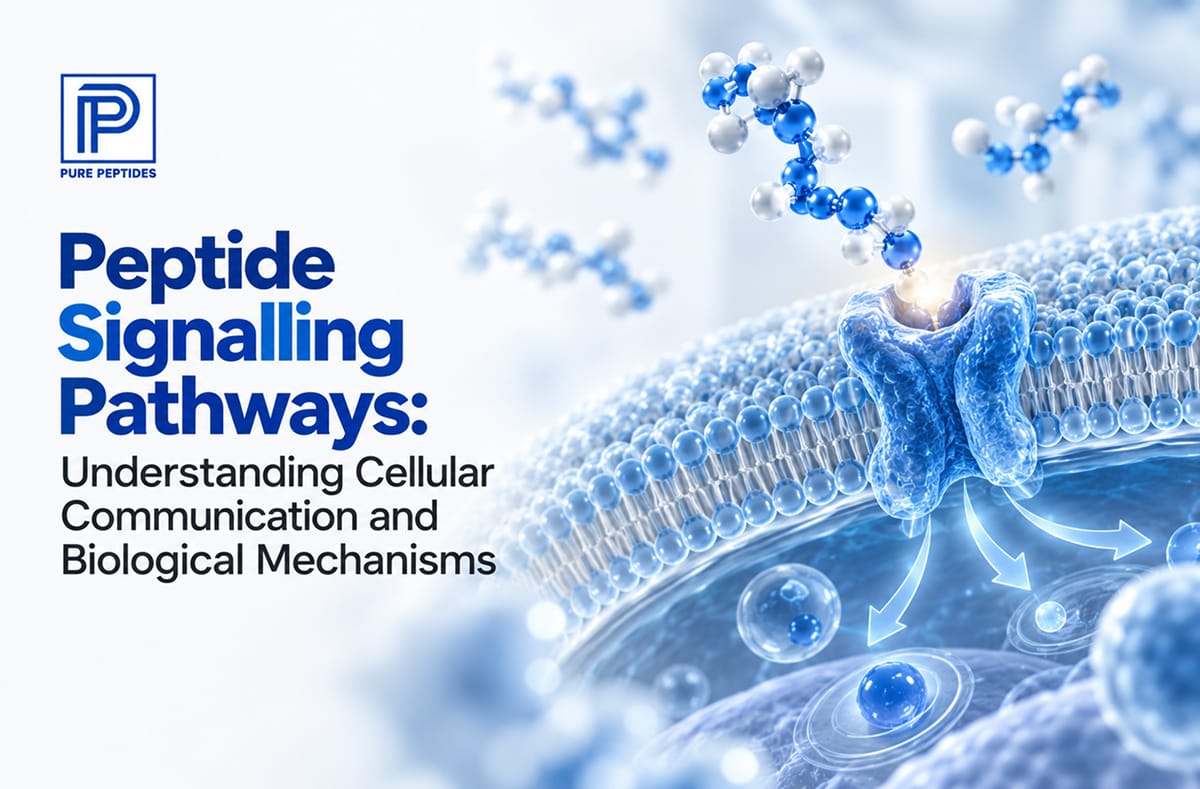
Peptide Signalling Pathways: Understanding Cellular Communication and Biological Mechanisms


Peptide Signalling Pathways describe how peptide molecules participate in communication between cells by interacting with receptors or other molecular targets. Rather than acting as isolated signals, peptides operate within networks that can involve receptors, second messengers, enzymes, ion movement, and changes in gene activity.
Therefore, understanding these pathways helps researchers connect a peptide-target interaction with a measurable cellular response. At Pure Peptides, this framework provides useful context when researchers compare peptide mechanisms, receptor systems, and laboratory findings.
Explore quality-focused research peptides for your laboratory needs at Pure Peptides.
What Are Peptide Signalling Pathways?
Peptide signalling pathways are sequences of molecular events that begin when a peptide interacts with a compatible biological target. In many systems, that target is a receptor on the cell membrane. After recognition, the receptor can change conformation and transmit information into the cell.
Importantly, the peptide usually represents only the first step in a larger signalling network. Researchers may also examine:
- Receptor binding
- G protein activation
- Second-messenger production
- Protein kinase activity
- Calcium movement
- Signal termination or desensitization
| Signalling Component | Research Role |
|---|---|
| Peptide ligand | Initiates molecular recognition |
| Receptor | Detects the extracellular signal |
| G protein or adaptor | Transfers information intracellularly |
| Second messenger | Amplifies or distributes the signal |
| Protein kinase | Modifies downstream proteins |
For example, many peptide hormones and neuropeptides interact with G protein-coupled receptors, or GPCRs. These receptors span the cell membrane and can activate intracellular signalling after ligand binding.
Therefore, Peptide Signalling Pathways help researchers move from asking what a peptide binds to examining what happens after binding.
Explore quality-tested research peptides with clear product information and laboratory-focused standards at Pure Peptides.

How Do Peptides Influence Cellular Communication?
Cells communicate by detecting chemical information from their surroundings and converting it into intracellular responses. Peptides can serve as extracellular signals within this process.
First, a peptide reaches a compatible target. Next, molecular recognition allows it to interact with a receptor or another signalling component. As a result, intracellular proteins can relay the information through one or more pathways.
For instance, a simplified sequence may include:
- A peptide approaches a target cell.
- The peptide binds to a compatible receptor.
- The receptor changes its molecular state.
- Intracellular signalling proteins become active.
- Second messengers or kinases transmit the signal.
- Cellular processes respond.
- Regulatory mechanisms reduce or terminate the signal.
However, cellular communication is rarely a simple on/off process. Receptor density, peptide concentration, binding affinity, cell type, exposure time, and receptor desensitization can all affect the observed response.
In addition, the same peptide may produce different outcomes in different cell systems because receptor levels and downstream proteins can vary. Consequently, researchers should interpret peptide signalling within the complete experimental model.
What Role Do Peptide Receptors Play in Signalling Pathways?
Peptide receptors help cells recognize extracellular signals and convert them into intracellular information. In particular, GPCRs represent one of the most widely studied receptor families in peptide research.
When a compatible peptide binds to a GPCR, receptor conformation can change. Consequently, the receptor can influence intracellular G proteins, which may regulate enzymes or ion-related processes.
| Pathway | Common Signalling Feature |
|---|---|
| cAMP/PKA | Cyclic AMP and protein kinase A activity |
| PLC/IP3 | Phospholipase C and IP3 formation |
| Calcium signalling | Changes in intracellular calcium |
| DAG/PKC | Diacylglycerol and protein kinase C activity |
| MAPK/ERK | Kinase cascades linked to cellular responses |
| PI3K/Akt | Growth- and metabolism-related signalling |
However, not every peptide receptor belongs to the GPCR family. Some peptide signals interact with receptor tyrosine kinases or other membrane-associated systems.
Furthermore, one receptor can engage more than one downstream pathway. Researchers may therefore investigate pathway preference, receptor internalization, or desensitization.
For this reason, Peptide Signalling Pathways research considers both receptor identity and the intracellular route activated after binding.
How Are Peptide Signalling Mechanisms Studied in Research?
Researchers use complementary approaches to investigate peptide signalling mechanisms. No single experiment can fully describe receptor binding, pathway activation, and cellular outcomes at the same time.
For example, binding assays can examine whether a peptide interacts with a target and how strongly that interaction occurs. Meanwhile, second-messenger assays can measure changes in cyclic AMP, calcium, or other signalling molecules.
Researchers may also use:
- Receptor-binding assays
- Cell-based signalling assays
- Calcium-flux measurements
- cAMP measurements
- Protein phosphorylation analysis
- Gene-expression studies
- Receptor internalization assays
In addition, researchers often compare peptide concentration with response magnitude. A concentration-response curve can help characterize how a system responds across a defined range.
However, an observed cellular response does not automatically identify the complete mechanism. Researchers may need receptor antagonists, pathway inhibitors, genetic approaches, or comparative cell models to identify the molecular route involved.
Likewise, assay conditions matter. Temperature, exposure time, receptor expression, cell type, and sample preparation can influence measured outcomes. Therefore, researchers strengthen conclusions by combining multiple forms of evidence.
Explore quality-tested research peptides with clear product information and laboratory-focused standards at Pure Peptides.
Why Are Biological Pathways Important in Peptide Research?
Biological pathways help researchers explain how molecular recognition can lead to larger cellular effects. Without pathway information, receptor binding and biological response can remain disconnected observations.
For example, researchers may detect peptide binding but still need to determine whether that interaction activates cAMP, calcium, kinase, or another intracellular system. Conversely, they may observe a cellular response without knowing which receptor initiated it.
| Research Question | Useful Evidence |
|---|---|
| What target recognizes the peptide? | Receptor-binding data |
| Which pathway becomes active? | Second-messenger or kinase assays |
| How strong is the response? | Concentration-response data |
| Does the response vary by cell type? | Comparative cellular models |
| Does structure influence signalling? | Structure-activity comparisons |
Moreover, Peptide Signalling Pathways can help researchers compare related sequences. Small structural changes may alter affinity, receptor selectivity, signalling strength, or pathway preference.
Nevertheless, mechanistic research should remain separate from claims about therapeutic benefit. Laboratory findings describe defined experimental conditions, whereas clinical effectiveness requires additional evidence.
This distinction also matters in Canada. Regulatory requirements for therapeutic peptide products remain separate from laboratory pathway findings. Therefore, Canadian researchers should distinguish mechanistic evidence from regulatory conclusions.
Explore quality-focused research peptides and clear laboratory product information at Pure Peptides.
Explore how peptide structure connects with biological function and signalling in Peptide Classification & Molecular Pathways: Understanding Structure, Functions, and Biological Signalling.
FAQs About Peptide Signalling Pathways
What are peptide signalling pathways?
Peptide signalling pathways are molecular processes through which peptide signals influence cells. Typically, they involve peptide recognition, receptor activation, intracellular signalling, and a measurable cellular response.
Do all peptides signal through GPCRs?
No. Although many peptide hormones and neuropeptides interact with GPCRs, other peptides can act through receptor tyrosine kinases, membrane-associated targets, or different molecular systems.
What is a second messenger in peptide signalling?
A second messenger is an intracellular molecule or ion that helps transmit information after receptor activation. For example, cyclic AMP, IP3, DAG, and calcium can participate in signalling networks.
Can one peptide activate several pathways?
Yes. Depending on the receptor and cellular environment, one peptide-receptor interaction may influence multiple downstream pathways. Therefore, researchers often examine more than one endpoint.
Why can the same peptide produce different results in different cells?
Different cells may express different receptor levels, signalling proteins, enzymes, or regulatory systems. Consequently, cellular context can influence the measured response.
Does pathway activity mean a peptide is approved for human use in Canada?
No. Experimental pathway activity and regulatory authorization are separate considerations. Therefore, laboratory signalling results alone do not establish authorization for therapeutic use.
Final Thoughts
Overall, Peptide Signalling Pathways provide a framework for understanding how peptide signals move from molecular recognition to intracellular responses. Receptors, G proteins, second messengers, kinases, and regulatory mechanisms can all contribute to this process.
Furthermore, signalling outcomes depend on receptor identity, peptide concentration, cell type, pathway availability, and experimental conditions. Therefore, researchers should interpret pathway data within the complete biological and analytical context.
Ultimately, pathway research helps connect peptide structure and receptor interaction with measurable cellular mechanisms. For Canadian researchers, however, these findings should remain distinct from therapeutic claims and regulatory authorization.
Disclaimer: This content is provided for educational and scientific research purposes only. Research peptides are intended for laboratory research only and are not intended for human consumption or medical use.