
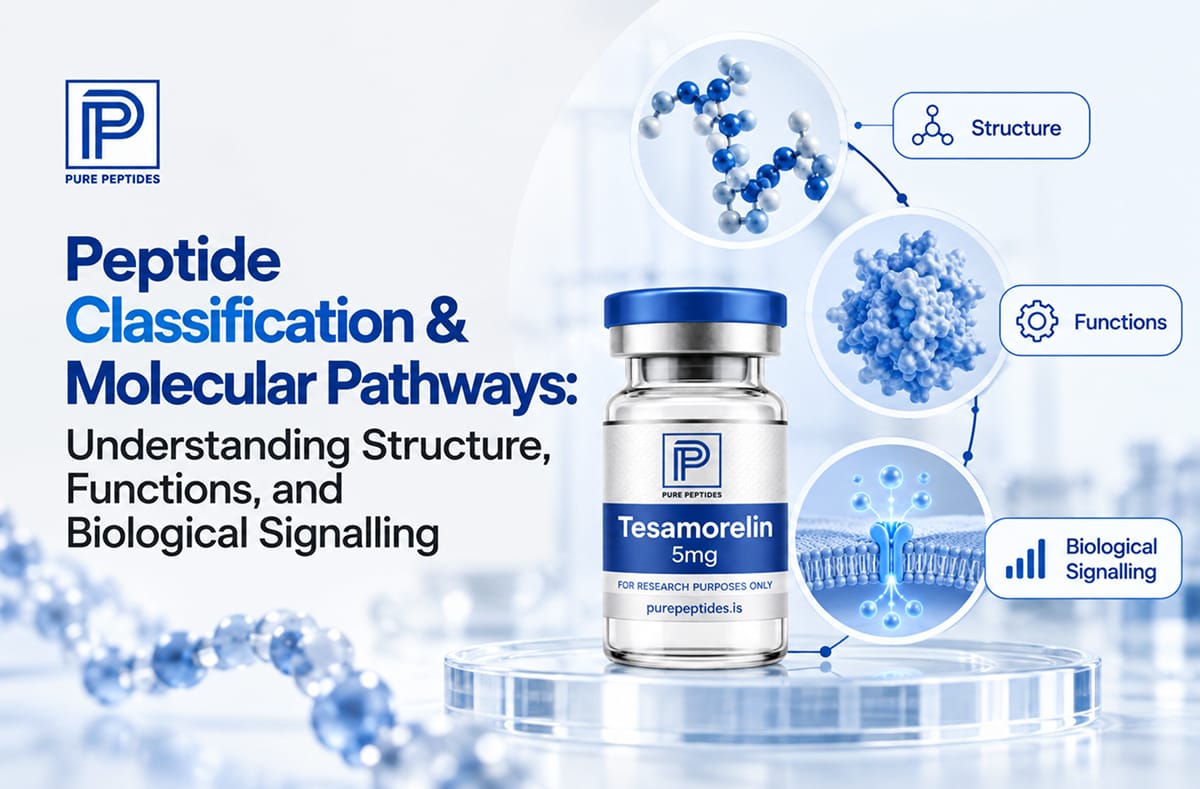
Peptide Classification & Molecular Pathways: Understanding Structure, Functions, and Biological Signalling


Peptide Classification & Molecular Pathways help researchers understand how chains of amino acids can perform different roles depending on their sequence, structure, and biological environment. Some act as signalling molecules, while others participate in metabolic, neural, immune, or membrane-related processes. Therefore, simply calling a molecule a “peptide” says little about how it behaves.
Peptide Classification & Molecular Pathways provide researchers with a framework for organizing this diversity and understanding how peptide signals operate within biological systems. Classification groups peptides by structural or functional characteristics, while pathway research examines how peptide signals are recognized and transmitted through cells. At Pure Peptides, understanding these principles can help researchers interpret research materials within a broader molecular context.
Explore quality-focused research peptides for your laboratory needs at Pure Peptides.
What Is Peptide Classification and Why Is It Important in Research?
Peptide Classification & Molecular Pathways help researchers organize molecules according to shared structural, functional, and signalling characteristics. Depending on the research objective, scientists may classify peptides by structure, biological function, source, receptor interaction, or mechanism of action.
Importantly, no single classification system applies to every peptide. Structural researchers may focus on whether a peptide is linear, cyclic, or stabilized by disulfide bonds. By contrast, molecular biologists may focus on receptor families or signalling roles.
For example, researchers commonly consider:
- Amino-acid sequence and length
- Linear or cyclic configuration
- Disulfide-bond patterns
- Secondary and three-dimensional structure
- Biological function
- Molecular target
- Signalling pathway
Therefore, classification is more than a naming system. It helps researchers compare related molecules, identify structural differences, and develop hypotheses about biological behaviour.
In Canada, scientific classification should remain separate from regulatory classification. Therefore, peptide structure alone does not determine whether a material is an authorized therapeutic product.
Explore quality-tested research peptides with clear product information and laboratory-focused standards at Pure Peptides.

How Are Peptides Classified Based on Structure and Biological Functions?
Structurally, peptides can take several forms. Linear peptides have an open amino-acid chain, whereas cyclic peptides contain a ring-like arrangement created through backbone or side-chain connections. In addition, some peptides are stabilized by disulfide bonds between cysteine residues.
| Classification Approach | Example Characteristic | Research Relevance |
|---|---|---|
| Linear peptides | Open amino-acid chain | Sequence and flexibility studies |
| Cyclic peptides | Ring-like structure | Conformational restriction |
| Disulfide-rich peptides | Cysteine-linked structure | Folding and stability |
| Helical peptides | Alpha-helical regions | Target recognition |
| Function-based peptides | Hormonal, neural, immune roles | Biological pathway studies |
| Target-based peptides | Receptor or membrane interaction | Mechanistic research |
Peptides can also be grouped by biological function. For example, peptide hormones participate in endocrine signalling, while neuropeptides contribute to communication within the nervous system. Meanwhile, certain host-defence peptides interact with microbial membranes or participate in immune processes.
However, these categories can overlap. Consequently, Peptide Classification & Molecular Pathways should be viewed as flexible research frameworks rather than rigid systems.
SEE MORE:
- Peptide Classification Explained: Types, Categories, and Research Applications
- Peptide Structure Explained: Amino Acids, Chains, and Molecular Organization
- Linear vs Cyclic Peptides: Structure, Design, and Research Applications
- Peptide Signalling Pathways: Understanding Cellular Communication and Biological Mechanisms
What Molecular Pathways Are Commonly Studied in Peptide Research?
In particular, many peptide hormones and neuropeptides interact with G protein-coupled receptors, or GPCRs, on cell membranes. After binding, these receptors can activate downstream signalling proteins.
For instance, commonly studied pathways include:
- Cyclic AMP and protein kinase A signalling
- Phospholipase C signalling
- IP3 and intracellular calcium signalling
- DAG and protein kinase C signalling
- MAPK/ERK pathways
- PI3K/Akt signalling
- Receptor-associated kinase pathways
- Beta-arrestin-associated signalling
However, not every peptide uses the same pathway. Some receptor systems primarily influence cyclic AMP, whereas others affect calcium-related or kinase signalling.
In addition, not all peptides act through GPCRs. For example, some peptide hormones interact with receptor tyrosine kinases. Other biologically active peptides may interact with membranes or non-receptor molecular targets.
Therefore, pathway classification must be linked to the specific peptide, receptor, and experimental model being studied.
How Do Peptides Interact With Receptors and Cellular Signalling Systems?
Peptide signalling often begins with molecular recognition between a peptide and a compatible target.
A simplified signalling sequence may include:
- A peptide reaches a target cell.
- The peptide binds to a compatible receptor.
- The receptor changes conformation.
- Intracellular signalling proteins become activated.
- Second messengers or kinase pathways transmit the signal.
- Downstream cellular responses develop.
- Regulatory mechanisms reduce or terminate signalling.
GPCRs provide a well-known example. These receptors span the cell membrane and can influence intracellular G proteins after ligand binding. As a result, downstream molecules may alter cyclic AMP levels, calcium concentrations, protein phosphorylation, or gene-regulatory activity.
Furthermore, receptor density, ligand concentration, cell type, signalling duration, and desensitization can all affect the final response.
Therefore, researchers should evaluate the complete experimental system rather than interpreting activity from ligand identity alone.
Explore quality-tested research peptides with clear product information and laboratory-focused standards at Pure Peptides.
Why Does Understanding Peptide Pathways Matter in Scientific Research?
Understanding molecular pathways helps researchers connect a molecular interaction with a measurable cellular response.
For example, detecting receptor binding does not automatically show what happens downstream. Conversely, observing a cellular change does not necessarily identify the receptor or pathway responsible. Therefore, pathway studies can help separate these questions.
| Research Question | Information Needed |
|---|---|
| What does the peptide bind? | Receptor or target identification |
| How strongly does it interact? | Binding and affinity studies |
| What happens after binding? | Signal-transduction analysis |
| Which pathway changes? | Second-messenger or kinase data |
| Does structure affect activity? | Structure-function studies |
| Is the response cell-specific? | Comparative cellular models |
Moreover, pathway research can explain why structurally related peptides sometimes produce different experimental results. Small sequence changes may influence receptor affinity, selectivity, stability, or signalling preference. Likewise, structural constraints may alter how a peptide approaches its target.
However, laboratory pathway findings should not be interpreted automatically as evidence of therapeutic benefit. Cellular studies, clinical evidence, and regulatory authorization represent different levels of evidence.
In Canada, products represented for therapeutic use must meet applicable regulatory requirements before authorized sale. Therefore, receptor activity or pathway data alone do not establish approval for human use.
SEE MORE:
- Peptide Receptors & Molecular Targets: Signalling Mechanisms
- GLP-1 Receptor Signalling Research: Understanding Incretin Pathways and Molecular Mechanisms
- Neuropeptide Signalling Pathways: Receptors, Functions, and Research Applications
- Research Peptides by Biological Pathway: Classification and Scientific Applications
FAQs About Peptide Classification and Molecular Pathways
What is peptide classification?
Peptide classification organizes peptides according to characteristics such as structure, sequence, biological function, molecular target, or signalling mechanism. However, the framework used depends on the research objective.
What are the main structural classes of peptides?
Researchers may describe peptides as linear, cyclic, disulfide-stabilized, helical, or according to other structural characteristics. Importantly, these categories can overlap.
What is a peptide signalling pathway?
A peptide signalling pathway describes molecular events that connect peptide recognition with downstream cellular responses. For example, receptor activation may influence cyclic AMP, calcium, protein kinases, or gene regulation.
Do all peptides bind to GPCRs?
No. Although many peptide hormones and neuropeptides signal through GPCRs, other peptides interact with receptor tyrosine kinases, membranes, or other molecular targets.
Can one peptide activate multiple signalling pathways?
Yes. Depending on the receptor and cellular environment, one peptide-receptor interaction may influence several pathways. In addition, signalling can vary between cell types.
Why does peptide structure matter for receptor binding?
Structure determines how chemical groups are presented to a target. Consequently, sequence changes or structural constraints may alter affinity, selectivity, or signalling behaviour.
Does understanding a peptide pathway prove therapeutic effectiveness?
No. Molecular pathway data can explain mechanisms in experimental systems. However, therapeutic effectiveness requires additional evidence and, where applicable, regulatory review.
Final Thoughts
Peptide classification provides researchers with a practical way to organize a diverse group of molecules. Meanwhile, molecular pathway research helps explain how peptide structure, receptor recognition, and intracellular signalling interact.
Therefore, evaluating both structure and pathway information provides more context than examining sequence or biological activity alone. Structural features can influence receptor interactions, while receptor type can determine which downstream pathways become active.
Explore quality-focused research peptides for your laboratory needs at Pure Peptides.
Ultimately, these relationships help researchers design experiments and interpret findings more carefully. For Canadian researchers, scientific classification should remain separate from regulatory authorization and claims regarding human use.
Disclaimer: This content is provided for educational and scientific research purposes only. Research peptides are intended for laboratory research only and are not intended for human consumption or medical use.

This article provides a useful framework for understanding how peptides can be classified and how their molecular pathways differ. I found the connection between peptide characteristics and biological signaling particularly helpful for putting different research areas into context.
I liked the structured approach to peptide classification. Understanding the differences between peptide groups and the pathways they may interact with makes it much easier to follow more detailed research later on.
The discussion of molecular pathways adds useful depth to the topic of peptide classification. I appreciate that the article connects basic peptide characteristics with the biological processes researchers are investigating.