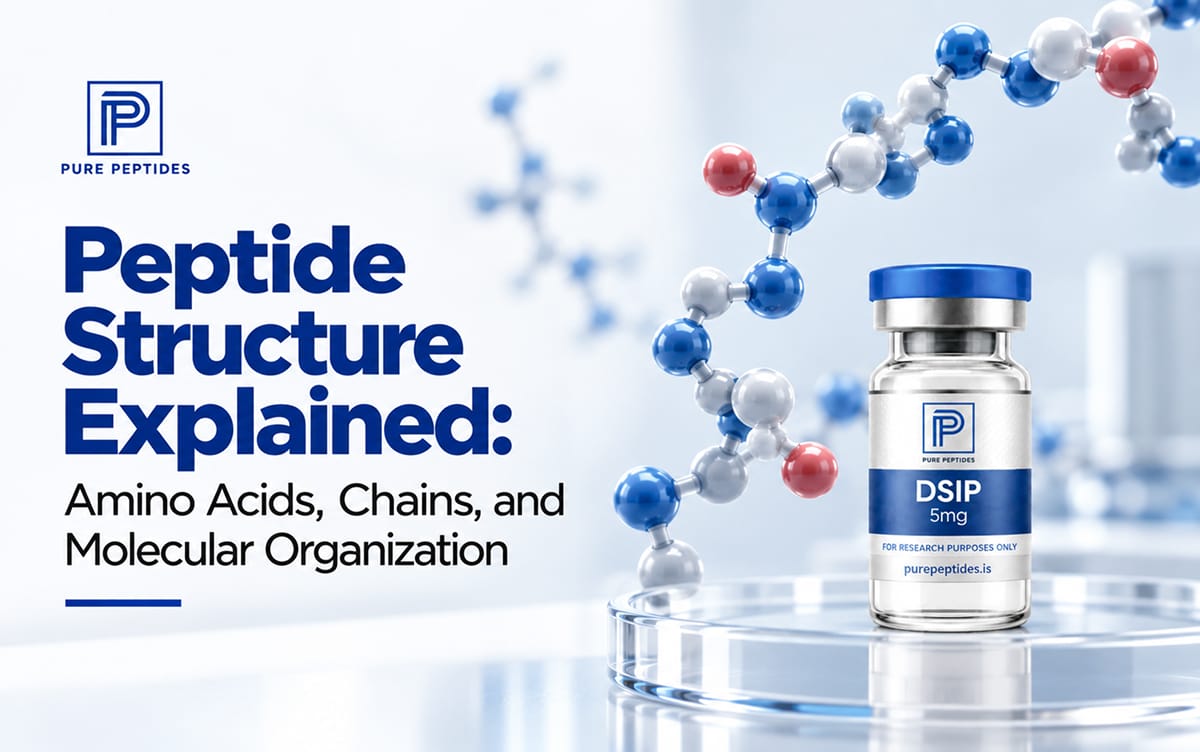
Peptide Structure Explained: Amino Acids, Chains, and Molecular Organization


Peptide Structure Explained begins with the molecular features that define a peptide: amino acids connected in an ordered chain through peptide bonds. However, sequence alone does not fully describe peptide structure. The backbone, side chains, bond geometry, charge, and three-dimensional conformation can all influence how a peptide behaves in a research environment.
Therefore, understanding peptide structure helps researchers interpret identity, stability, molecular interactions, and analytical results more effectively. At Pure Peptides, these structural principles also provide useful context when researchers compare materials for laboratory studies.
Explore quality-focused research peptides for your laboratory needs at Pure Peptides.
What Is the Basic Structure of a Peptide?
A peptide consists of amino-acid residues connected in a specific sequence. Each standard alpha-amino acid contains a central alpha carbon, an amino group, a carboxyl group, a hydrogen atom, and a variable side chain.
When amino acids join, their repeating atoms form the peptide backbone. Meanwhile, the side chains extend from that backbone and create much of the chemical diversity among peptides.
For example, researchers commonly examine:
- Amino-acid sequence
- Peptide-chain length
- Backbone organization
- Side-chain properties
- Disulfide bonds
- Cyclization
- Three-dimensional conformation
Importantly, side chains can differ in charge, polarity, size, and hydrophobicity. Consequently, two peptides of the same length may show very different molecular properties when their amino-acid sequences differ.
| Structural Feature | What It Describes | Research Relevance |
|---|---|---|
| Amino-acid sequence | Order of residues | Molecular identity |
| Backbone | Repeating chain framework | Molecular geometry |
| Side chains | Variable chemical groups | Charge and interactions |
| Disulfide bonds | Links between cysteines | Structural constraints |
| Cyclization | Ring-like organization | Conformational flexibility |
| 3D conformation | Spatial arrangement | Molecular recognition |
Therefore, Peptide Structure Explained involves more than counting amino acids. Researchers also need to consider how those residues organize within the molecule.
Explore quality-tested research peptides with clear product information and laboratory-focused standards at Pure Peptides.
How Are Amino Acids Connected to Form Peptide Chains?
Amino acids connect through peptide bonds. During bond formation, the carboxyl group of one amino acid connects with the amino group of another, creating an amide linkage between carbon and nitrogen.
As a result, a peptide chain develops directionality. Researchers call one end the N-terminus and the opposite end the C-terminus. By convention, scientists usually write peptide sequences from the N-terminus toward the C-terminus.
Importantly, a peptide bond does not behave like a completely free single bond. Electron delocalization gives the bond partial double-bond character. Consequently, atoms around the peptide bond remain relatively planar, which limits rotation.
Researchers may therefore consider several features when examining peptide-chain formation:
- Sequence order
- N-to-C direction
- Peptide-bond geometry
- Side-chain position
- Backbone flexibility
- Intramolecular interactions
However, the complete peptide chain can still change shape. Bonds beside the peptide bond allow rotational movement, so peptides can adopt different conformations.
Thus, molecular organization reflects a balance between structural restriction and flexibility. This balance becomes especially important when researchers study folding, stability, or molecular recognition.
What Is the Role of the Peptide Backbone in Molecular Structure?
The peptide backbone creates the repeating framework that runs through the molecule. Specifically, nitrogen, alpha carbon, and carbonyl carbon atoms repeat along the chain.
Because peptide bonds restrict some rotational movement, neighbouring backbone bonds provide much of the chain’s remaining flexibility. Therefore, backbone geometry strongly influences the shapes a peptide can adopt.
In addition, carbonyl and amide groups within the backbone can participate in hydrogen bonding. These interactions may help form helices, turns, or other organized structures.
Several factors can influence backbone behaviour:
- Amino-acid sequence
- Hydrogen bonding
- Side-chain interactions
- Solvent environment
- Temperature
- pH
- Cyclization
- Other structural constraints
For instance, glycine generally allows greater conformational flexibility because it has a very small side chain. By contrast, proline restricts backbone geometry because its side chain connects back to its nitrogen atom.
Moreover, environmental conditions can influence the conformation that a peptide prefers. Therefore, researchers should consider both sequence and experimental conditions when interpreting structural data.
Overall, the backbone provides the central framework, while side chains and environmental interactions help determine how that framework behaves.
How Are Peptide Structures Different From Proteins?
Peptides and proteins share the same fundamental chemistry because both contain amino acids linked through peptide bonds. However, researchers generally distinguish them by size, structural complexity, folding behaviour, and biological organization.
Peptides are usually shorter and may remain relatively flexible. Proteins, meanwhile, commonly contain longer amino-acid chains that organize into larger three-dimensional structures and functional domains.
| Characteristic | Peptides | Proteins |
|---|---|---|
| Building blocks | Amino acids | Amino acids |
| Main linkage | Peptide bonds | Peptide bonds |
| Typical length | Generally shorter | Generally longer |
| Flexibility | Often relatively flexible | Often more highly organized |
| Folding | May adopt several conformations | Often forms defined domains |
| Structural complexity | Usually lower | Usually higher |
Nevertheless, scientists do not use one universal amino-acid cutoff to separate every peptide from every protein. Some shorter polypeptides form stable three-dimensional structures, while certain regions within proteins remain highly flexible.
Therefore, researchers should consider molecular organization rather than relying only on chain length.
In Canada, scientific terminology also differs from regulatory classification. Regulatory authorities consider multiple factors when determining how a peptide product fits within an applicable framework. Consequently, researchers should not use molecular size or structural category alone to infer regulatory status.
Explore quality-tested research peptides with clear product information and laboratory-focused standards at Pure Peptides.
Why Is Peptide Structure Important in Research Studies?
Peptide structure influences many aspects of laboratory characterization. First, sequence establishes primary molecular identity. Next, side-chain chemistry influences charge, hydrophobicity, solubility, and intermolecular interactions. Finally, molecular conformation can influence how a peptide approaches a receptor, enzyme, membrane, or other target.
For this reason, researchers may use structural information to investigate questions such as:
- Does the material match the intended sequence?
- Does molecular mass match expectations?
- Are disulfide bonds present?
- Does cyclization limit flexibility?
- Could sequence influence chromatographic behaviour?
- Could structural changes affect stability?
- Does conformation influence molecular recognition?
Moreover, researchers can combine several analytical approaches depending on the scientific objective. For example, mass spectrometry can provide molecular-mass information, while chromatography can help separate components within a sample. In addition, spectroscopic and computational methods can provide further structural context.
However, no single analytical method describes every aspect of molecular organization. Likewise, structural information alone cannot establish a biological effect. Researchers still need appropriate experimental evidence when studying binding, signalling, or functional activity.
This distinction also matters in Canada. Regulatory requirements for therapeutic peptide products remain separate from laboratory structural characterization. Therefore, research findings alone do not establish authorization for human use.
For quality-focused research materials and clear laboratory product information, explore the available selection at Pure Peptides.
Explore how peptide structure connects with biological function and signalling in Peptide Classification & Molecular Pathways: Understanding Structure, Functions, and Biological Signalling.
FAQs About Peptide Structure
What is the basic structure of a peptide?
A peptide contains amino-acid residues joined by peptide bonds. Together, repeating backbone atoms form the main chain, while side chains provide different chemical properties.
What is a peptide bond?
A peptide bond is an amide linkage between the carbonyl carbon of one amino-acid residue and the nitrogen of the next. Importantly, electron delocalization gives this bond partial double-bond character, which limits rotation and contributes to planarity.
What are the N-terminus and C-terminus?
The N-terminus represents one end of a peptide chain, while the C-terminus represents the opposite end. Scientists typically write peptide sequences from N to C.
Can two peptides have the same length but different structures?
Yes. Different amino-acid sequences create different side-chain arrangements, charge distributions, interaction patterns, and conformational preferences. Therefore, chain length alone cannot define molecular structure.
Are peptides always folded into one shape?
No. Some peptides prefer particular conformations, whereas others remain flexible and sample multiple states. Moreover, pH, temperature, solvent conditions, and molecular interactions can affect conformation.
How are peptides different from proteins?
Both contain amino acids joined through peptide bonds. However, peptides are generally shorter and often less structurally complex, while proteins commonly form larger organized structures.
Why is peptide structure important in research?
Structure can influence identity, molecular mass, stability, solubility, chromatographic behaviour, and molecular interactions. Therefore, structural analysis provides useful context for laboratory characterization.
Final Thoughts
Overall, Peptide Structure Explained provides a foundation for understanding how amino-acid sequence, peptide bonds, backbone geometry, side chains, and three-dimensional organization work together.
Although peptides share a common backbone, their sequences and structural constraints create substantial molecular diversity. Therefore, researchers should evaluate several structural characteristics rather than relying only on peptide length or name.
Explore quality-focused research peptides for your laboratory needs at Pure Peptides.
Ultimately, understanding peptide structure supports stronger analytical interpretation and experimental design. For Canadian researchers, however, molecular characterization should remain separate from regulatory authorization and claims regarding human use.
Disclaimer: This content is provided for educational and scientific research purposes only. Research peptides are intended for laboratory research only and are not intended for human consumption or medical use.
This is a clear introduction to peptide structure, especially for readers who are still learning how amino acids form peptide chains. I found the explanation of the structural levels helpful for understanding why different peptides can have such distinct characteristics.
I appreciate how the article breaks down the basic components of peptide structure in an easy-to-follow way. Understanding amino acid sequences and peptide bonds provides a useful foundation for exploring peptide chemistry and research in greater detail.
A useful resource for anyone new to peptide science. The connection between molecular structure and peptide properties is explained in a straightforward way, making the topic easier to understand before moving into more advanced research concepts.