
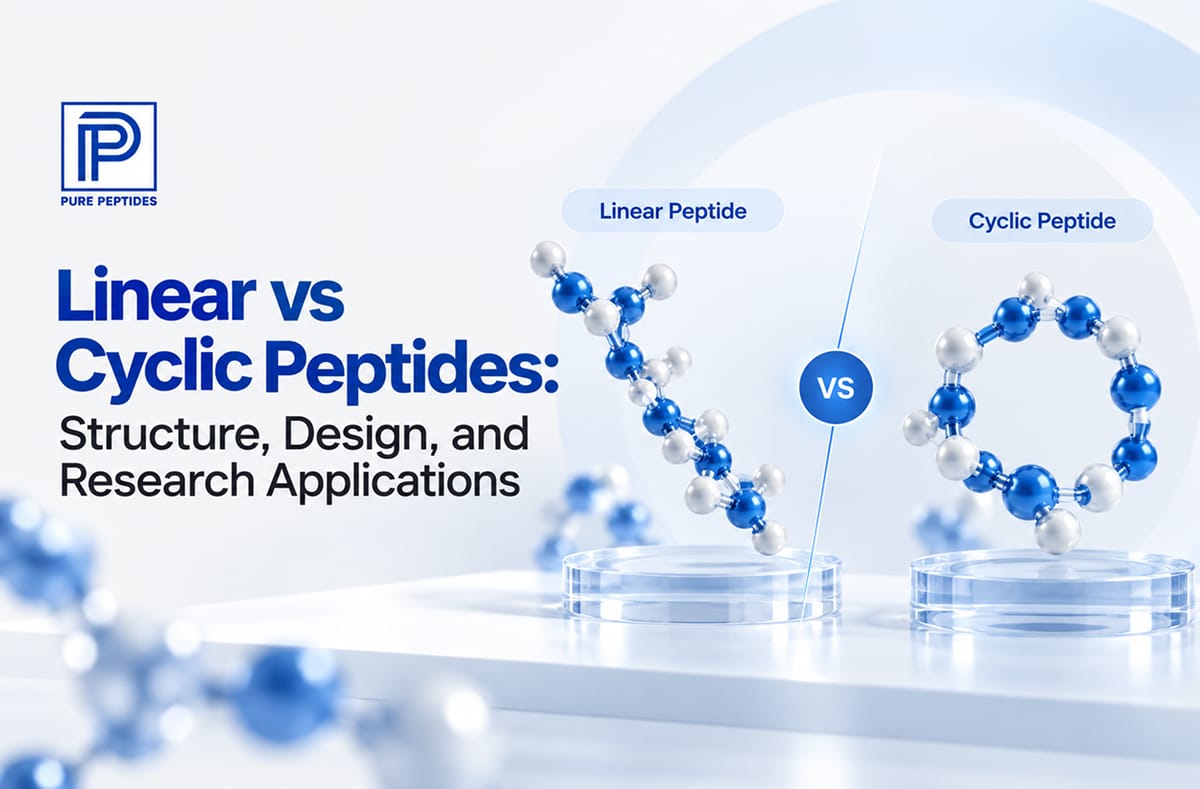
Linear vs Cyclic Peptides: Structure, Design, and Research Applications


Linear vs Cyclic Peptides describes two structural formats that researchers commonly compare when studying peptide chemistry. Linear peptides contain an open amino-acid chain, whereas cyclic peptides contain a covalent connection that creates a ring or constrained region. Therefore, even when two peptides contain similar amino acids, their molecular organization can influence flexibility, stability, target recognition, and analytical behaviour.
At Pure Peptides, understanding these structural differences can help researchers compare research materials more carefully. However, structure alone does not determine biological activity, research suitability, or regulatory status.
Explore quality-focused research peptides for your laboratory needs at Pure Peptides.
What Are Linear and Cyclic Peptides?
In general, linear peptides consist of amino-acid residues connected through peptide bonds in an open chain. Generally, the chain contains distinct N- and C-termini unless researchers chemically modify them.
Cyclic peptides, by contrast, contain an intramolecular connection that creates a ring. Depending on the molecule, researchers may encounter backbone cyclization, side-chain connections, or disulfide-linked loops.
For example, researchers may compare:
- Backbone organization
- N- and C-terminal structure
- Ring size
- Amino-acid sequence
- Side-chain chemistry
- Disulfide connectivity
- Conformational flexibility
- Molecular mass
| Structural Feature | Linear Peptides | Cyclic Peptides |
|---|---|---|
| Chain organization | Open chain | Ring or constrained region |
| Termini | Usually distinct N- and C-termini | May remain free or form part of the ring |
| Flexibility | Often greater | Often more restricted |
| Conformation | May sample many states | May favour fewer states |
| Stability | Sequence-dependent | May increase in some designs |
| Design | Generally simpler | Requires a cyclization strategy |
Therefore, Linear vs Cyclic Peptides research involves more than comparing molecular shapes. Instead, researchers examine how structural constraints influence peptide behaviour.
Explore quality-tested research peptides with clear product information and laboratory-focused standards at Pure Peptides.

How Does Cyclic Peptide Structure Differ From Linear Peptides?
The primary difference involves conformational freedom. Linear peptides can rotate around several backbone bonds and may therefore explore multiple molecular conformations.
In contrast, cyclization restricts some of this movement. As a result, a cyclic peptide may favour a narrower range of conformations and present its side chains differently to molecular targets.
However, cyclization does not make every peptide rigid. Ring size, amino-acid sequence, linkage position, and side-chain interactions still influence flexibility.
Researchers commonly study several cyclization approaches:
- Head-to-tail cyclization connects the N-terminus with the C-terminus.
- Side-chain cyclization connects functional groups on selected residues.
- Head-to-side-chain cyclization connects a terminal group with a side chain.
- Disulfide cyclization connects cysteine residues through a disulfide bond.
Furthermore, some peptides contain several loops or disulfide bonds. Consequently, cyclic structures can range from moderately constrained molecules to highly organized systems.
Therefore, researchers should describe the actual cyclization pattern rather than treating “cyclic peptide” as a complete structural description.
Why Are Cyclic Peptides Studied in Molecular Research?
Researchers study cyclic peptides because conformational restriction can influence several experimentally relevant properties.
For example, a constrained structure may change how a peptide approaches a receptor, enzyme, protein surface, or other molecular target. In addition, reducing conformational freedom can influence the energetic requirements associated with molecular recognition.
Cyclization may also reduce access to peptide termini in some designs. Consequently, certain cyclic structures can show increased resistance to particular proteolytic processes compared with related linear peptides.
Researchers frequently examine cyclic peptides in:
- Structure-activity relationship studies
- Receptor-binding research
- Enzyme-interaction studies
- Protein-protein interaction research
- Conformational studies
- Membrane-interaction research
- Stability and degradation testing
Moreover, comparing linear and cyclic versions can help researchers investigate whether molecular conformation contributes to an observed result.
However, cyclic structure does not automatically produce stronger binding, greater stability, or improved biological activity. Researchers still need experimental data for the specific sequence and system.
What Factors Influence Cyclic Peptide Design and Stability?
Several variables can influence cyclic peptide behaviour. First, ring size affects how much flexibility remains after cyclization. A small ring may create substantial structural strain, whereas a larger ring may retain more conformational freedom.
Second, researchers must consider where the cyclization occurs. A linkage may stabilize a useful conformation, but another position could interfere with molecular recognition.
| Design Factor | Research Importance |
|---|---|
| Ring size | Influences strain and flexibility |
| Cyclization position | Changes molecular organization |
| Amino-acid sequence | Determines local chemistry |
| Linkage type | Influences geometry |
| Disulfide pattern | Affects cysteine-rich structures |
| pH | Influences ionization and some degradation pathways |
| Temperature | Can influence chemical stability |
| Oxidative conditions | May affect susceptible residues |
In addition, cyclic peptides can still undergo chemical degradation. Depending on the sequence and environment, researchers may investigate oxidation, hydrolysis, deamidation, disulfide exchange, or other molecular changes.
Therefore, researchers should not use “cyclic” as a synonym for “stable.” Instead, they need peptide-specific analytical information to determine stability under defined research conditions.
Explore quality-tested research peptides with clear product information and laboratory-focused standards at Pure Peptides.

How Are Linear and Cyclic Peptides Compared in Research?
A meaningful comparison requires researchers to control more than molecular shape. For instance, sequence, concentration, assay conditions, sample handling, and analytical methods can all influence experimental results.
For instance, researchers may compare linear and cyclic peptides by evaluating:
- Chromatographic purity
- Molecular mass
- Conformational behaviour
- Degradation patterns
- Target-binding characteristics
- Solubility
- Response in a defined experimental assay
| Research Question | Useful Approach |
|---|---|
| Does cyclization restrict flexibility? | Structural or conformational analysis |
| Does stability change? | Controlled degradation testing |
| Does target recognition change? | Binding studies |
| Does mass match the expected structure? | Mass analysis |
| Are additional components present? | Chromatographic analysis |
| Does experimental activity change? | Controlled functional assay |
Importantly, researchers should not assume that the cyclic version represents the “better” peptide. Greater flexibility may help a linear sequence interact with a particular target. Conversely, a cyclic analogue may hold important residues in a more favourable arrangement.
Therefore, Linear vs Cyclic Peptides comparisons work best when researchers define the specific property they want to investigate before interpreting the results.
In Canadian research settings, structural classification also remains separate from regulatory authorization. Consequently, a linear or cyclic structure does not establish whether a peptide has approval for therapeutic or human use.
Explore quality-focused research peptides and clear laboratory product information at Pure Peptides.
Explore how peptide structure connects with biological function and signalling in Peptide Classification & Molecular Pathways: Understanding Structure, Functions, and Biological Signalling.
FAQs About Linear and Cyclic Peptides
What is the main difference between linear and cyclic peptides?
Linear peptides contain an open amino-acid chain. In contrast, cyclic peptides contain a covalent connection that creates a ring or constrained region within the molecule.
Are cyclic peptides always more stable than linear peptides?
No. Cyclization can increase stability in certain systems by restricting conformation or reducing access to susceptible regions. However, sequence, linkage chemistry, environment, and specific degradation pathways also influence stability.
Do cyclic peptides always bind more strongly to molecular targets?
No. Cyclization can increase, decrease, or have little effect on binding. Therefore, researchers need direct experimental evidence for each peptide-target system.
What is head-to-tail cyclization?
Head-to-tail cyclization connects the N-terminus with the C-terminus. As a result, the peptide forms a continuous cyclic backbone without free terminal ends in the main ring.
Can disulfide bonds create cyclic peptide structures?
Yes. A disulfide bond between cysteine residues can create a loop and restrict peptide conformation. Moreover, some peptides contain multiple disulfide bonds that create more complex structures.
Why do researchers compare linear and cyclic versions of peptides?
Researchers can use these comparisons to study how conformational restriction affects stability, target recognition, degradation, molecular flexibility, or experimental activity.
Does a cyclic structure mean a peptide is approved for human use in Canada?
No. Molecular structure and regulatory authorization represent separate considerations. Therefore, research findings or cyclic design alone do not establish authorization for therapeutic use.
Final Thoughts
Overall, Linear vs Cyclic Peptides research helps scientists examine how molecular organization influences flexibility, stability, target recognition, and experimental behaviour.
Linear peptides retain an open chain and often greater conformational freedom. Cyclic peptides, meanwhile, introduce structural constraints through specific covalent connections. However, neither format is universally superior.
Therefore, researchers should consider sequence, ring design, linkage chemistry, environmental conditions, and the specific experimental objective when comparing these structures.
Explore quality-focused research peptides for your laboratory needs at Pure Peptides.
Ultimately, careful structural and analytical comparison provides stronger information than assumptions based on peptide shape alone. For Canadian researchers, scientific classification should also remain separate from regulatory authorization and human-use claims.
Disclaimer: This content is provided for educational and scientific research purposes only. Research peptides are intended for laboratory research only and are not intended for human consumption or medical use.