GLP-1 Receptor Signalling Research: Understanding Incretin Pathways and Molecular Mechanisms


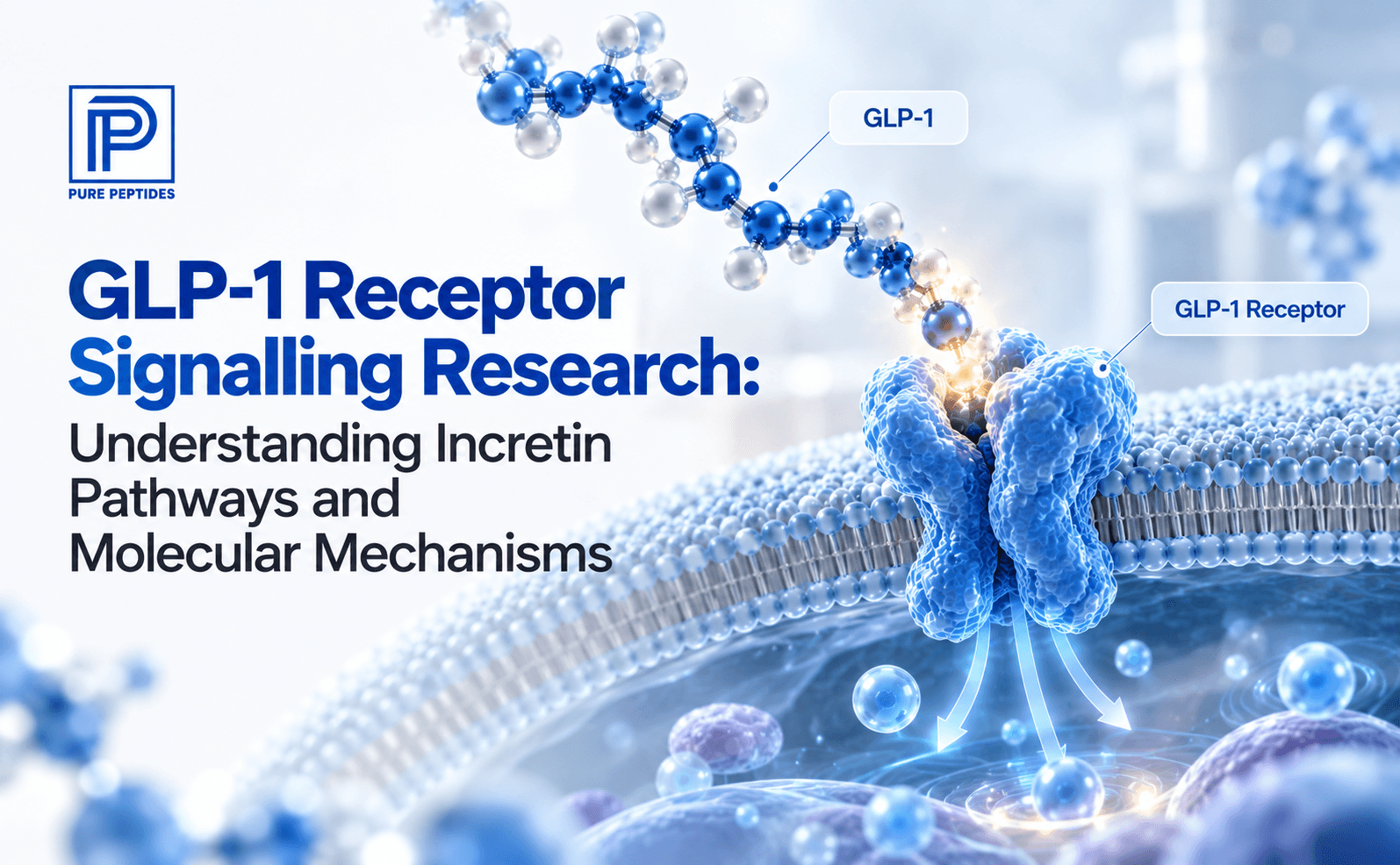
GLP-1 Receptor Signalling is an important research area for understanding how peptide signals influence cellular communication, metabolic regulation, and receptor-mediated pathways. Glucagon-like peptide-1, commonly called GLP-1, interacts with the GLP-1 receptor (GLP-1R), a class B G protein-coupled receptor. Consequently, receptor activation can initiate intracellular signalling events involving cyclic AMP, protein kinases, ion channels, and other regulatory proteins.
At TrueNovaLabs, understanding these molecular mechanisms provides useful context for researchers studying incretin biology and peptide signalling. However, receptor activity observed in laboratory systems should remain separate from clinical conclusions or claims about human use.
Explore quality-focused research peptides for your laboratory needs at Pure Peptides.
What Is GLP-1 Receptor Signalling?
GLP-1 receptor signalling describes the molecular events that occur after GLP-1 or another compatible ligand interacts with GLP-1R.
In general, GLP-1R belongs to the class B1 family of GPCRs. After ligand binding, the receptor commonly couples to stimulatory G proteins, particularly Gs. As a result, Gs can activate adenylyl cyclase, which increases intracellular cyclic AMP, or cAMP.
Researchers may then observe several downstream events:
- Activation of protein kinase A, or PKA
- Activation of cAMP-regulated exchange proteins such as Epac
- Changes in ion-channel activity
- Modulation of intracellular calcium
- Changes in vesicle-associated processes
- Receptor internalization and recycling
- Activation of additional kinase pathways
| Signalling Component | Main Research Role |
|---|---|
| GLP-1 or related ligand | Initiates receptor interaction |
| GLP-1 receptor | Recognizes the peptide signal |
| Gs protein | Connects receptor activation with intracellular signalling |
| Adenylyl cyclase | Generates cAMP |
| cAMP | Functions as an intracellular second messenger |
| PKA / Epac | Mediates downstream signalling |
| Calcium-related mechanisms | Contribute to cellular responses |
Therefore, GLP-1 Receptor Signalling involves a network rather than one isolated biochemical reaction.
Explore quality-tested research peptides with clear product information and laboratory-focused standards at Pure Peptides.
How Does GLP-1 Interact With Its Receptor Pathway?
GLP-1 first interacts with the extracellular region and transmembrane binding environment of GLP-1R. Subsequently, ligand binding promotes conformational changes that allow the receptor to communicate with intracellular signalling proteins.
A simplified GLP-1R pathway may involve:
- GLP-1 approaches the receptor.
- The peptide interacts with GLP-1R.
- The receptor changes conformation.
- Gs proteins become activated.
- Adenylyl cyclase increases cAMP production.
- PKA, Epac, and related pathways respond.
- Cellular signalling changes occur.
- Regulatory processes reduce or reorganize receptor activity.
Importantly, receptor activation does not produce an identical response in every experimental system. For example, receptor density, ligand concentration, cell type, exposure duration, and downstream protein expression can all change the measured outcome.
In pancreatic beta-cell research, GLP-1R signalling is especially well studied because cAMP-related mechanisms can amplify glucose-dependent insulin secretory processes. However, researchers should preserve the glucose-dependent context when interpreting these findings rather than treating receptor activation as an isolated insulin-release mechanism.
Furthermore, GLP-1R can undergo internalization after activation. Therefore, researchers also study receptor trafficking, recycling, and desensitization when examining longer signalling periods.
What Role Do Incretin Pathways Play in Peptide Research?
Incretins are gut-derived signals associated with nutrient-responsive endocrine communication. The two major incretin hormones commonly studied are GLP-1 and glucose-dependent insulinotropic polypeptide, or GIP.
After nutrient intake, intestinal endocrine cells release these signals. Consequently, researchers study how incretin receptors connect nutrient sensing with downstream cellular pathways.
Incretin research commonly examines:
- GLP-1 receptor signalling
- GIP receptor signalling
- Glucose-dependent cellular responses
- cAMP generation
- Receptor selectivity
- Receptor trafficking
- Combined receptor activation
- Structure-activity relationships
Moreover, GLP-1 and GIP receptors belong to related class B GPCR families but maintain distinct ligand-recognition characteristics.
For this reason, researchers increasingly compare single-receptor signalling with systems that engage more than one incretin-related receptor. Such studies can help clarify receptor selectivity, pathway integration, and differences between molecular designs.
Nevertheless, incretin biology extends beyond a single assay endpoint. Researchers must consider receptor expression, tissue context, ligand concentration, and experimental model before drawing broader conclusions.
How Are GLP-1 Related Signalling Mechanisms Studied?
Researchers use several complementary methods because one experiment cannot describe every part of the GLP-1 receptor pathway.
For instance, binding studies can examine ligand-receptor interactions. Meanwhile, cell-based signalling assays can measure downstream cAMP production or other functional responses.
Common research approaches include:
| Research Method | What It Can Examine |
|---|---|
| Receptor-binding assays | Ligand interaction and affinity |
| cAMP assays | Gs-associated signalling |
| Concentration-response studies | Relationship between ligand level and response |
| Calcium measurements | Intracellular ion-related changes |
| Beta-arrestin assays | Regulatory signalling and receptor behaviour |
| Internalization assays | Receptor trafficking after activation |
| Mutational studies | Contribution of specific receptor residues |
| Structural analysis | Ligand-receptor organization |
In addition, structural methods can help researchers visualize how peptide ligands interact with receptor regions. Mutational experiments can then test whether particular amino acids contribute to binding or activation.
However, binding affinity and functional potency describe different properties. A ligand may bind strongly without producing the same signalling profile as another ligand.
Therefore, researchers often combine binding, signalling, structural, and cellular evidence before proposing a molecular mechanism.
Explore quality-tested research peptides with clear product information and laboratory-focused standards at Pure Peptides.

What Are the Current Research Questions Around GLP-1 Pathways?
Modern GLP-1 research increasingly focuses on how the receptor signals, not simply whether activation occurs.
One important question involves signalling bias. Different ligands may stabilize different receptor conformations and, therefore, favour particular intracellular responses. Researchers continue to investigate how G protein signalling, beta-arrestin recruitment, and receptor trafficking relate to these differences.
Another research area involves receptor internalization. After activation, cells may move GLP-1 receptors away from the cell surface. Subsequently, receptors may recycle, remain intracellular, or follow other trafficking routes.
Researchers are also examining:
- How ligand structure influences receptor conformation
- Why signalling differs among experimental cell models
- How receptor density changes measured responses
- How long signalling persists after ligand exposure
- How GLP-1 and GIP pathways interact
- How multi-receptor peptide designs alter signalling profiles
- How laboratory observations translate across biological models
Furthermore, species differences can complicate interpretation. Therefore, researchers should confirm that receptor sequence, expression patterns, and experimental conditions match the scientific question.
For Canadian research settings, molecular studies and therapeutic authorization also represent separate considerations. Health products intended for therapeutic use fall under applicable Canadian regulatory requirements. Consequently, laboratory evidence about GLP-1 Receptor Signalling does not independently establish authorization, clinical efficacy, or suitability for human use.
Explore research-focused peptide information and laboratory-oriented resources at TrueNovaLabs.
Explore how peptide structure connects with biological function and signalling in Peptide Classification & Molecular Pathways: Understanding Structure, Functions, and Biological Signalling.
FAQs About GLP-1 Receptor Signalling Research
What is GLP-1 receptor signalling?
GLP-1 receptor signalling describes the molecular events that follow interaction between a compatible ligand and GLP-1R. Typically, these events include G protein activation, cAMP production, and downstream cellular signalling.
What type of receptor is GLP-1R?
GLP-1R is a class B1 G protein-coupled receptor. In particular, researchers commonly study its coupling to Gs proteins and subsequent cAMP signalling.
What is the role of cAMP in GLP-1 signalling?
cAMP acts as an intracellular second messenger. As a result, it can regulate proteins such as PKA and Epac and contribute to downstream cellular responses.
Are GLP-1 and GIP the same peptide?
No. GLP-1 and GIP are distinct incretin hormones with different receptors. However, researchers often study both because their pathways participate in nutrient-responsive endocrine signalling.
Does GLP-1R only signal through cAMP?
No. Although Gs-cAMP signalling represents a major pathway, researchers also investigate calcium-related mechanisms, kinase networks, beta-arrestin recruitment, and receptor trafficking.
Why do researchers study GLP-1 receptor internalization?
Internalization can influence how long receptors remain available at the cell surface and how signalling changes over time. Therefore, receptor trafficking provides important information about pathway regulation.
Does laboratory GLP-1 receptor activity prove therapeutic effectiveness?
No. Laboratory signalling results describe molecular responses under defined experimental conditions. Clinical effectiveness requires separate evidence and regulatory assessment.
Final Thoughts
Overall, GLP-1 Receptor Signalling provides a detailed model for studying how peptide-receptor interactions become intracellular biological signals. Ligand binding can activate G proteins, increase cAMP, influence downstream regulatory proteins, and alter receptor trafficking.
Furthermore, current research examines signalling bias, receptor internalization, incretin pathway integration, and differences between experimental models. Therefore, researchers should evaluate multiple molecular endpoints instead of relying on a single assay.
Explore quality-focused research peptides for your laboratory needs at Pure Peptides.
Ultimately, understanding GLP-1 pathways can support deeper investigation of incretin biology and receptor signalling. For Canadian research contexts, however, experimental findings should remain clearly separate from therapeutic claims and regulatory authorization.
Disclaimer: This content is provided for educational and scientific research purposes only. Research peptides are intended for laboratory research only and are not intended for human consumption or medical use.