Peptide Receptors & Molecular Targets: Signalling Mechanisms


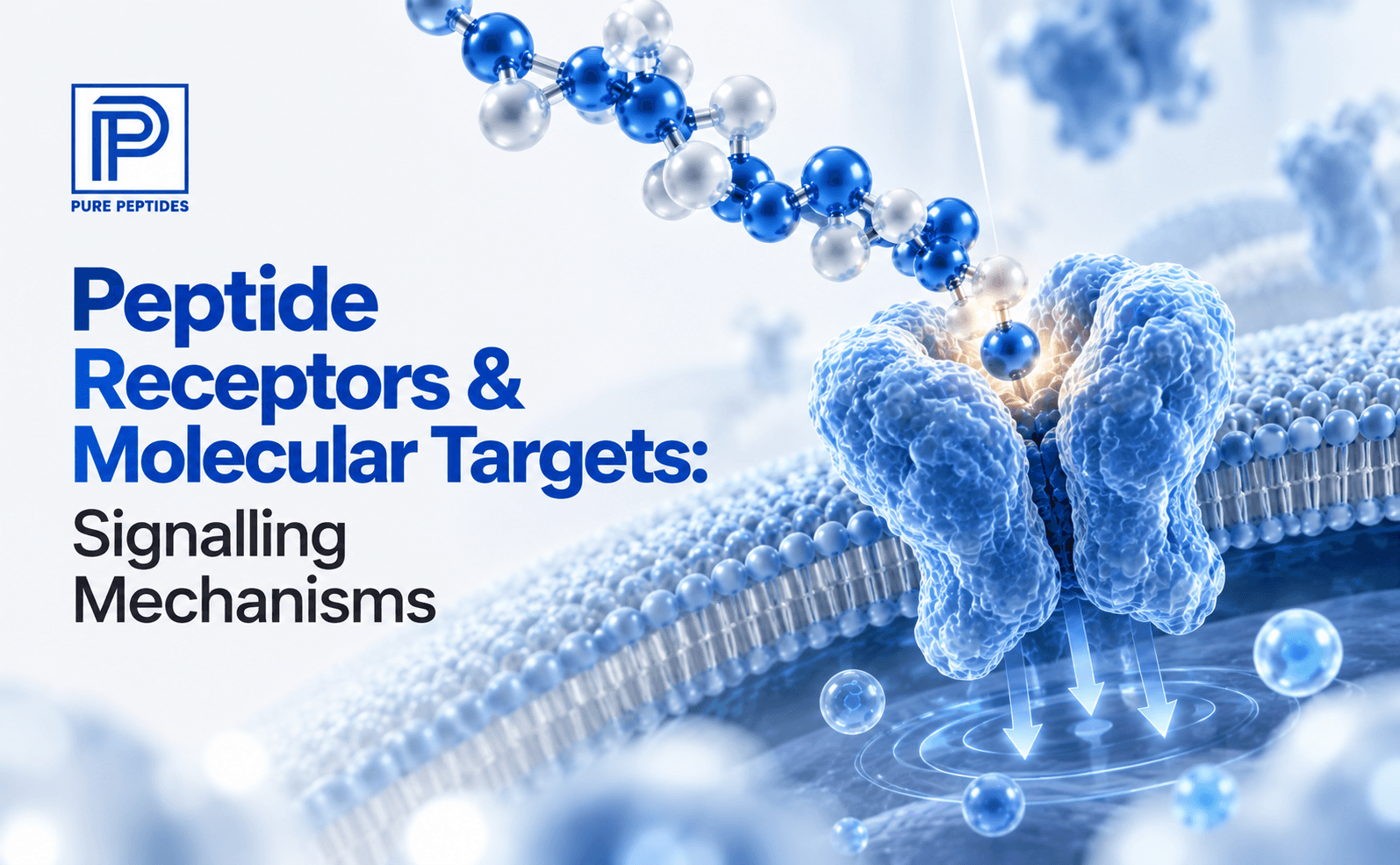
Peptide Receptors & Molecular Targets help researchers understand how peptide molecules recognize specific biological components and influence cellular signalling. In many systems, a peptide acts as a ligand that interacts with a receptor or another molecular target. Therefore, identifying the target represents an important step toward explaining how a peptide produces a measurable response in an experimental model.
At Pure Peptides, understanding receptor interactions provides useful scientific context when researchers compare peptide structure, signalling mechanisms, and laboratory findings. However, receptor binding alone does not establish biological effectiveness or suitability for human use.
Explore quality-focused research peptides for your laboratory needs at Pure Peptides.
What Are Peptide Receptors and How Do They Work?
Peptide receptors are proteins that recognize particular peptide molecules and help cells respond to extracellular signals. In many cases, these receptors sit within the cell membrane and connect an extracellular peptide signal with intracellular signalling machinery.
Typically, receptor-mediated signalling involves several stages:
- A peptide approaches a compatible receptor.
- Molecular recognition allows the peptide to bind.
- Binding changes the receptor’s molecular state or conformation.
- The receptor activates intracellular signalling components.
- Downstream pathways generate measurable cellular responses.
- Regulatory processes reduce or terminate the signal.
Importantly, peptide receptors do not simply act as passive docking sites. Instead, their structure helps determine which ligands they recognize and how they transmit information.
Researchers commonly examine:
- Ligand-receptor binding
- Binding affinity
- Receptor selectivity
- Receptor activation
- Intracellular signalling
- Receptor internalization
- Desensitization
| Receptor Feature | What Researchers Examine |
|---|---|
| Ligand recognition | Which peptide interacts with the receptor |
| Affinity | Strength of peptide-receptor interaction |
| Selectivity | Preference for one ligand over another |
| Activation | Changes following ligand binding |
| Internalization | Movement of receptors after activation |
| Desensitization | Reduction in signalling over time |
Therefore, Peptide Receptors & Molecular Targets research connects molecular recognition with downstream cellular mechanisms.
Explore quality-tested research peptides with clear product information and laboratory-focused standards at Pure Peptides.
How Do Peptides Interact With Specific Molecular Targets?
Peptide-target interactions depend on molecular compatibility. For example, amino-acid side chains may form hydrogen bonds, ionic interactions, hydrophobic contacts, or other non-covalent interactions with a target.
As a result, even small changes in peptide sequence can alter how strongly a peptide interacts with a receptor or other molecule.
Researchers may study targets such as:
- Cell-surface receptors
- Enzymes
- Transport-related proteins
- Membrane components
- Intracellular proteins
- Protein-protein interaction surfaces
However, the presence of a potential binding site does not guarantee strong or selective interaction. Molecular conformation also matters because a peptide must present key residues in an arrangement compatible with the target.
For instance, cyclization or other structural constraints can change peptide flexibility. Consequently, these changes may alter target recognition without changing the overall number of amino acids.
Moreover, experimental conditions can influence binding measurements. Temperature, pH, receptor density, peptide concentration, and assay design may all affect observed results.
Therefore, researchers should interpret target interaction data within the conditions used to generate them.
What Role Do GPCRs Play in Peptide Signalling?
G protein-coupled receptors, or GPCRs, represent a major receptor family in peptide signalling research. These membrane proteins contain seven transmembrane regions and respond to many types of extracellular signals, including numerous peptide hormones and neuropeptides.
When a compatible peptide interacts with a GPCR, receptor conformation can change. Subsequently, the receptor can influence intracellular G proteins and related signalling components.
For example, researchers commonly investigate pathways involving:
| Signalling Route | Common Research Focus |
|---|---|
| cAMP/PKA | Cyclic AMP and protein kinase activity |
| PLC/IP3 | Phospholipase C and IP3 signalling |
| Calcium | Intracellular calcium changes |
| DAG/PKC | Protein kinase C activation |
| MAPK/ERK | Downstream kinase signalling |
| Beta-arrestin | Receptor regulation and signalling |
However, GPCR signalling is not always linear. One receptor may influence several downstream pathways, while different ligands may produce different signalling patterns through the same receptor.
In addition, receptor internalization and desensitization can change cellular responses over time. Therefore, researchers may examine both the initial activation and later regulatory events.
Not every peptide acts through a GPCR. Some peptides interact with receptor tyrosine kinases, enzymes, membrane structures, or other molecular systems. Consequently, Peptide Receptors & Molecular Targets research requires target-specific analysis rather than assuming one universal mechanism.
How Are Peptide-Receptor Interactions Studied?
Researchers use several complementary methods to investigate peptide-receptor interactions. First, binding experiments can determine whether a peptide interacts with a target. Next, functional assays can examine whether that interaction changes intracellular activity.
For instance, researchers may use:
- Binding assays
- Competition assays
- Concentration-response studies
- cAMP measurements
- Calcium-flux assays
- Protein phosphorylation analysis
- Receptor internalization studies
- Cell-based functional assays
Binding affinity provides one important measurement. However, strong binding does not necessarily mean strong receptor activation. A ligand may interact with a receptor without producing the same signalling response as another ligand.
Therefore, researchers often distinguish between affinity and functional activity.
Similarly, a concentration-response experiment can show how the measured response changes as peptide concentration changes. Nevertheless, researchers must interpret these results alongside receptor expression and assay conditions.
In addition, comparative experiments can examine structurally related peptides. Researchers may alter one or more amino acids and then determine whether receptor recognition, affinity, or signalling changes.
As a result, peptide-receptor studies can contribute to structure-activity relationship research and help identify molecular features associated with specific interactions.
Explore quality-tested research peptides with clear product information and laboratory-focused standards at Pure Peptides.

Why Are Receptors Important in Understanding Peptide Functions?
Receptors provide a molecular connection between peptide structure and cellular response. Without identifying the target, researchers may observe a biological change without understanding the mechanism behind it.
For this reason, receptor studies help answer several distinct questions:
| Research Question | Relevant Evidence |
|---|---|
| What does the peptide interact with? | Target-identification studies |
| How strongly does it bind? | Affinity measurements |
| Does binding activate the receptor? | Functional assays |
| Which pathway follows activation? | Signalling measurements |
| Does structure alter interaction? | Structure-activity studies |
| Does response vary by cell type? | Comparative cellular models |
Furthermore, target identification can help researchers distinguish direct effects from downstream observations. For example, a cellular change may result from receptor activation, secondary signalling, or another indirect mechanism.
Therefore, researchers need several types of evidence before assigning a specific mechanism.
Understanding Peptide Receptors & Molecular Targets also helps researchers compare related peptides. Small structural differences may change receptor selectivity or signalling behaviour. Likewise, the same peptide may produce different results when researchers use cell models with different receptor expression levels.
However, molecular activity should remain separate from therapeutic claims. Laboratory receptor data describe responses under defined experimental conditions and do not independently establish clinical effectiveness.
For Canadian research settings, scientific evidence about receptor activity should also remain separate from regulatory authorization for therapeutic products.
Explore quality-focused research peptides and clear laboratory product information at Pure Peptides.
Explore how peptide structure connects with biological function and signalling in Peptide Classification & Molecular Pathways: Understanding Structure, Functions, and Biological Signalling.
FAQs About Peptide Receptors
What is a peptide receptor?
A peptide receptor is a protein that recognizes a compatible peptide ligand and can transmit information into a cell or influence another biological process.
Do all peptides bind to receptors?
No. Although many signalling peptides interact with receptors, other peptides may interact with enzymes, membranes, transport proteins, or other molecular targets.
What is receptor affinity?
Receptor affinity describes the strength of interaction between a ligand and receptor under defined experimental conditions. However, affinity does not directly indicate how strongly the receptor activates downstream signalling.
What are GPCRs?
GPCRs are membrane receptors with seven transmembrane regions. Many peptide hormones and neuropeptides interact with GPCRs to influence intracellular signalling pathways.
Can one peptide interact with more than one receptor?
Yes. Depending on its structure and receptor family, a peptide may interact with several targets. Therefore, researchers often investigate selectivity alongside affinity.
Why can receptor signalling change between cell types?
Different cell types may express different receptor levels, G proteins, enzymes, or regulatory components. Consequently, the same peptide can produce different experimental responses in different cellular systems.
Does receptor activity prove therapeutic effectiveness?
No. Receptor activity describes a molecular or cellular observation. In contrast, therapeutic effectiveness requires additional evidence from appropriate studies.
Final Thoughts
Overall, Peptide Receptors & Molecular Targets provide a framework for understanding how peptide structure connects with biological recognition and cellular signalling.
Receptor identity, binding affinity, selectivity, downstream pathways, and experimental conditions can all influence the observed response. Therefore, researchers should evaluate these factors together rather than relying on receptor binding alone.
Furthermore, combining binding studies with functional and signalling assays can provide a more complete view of peptide-target interactions.
Explore quality-focused research peptides for your laboratory needs at Pure Peptides.
Ultimately, receptor research helps scientists investigate biological mechanisms with greater precision. For Canadian researchers, however, laboratory findings should remain distinct from clinical claims and regulatory authorization for human use.
Disclaimer: This content is provided for educational and scientific research purposes only. Research peptides are intended for laboratory research only and are not intended for human consumption or medical use.