
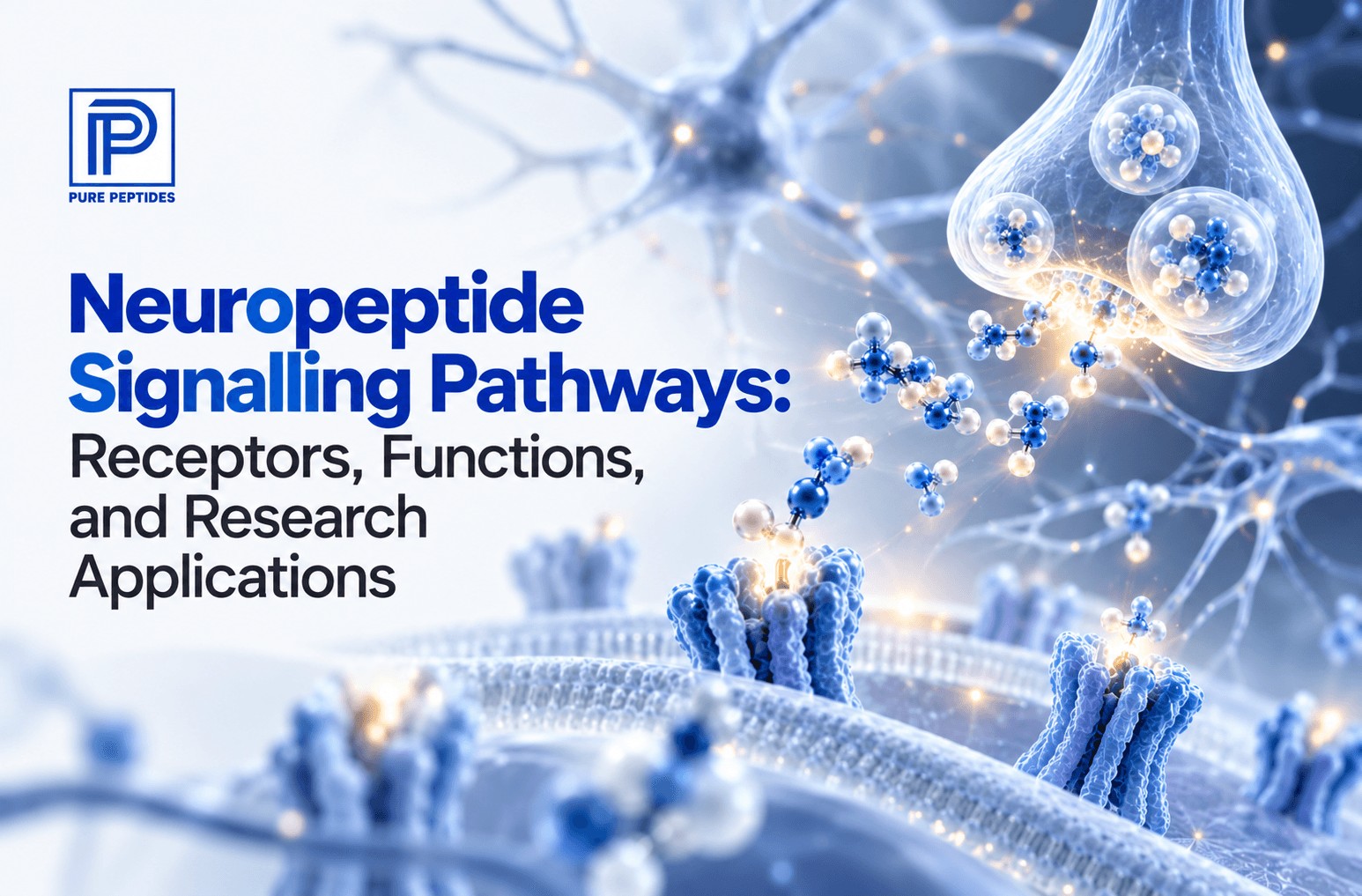
Neuropeptide Signalling Pathways: Receptors, Functions, and Research Applications


Neuropeptide Signalling describes how peptide messengers help neurons and other cells exchange biological information. By comparison with many fast neurotransmitter systems, neuropeptides often influence broader signalling networks through receptors that regulate intracellular pathways over different timescales. Therefore, researchers study these molecules to understand how peptide signals connect neural activity with endocrine, metabolic, behavioural, and cellular processes.
In addition, understanding these mechanisms helps researchers compare peptide structures, receptor systems, and laboratory findings more accurately. However, laboratory findings describe defined experimental models and should remain separate from therapeutic or human-use conclusions.
Explore quality-focused research peptides for your laboratory needs at Pure Peptides.
What Are Neuropeptide Signalling Pathways?
In general, neuropeptide signalling pathways begin when neurons or specialized cells release peptide messengers into the surrounding environment. As a result, these molecules can interact with compatible receptors on nearby or more distant target cells.
Unlike classical fast neurotransmission, neuropeptide communication does not always depend on a narrowly defined synaptic connection. Instead, peptide signals may diffuse beyond the release site and influence cells that express the appropriate receptor.
For example, researchers commonly investigate:
- Neuropeptide synthesis and processing
- Peptide storage and release
- Receptor recognition
- G protein activation
- Second-messenger production
- Calcium signalling
- Protein kinase pathways
- Receptor internalization
- Signal termination
| Signalling Component | Research Importance |
|---|---|
| Neuropeptide | Carries the extracellular signal |
| Receptor | Recognizes the peptide |
| G protein | Transfers receptor activity intracellularly |
| Second messenger | Distributes or amplifies the signal |
| Protein kinase | Modifies downstream cellular proteins |
| Regulatory proteins | Control signalling duration |
Therefore, Neuropeptide Signalling involves a sequence of connected molecular events rather than one isolated receptor interaction.
Explore quality-tested research peptides with clear product information and laboratory-focused standards at Pure Peptides.

How Do Neuropeptides Communicate With Cellular Receptors?
More specifically, neuropeptide communication depends on molecular recognition. First, a peptide reaches a cell that expresses a compatible receptor. Next, structural interactions allow the peptide to bind to that receptor.
As a result, receptor conformation can change and trigger intracellular signalling.
For instance, a simplified signalling sequence may include:
- A cell releases a neuropeptide.
- The peptide reaches a receptor-expressing target cell.
- The peptide interacts with its receptor.
- The receptor activates intracellular signalling proteins.
- Second messengers or kinases transmit the signal.
- Cellular activity changes.
- Regulatory mechanisms reduce or terminate signalling.
Importantly, the final response depends on more than peptide identity. For example, receptor density, peptide concentration, cell type, exposure duration, and downstream protein expression can all influence the measured result.
Furthermore, neuropeptides often act as modulators rather than simple on-and-off switches. Consequently, they can influence neuronal excitability, synaptic activity, hormone release, or intracellular signalling without producing identical effects in every cell type.
Therefore, researchers need to interpret Neuropeptide Signalling within the complete cellular environment rather than from ligand identity alone.
What Types of Neuropeptide Receptors Are Studied in Research?
In particular, many neuropeptides communicate through G protein-coupled receptors, or GPCRs. These membrane proteins convert extracellular peptide recognition into intracellular signalling events.
Different GPCRs can interact with different G protein families. Consequently, receptor activation may influence cAMP, phospholipase C, intracellular calcium, protein kinases, or other signalling systems.
For example, researchers commonly investigate receptor systems associated with:
- Neuropeptide Y signalling
- Neurokinin signalling
- Somatostatin pathways
- Galanin signalling
- Orexin-related pathways
- Corticotropin-releasing factor signalling
- Opioid peptide signalling
- VIP and PACAP pathways
However, researchers should not assume that every neuropeptide uses the same receptor mechanism.
| Receptor Feature | Possible Research Focus |
|---|---|
| Ligand affinity | Strength of peptide-receptor interaction |
| Selectivity | Preference among related receptors |
| G protein coupling | Intracellular signalling route |
| Receptor density | Availability on target cells |
| Internalization | Movement after receptor activation |
| Desensitization | Reduced signalling after continued exposure |
Furthermore, receptor subtypes can respond differently to related peptide ligands. Therefore, researchers often examine receptor selectivity alongside overall binding affinity.
How Are Neuropeptide Pathways Investigated?
For this reason, researchers combine multiple experimental methods to understand neuropeptide pathways. First, binding assays can determine whether a peptide interacts with a receptor. Next, functional studies can measure what happens after that interaction.
In addition, researchers may use:
- Receptor-binding assays
- Concentration-response studies
- cAMP measurements
- Calcium imaging
- Protein phosphorylation analysis
- Gene-expression analysis
- Receptor internalization assays
- Genetic manipulation
- Cellular imaging techniques
Moreover, molecular sensors can help researchers visualize neuropeptide activity in biological systems. As a result, scientists can investigate when particular signalling pathways become active rather than relying only on indirect downstream measurements.
However, one experiment rarely explains the entire mechanism. For example, a binding assay may demonstrate receptor interaction without revealing every downstream pathway. Conversely, a cellular response does not necessarily identify which receptor initiated it.
Therefore, researchers often combine receptor, signalling, structural, and cellular evidence.
Likewise, experimental conditions require careful control. Temperature, cell type, receptor expression, peptide concentration, exposure time, and analytical procedures can all influence measured results. Consequently, stronger conclusions usually come from several complementary approaches rather than a single assay.
Explore quality-tested research peptides with clear product information and laboratory-focused standards at Pure Peptides.

Why Are Neuropeptides Important in Biological Research?
More importantly, neuropeptides represent a valuable research area because they connect neural communication with broader biological regulation.
For instance, scientists investigate neuropeptide systems in models involving:
- Feeding-related signalling
- Stress-response pathways
- Sleep and wakefulness
- Reproductive signalling
- Learning-related mechanisms
- Nociceptive signalling
- Neuroendocrine communication
- Metabolic regulation
- Behavioural responses
However, these categories frequently overlap. For example, a neuropeptide involved in metabolic signalling may also participate in neural or endocrine pathways. Likewise, a signalling system associated with stress may influence several tissues.
Therefore, researchers increasingly examine signalling networks instead of assigning one fixed function to each peptide.
| Research Question | Useful Evidence |
|---|---|
| Which receptor recognizes the peptide? | Binding studies |
| Which pathway becomes active? | Second-messenger assays |
| Does the response vary by cell type? | Comparative cellular studies |
| Does concentration affect signalling? | Concentration-response analysis |
| How long does signalling persist? | Time-course studies |
| Does structure alter activity? | Structure-activity research |
Furthermore, Neuropeptide Signalling research can help scientists investigate how molecular networks change across different experimental conditions.
For Canadian research settings, however, laboratory classification and therapeutic authorization remain separate matters. Therefore, experimental evidence about receptor activity or biological mechanisms should not automatically lead to claims about clinical effectiveness or authorized human use.
Explore research peptides with clear laboratory-focused information and quality considerations at Pure Peptides.
Explore how peptide structure connects with biological function and signalling in Peptide Classification & Molecular Pathways: Understanding Structure, Functions, and Biological Signalling.
FAQs About Neuropeptide Signalling Pathways
What is neuropeptide signalling?
Neuropeptide signalling describes how peptide messengers communicate with target cells through receptors and downstream molecular pathways. Typically, the process involves receptor recognition, intracellular signalling, and a measurable cellular response.
How are neuropeptides different from classical neurotransmitters?
By comparison, neuropeptides often act through slower modulatory pathways and can influence broader cellular networks. In addition, their signalling may extend beyond tightly localized synaptic connections.
Do most neuropeptides signal through GPCRs?
Yes. Many known neuropeptides interact with GPCRs. However, receptor subtype and downstream signalling can differ substantially among peptide systems.
Can one neuropeptide interact with multiple receptors?
Yes. Some peptides can interact with several related receptor subtypes. Consequently, researchers often examine receptor affinity and selectivity separately.
What second messengers participate in neuropeptide signalling?
Depending on the receptor, signalling may involve cAMP, IP3, DAG, intracellular calcium, and several protein kinase pathways.
Why can neuropeptide responses differ between cell types?
For example, different cells may express different receptors, receptor densities, G proteins, enzymes, and regulatory proteins. Therefore, cellular context can significantly influence experimental responses.
How do researchers measure neuropeptide signalling?
Researchers can combine binding assays, cAMP measurements, calcium imaging, receptor internalization studies, molecular sensors, genetic approaches, and other cell-based techniques.
Does neuropeptide activity prove therapeutic effectiveness?
No. In contrast, laboratory signalling data describe molecular or cellular activity under defined experimental conditions. Clinical effectiveness requires separate evidence and regulatory evaluation.
Final Thoughts
Overall, Neuropeptide Signalling provides a framework for understanding how peptide messengers connect neural activity with cellular and biological responses. More specifically, receptors, G proteins, second messengers, kinases, and regulatory mechanisms all contribute to these communication networks.
In addition, neuropeptide pathways can influence neural, endocrine, metabolic, and behavioural research models. Therefore, researchers should consider receptor subtype, cell type, signalling context, peptide concentration, and experimental conditions together.
Explore quality-focused research peptides for your laboratory needs at Pure Peptides.
As a result, studying neuropeptide pathways can improve the interpretation of cellular communication and receptor biology. For Canadian researchers, however, laboratory findings should remain clearly separate from therapeutic claims and regulatory authorization.
Disclaimer: This content is provided for educational and scientific research purposes only. Research peptides are intended for laboratory research only and are not intended for human consumption or medical use.