
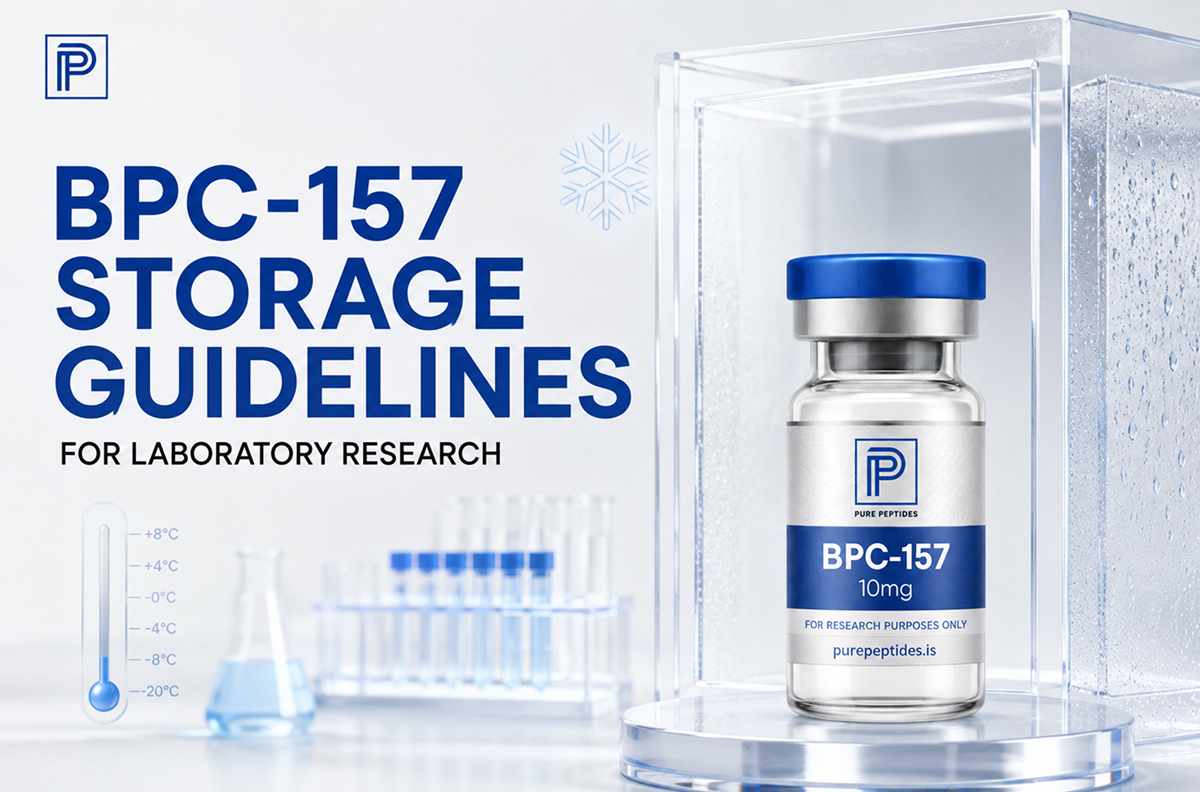
BPC-157 Storage Guidelines for Laboratory Research


Proper BPC-157 storage is an important part of maintaining sample integrity and experimental reproducibility. Temperature, moisture, light exposure, contamination, and repeated handling may affect BPC-157 and other synthetic peptides. In addition, preparing a lyophilized peptide as a solution can change its storage requirements.
Researchers sourcing laboratory materials from Pure Peptides should include storage in a broader quality-control process alongside careful handling, batch documentation, and product-specific instructions. Rather than applying one universal storage rule, laboratories should consider the physical state, formulation, packaging, and available stability information for each research material.
Why Proper BPC-157 Storage Matters
Storage conditions can influence peptide stability and, consequently, the reliability of laboratory experiments. If a research sample changes chemically during storage, its composition may differ from the material initially characterized for the study.
Several factors can affect sample integrity:
- Temperature fluctuations
- Moisture exposure
- Light exposure
- Chemical degradation
- Contamination
- Repeated handling
| Storage Factor | Potential Research Concern |
|---|---|
| Temperature | May influence degradation rates |
| Moisture | Can affect dry peptide stability |
| Light | May contribute to chemical changes |
| Freeze-thaw cycles | Add repeated sample stress |
| Contamination | Can compromise sample integrity |
| Poor documentation | Reduces experimental traceability |
Importantly, researchers cannot determine peptide integrity from appearance alone. A sample may look unchanged while its chemical composition has altered. Therefore, appropriate storage practices support both sample preservation and reproducibility between experiments.
Explore laboratory research options with Pure Peptides: BPC-157 10mg.
Storing Lyophilized BPC-157
Lyophilization removes water from a peptide preparation and creates a dry material that generally maintains greater storage stability than the same peptide in solution. However, lyophilized material still requires controlled handling.
Moisture is a particularly important consideration. Opening a cold vial immediately in a warmer, more humid environment may cause condensation to form inside the container. For this reason, laboratories commonly keep the vial sealed while it appropriately equilibrates to the working environment before opening it.
Researchers should also minimize unnecessary vial opening and environmental exposure. Keeping the container properly sealed helps reduce contact with humidity and other external conditions.
Researchers should also limit repeated movement between storage and laboratory environments where practical. In addition, if an experimental protocol requires frequent access to the material, laboratories may consider organizing samples into suitable research quantities when permitted by the product instructions and laboratory SOPs.
Ultimately, the exact storage temperature and duration for lyophilized BPC-157 should follow the information provided for the specific product and batch rather than a generalized peptide-storage recommendation.
Storage Considerations for Prepared Solutions
Once researchers prepare BPC-157 as a solution, additional variables can influence its stability. Therefore, researchers should not automatically apply lyophilized-material instructions to a prepared research solution.
Important factors include:
| Variable | Research Consideration |
|---|---|
| Solvent or buffer | May influence chemical stability |
| pH | Can affect degradation pathways |
| Concentration | May alter solution behaviour |
| Temperature | Influences chemical reaction rates |
| Container | May affect adsorption or contamination |
| Storage duration | Longer storage can increase uncertainty |
For example, changes in pH or buffer composition may alter the chemical environment surrounding the peptide. Likewise, the choice of container may become relevant if the peptide interacts with the storage surface.
Prepared solutions also require greater attention to contamination. As a result, researchers should use appropriate clean-handling procedures and minimize unnecessary access to the sample.
Repeated freeze-thaw cycles should generally be limited when the experimental protocol and product-specific guidance call for it. Working aliquots may reduce repeated manipulation of a primary sample, although aliquoting itself must be performed using appropriate laboratory procedures.
Most importantly, there is no universal prepared-solution shelf life that should be applied to every BPC-157 research material. Stability depends on the formulation and storage conditions being used.
Temperature, Light, and Moisture Exposure
Several environmental factors, including temperature, light, and moisture, can influence BPC-157 storage conditions.
Temperature
Temperature can influence the rate of chemical reactions associated with peptide degradation. Although colder conditions may slow many degradation processes, this does not mean that one temperature is appropriate for every BPC-157 formulation.
Therefore, researchers should prioritize product-specific information when selecting storage conditions.
A useful hierarchy is:
Product label → Manufacturer instructions → Batch documentation → Stability data → Laboratory SOP
This approach reduces the risk of applying generalized recommendations to a product with different stability characteristics.
Light
Unnecessary light exposure should also be minimized. When product documentation specifies light protection, the material should remain in appropriate packaging or laboratory containers during storage.
Moisture
Moisture is especially relevant for dry, lyophilized material. Consequently, keeping containers properly sealed and minimizing exposure to humid environments can help maintain suitable storage conditions.
Together, these environmental controls help create more consistent conditions between receipt, storage, and experimental use.
Preventing Contamination and Degradation
Appropriate temperature control cannot protect sample integrity if poor laboratory handling introduces contamination or unnecessary stress.
Researchers should incorporate basic sample-management practices into their protocol:
- Use clean laboratory equipment
- Minimize unnecessary vial opening
- Use suitable storage containers
- Clearly label samples and aliquots
- Limit unnecessary freeze-thaw cycles
- Record preparation and storage dates
- Follow established laboratory SOPs
In addition, laboratories may use analytical methods when verification of sample integrity is important.
High-performance liquid chromatography (HPLC) can evaluate chromatographic purity and identify changes in an impurity profile. For instance, the appearance or growth of secondary peaks over time may indicate a change in sample composition.
Mass spectrometry provides different information. It can help confirm molecular identity by evaluating molecular mass. However, molecular identity and chromatographic purity are separate analytical questions.
For more detailed stability research, laboratories can compare a sample before and after controlled storage:
Initial analysis → Controlled storage → Defined time point → Repeat analysis → Comparison
This type of experimental design provides stronger evidence about sample stability than visual inspection alone.
Explore laboratory research options with Pure Peptides: BPC-157 10mg.
Documentation and Product-Specific Instructions
Documentation connects storage practices with experimental traceability. Without clear records, researchers may have difficulty determining whether differences between experiments resulted from biological effects, sample handling, or storage history.
Useful records may include:
- Product name
- Batch or lot number
- Date received
- Storage conditions
- Date first opened
- Preparation date
- Solvent or buffer used
- Concentration
- Aliquot identification
- Relevant analytical results
For example, if two experiments using the same peptide produce different results, researchers can compare their batch numbers, preparation dates, and storage histories to identify potential sources of variation.
Product-specific instructions should take priority over generalized peptide recommendations whenever validated information is available. This is particularly important because formulation, packaging, and stability characteristics may vary between products and suppliers.
For Canadian laboratories, documentation should also support compliance with applicable research and regulatory requirements. Experimental research involving BPC-157 should remain clearly distinguished from claims of therapeutic authorization or clinical use.
Accordingly, combining product-specific instructions with consistent documentation provides a stronger foundation for reproducible laboratory research.
Explore tissue repair pathways, angiogenesis, and current scientific evidence in Peptides in Tissue Repair Research: Mechanisms, Applications, and Evidence.
FAQ About BPC-157 Storage
How should lyophilized BPC-157 be stored?
Researchers should follow the conditions specified for the particular product and batch. In general, laboratories should control temperature, moisture, light exposure, and unnecessary handling while keeping the material appropriately sealed.
Is lyophilized BPC-157 more stable than a prepared solution?
Lyophilization removes water from the preparation, which generally improves the storage characteristics of many peptides. However, actual stability still depends on the peptide formulation, packaging, environmental conditions, and available stability data.
Can prepared BPC-157 solutions be refrigerated?
The appropriate storage condition depends on the specific formulation, solvent, concentration, and available stability information. Therefore, researchers should avoid treating a generic peptide-storage recommendation as validated guidance for every BPC-157 solution.
Why should repeated freeze-thaw cycles be minimized?
Repeated freezing and thawing increases sample handling and environmental stress. For this reason, laboratories may minimize these cycles or use appropriately prepared working aliquots when supported by their experimental protocol.
Does a clear solution mean BPC-157 remains stable?
No. A sample can undergo chemical changes without obvious visual differences. Instead, analytical methods such as HPLC can provide more meaningful information about changes in chromatographic purity.
How long can BPC-157 be stored?
There is no universal storage duration that applies to every BPC-157 research product. Physical state, formulation, temperature, packaging, and available stability data can all affect storage duration. Therefore, product-specific instructions should remain the primary reference.
Final Thoughts
Effective BPC-157 storage requires more than selecting a storage temperature. Researchers should consider whether the material is lyophilized or prepared in solution, while also controlling environmental exposure, contamination, handling, and documentation.
Moreover, analytical methods can provide additional information when researchers need to evaluate sample integrity after storage. Ultimately, product-specific instructions and consistent laboratory procedures provide the strongest basis for maintaining traceability and experimental reproducibility
Disclaimer: This content is provided for educational and scientific research purposes only. Research peptides are intended for laboratory use only and are not intended for human consumption or medical use.
Really useful guide on BPC-157 storage. I liked the practical focus on factors such as temperature, moisture and handling, since storage conditions can be easy to overlook when working with research materials. A comparison of storage considerations for different peptide formulations would be an interesting follow-up.
I found the storage recommendations particularly helpful. Maintaining consistent conditions seems important for preserving the integrity of a research sample, especially when it may be stored for an extended period. I’d be interested in seeing a checklist of common handling and storage mistakes to avoid.
Appreciate how straightforward this article makes BPC-157 storage. It’s easy to focus on the quality of a research material when it is first received and overlook how subsequent handling can affect sample integrity. A follow-up covering how researchers document storage conditions would be very useful.