
Cagrilintide Mechanism of Action: Amylin Receptor Signalling in Metabolic Research


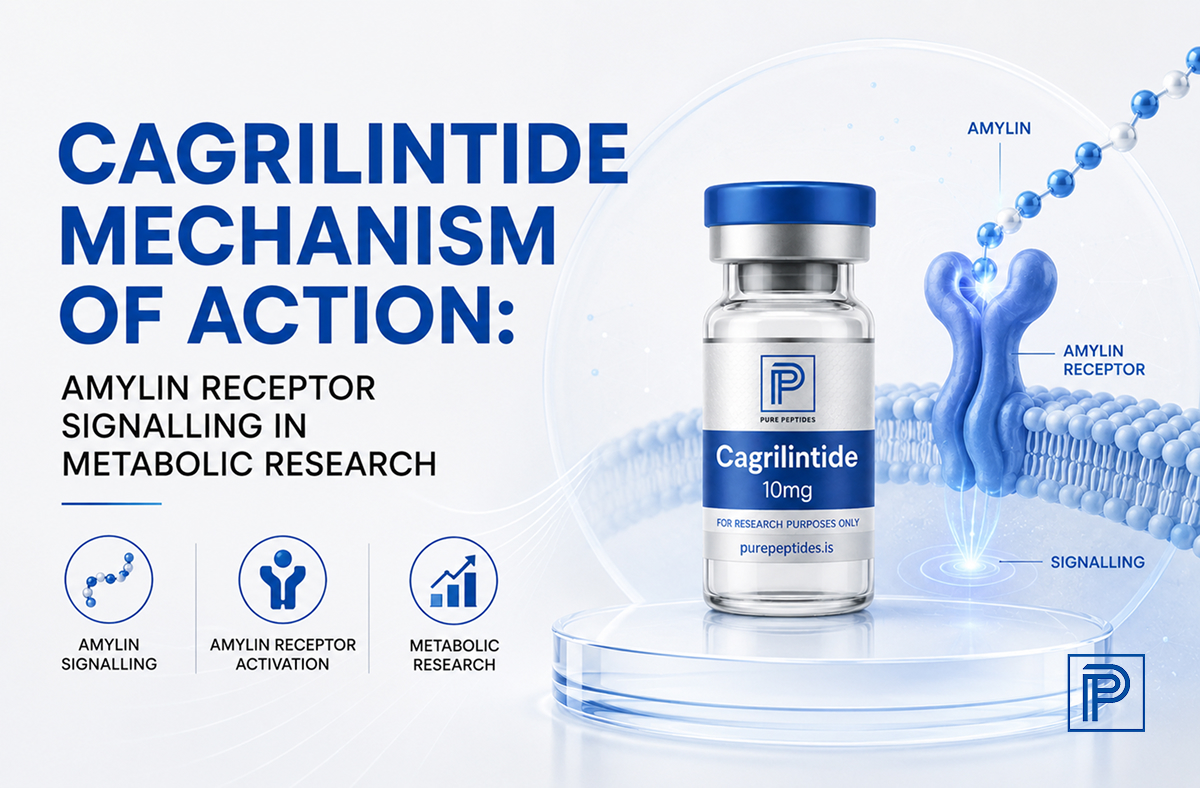
The cagrilintide mechanism of action centres on sustained signalling through amylin-related receptor systems involved in appetite regulation, gastric physiology, endocrine communication, and energy balance. Cagrilintide is a long-acting, lipidated analogue of amylin designed to produce more prolonged activity than the native hormone.
For researchers exploring metabolic compounds through Pure Peptides, cagrilintide provides a useful model for studying how amylin receptor signalling connects central nervous system pathways with gastrointestinal and endocrine responses.
Importantly, cagrilintide does not act through one simple receptor. Current research indicates activity across several amylin receptor subtypes as well as the calcitonin receptor. Therefore, researchers need to evaluate its mechanism as a multi-receptor signalling system rather than a single-pathway effect.
This broader view is especially important because metabolic regulation depends on communication among several tissues. A receptor-level response in one experimental system may contribute only one part of a larger physiological outcome.
Understanding the Proposed Mechanism of Cagrilintide
Cagrilintide was developed to reproduce key aspects of endogenous amylin signalling while extending the duration of activity.
At the receptor level, it interacts with receptor systems built around the calcitonin receptor (CTR). When CTR associates with receptor activity-modifying proteins, it forms different amylin receptor subtypes, including AMY1, AMY2, and AMY3.
Cagrilintide can activate these receptor complexes and the calcitonin receptor itself.
| Mechanistic Component | Research Significance |
|---|---|
| AMY1, AMY2, AMY3 receptors | Amylin-related signalling |
| Calcitonin receptor | Additional receptor activity |
| Gs signalling | Intracellular signal transmission |
| Central pathways | Meal-related and energy-balance research |
| Gastrointestinal pathways | Nutrient handling and gastric physiology |
This receptor profile helps explain why the cagrilintide mechanism of action involves several interconnected physiological systems.
Rather than assigning every effect to one receptor, researchers examine how receptor subtype activity contributes to the broader metabolic response. In addition, the compound’s long-acting design means that duration of exposure may influence how strongly or how long these pathways remain active.
Explore quality-tested research peptides with clear product information and laboratory-focused standards at Pure Peptides.
Amylin Receptors and Metabolic Signalling
Amylin receptors have an unusual structure compared with many other metabolic receptors.
The calcitonin receptor combines with different receptor activity-modifying proteins, or RAMPs, to create multiple amylin receptor subtypes. These receptor configurations can differ in their response to amylin-related peptides.
When cagrilintide activates these receptors, signalling commonly involves Gs proteins, which can stimulate adenylyl cyclase and increase intracellular cyclic AMP (cAMP).
However, receptor activation represents only the first step.
The final biological response can also depend on:
- Receptor subtype distribution
- Tissue exposure
- Peptide concentration
- Duration of signalling
- Communication between organ systems
For this reason, researchers distinguish receptor pharmacology from whole-body metabolic outcomes.
Cagrilintide’s long-acting design adds another layer of complexity because sustained receptor exposure may differ from the shorter signalling pattern of native amylin. Researchers therefore need to consider not only whether a receptor becomes active, but also how long that activation persists and how repeated signalling may affect downstream pathways.
Central Nervous System Pathways Under Investigation
Central nervous system signalling is a major area of cagrilintide research.
Endogenous amylin participates in neural pathways involved in meal termination and energy balance. Researchers have therefore investigated brain regions that can respond to circulating metabolic signals, particularly hindbrain structures such as the area postrema.
Preclinical studies suggest that amylin receptor subtypes in the brain contribute to cagrilintide-associated metabolic responses.
Researchers may examine:
- Meal-related signalling
- Food intake
- Satiety-related responses
- Neural activation
- Energy balance
Importantly, these pathways should not be simplified into a single “appetite effect.”
Central metabolic regulation involves communication among multiple neural and peripheral systems. Therefore, cagrilintide’s central effects likely reflect coordinated signalling rather than activity at one isolated brain region.
In addition, peripheral signals from the gastrointestinal tract and endocrine system may influence central responses. This means researchers need to consider bidirectional communication between the brain and other metabolic tissues when interpreting experimental findings.
Animal models provide useful mechanistic evidence, but researchers still need to account for differences between animal neural circuitry and human physiology.
Gastric and Nutrient-Related Signalling
The cagrilintide mechanism of action also includes gastrointestinal processes associated with normal amylin biology.
One important pathway involves gastric emptying. By influencing how quickly stomach contents move into the intestine, amylin-related signalling can affect the timing of nutrient delivery and post-meal metabolic responses.
Amylin also participates in glucagon-related regulation following nutrient intake.
These pathways connect gastrointestinal physiology with broader endocrine signalling.
| Pathway | Research Relevance |
|---|---|
| Gastric emptying | Timing of nutrient delivery |
| Meal-related signalling | Nutrient-status communication |
| Glucagon regulation | Post-meal endocrine response |
| Central signalling | Energy-balance pathways |
However, researchers should not assume that every known function of native amylin contributes equally to cagrilintide’s effects.
Cagrilintide has different pharmacokinetic properties and a much longer duration of activity. Therefore, compound-specific evidence remains important when evaluating its mechanism.
Researchers may also examine how changes in nutrient delivery affect downstream glucose, insulin, and glucagon responses. This creates a useful connection between gastric physiology and broader metabolic signalling rather than treating them as separate systems.
Explore quality-tested research peptides with clear product information and laboratory-focused standards at Pure Peptides.
Interaction With Other Metabolic Hormone Pathways
Cagrilintide research increasingly examines how amylin signalling interacts with other metabolic hormone systems.
GLP-1 signalling provides one of the clearest examples. Amylin and GLP-1 receptors operate through different pathways but can influence overlapping metabolic outcomes.
This mechanistic distinction has led researchers to study cagrilintide alongside GLP-1-based compounds such as semaglutide.
From a research perspective, combination studies can help answer whether different receptor systems produce complementary metabolic responses.
However, these experiments also create an interpretation challenge. If researchers observe an outcome after combining two compounds, they cannot automatically determine how much each pathway contributed.
Therefore, combination research is most useful when investigators compare:
- Cagrilintide alone
- The second metabolic compound alone
- The combined formulation
- Appropriate control groups
This design helps separate individual pathway effects from combined responses.
Researchers may also investigate whether one pathway changes the sensitivity or downstream response of another. Such interactions are especially relevant in metabolic systems, where several hormone signals often converge on overlapping physiological endpoints.
Limitations of Current Mechanistic Research
Several aspects of the cagrilintide mechanism of action remain under investigation.
First, receptor-level studies cannot reproduce complete human metabolism. Structural and cellular experiments can identify binding and signalling mechanisms, but they do not capture interactions among the brain, pancreas, gastrointestinal tract, liver, and other tissues.
Second, receptor-specific contributions remain difficult to quantify. Because cagrilintide can activate several amylin receptor subtypes and the calcitonin receptor, one physiological outcome may reflect more than one receptor system.
Third, central nervous system evidence remains partly dependent on animal models. Species differences in receptor expression and neural circuitry may influence translation.
Finally, combination studies add complexity because multiple hormone pathways operate simultaneously.
Key unanswered questions include:
- Which receptor subtypes contribute most to specific outcomes?
- How important is calcitonin receptor activity?
- How do central and gastrointestinal pathways interact?
- How does sustained signalling differ from native amylin?
- How does cagrilintide interact with incretin pathways?
- Do different tissues respond differently to prolonged receptor activation?
For Canadian researchers, clinical investigation should also remain distinct from general therapeutic authorization. Research activity does not by itself establish approval for routine human use.
Explore how key peptides interact with metabolic pathways and signalling systems in our guide: Peptides in Metabolic Signalling Research: Pathways, Compounds, and Evidence.
FAQ About the Cagrilintide Mechanism of Action
What is the main cagrilintide mechanism of action?
Cagrilintide acts as a long-acting agonist at amylin receptor subtypes and the calcitonin receptor, influencing central, gastrointestinal, and endocrine metabolic pathways.
Does cagrilintide act only on amylin receptors?
No. Research indicates activity at AMY1, AMY2, and AMY3 receptors as well as the calcitonin receptor.
How are amylin receptors formed?
Amylin receptors form when the calcitonin receptor combines with receptor activity-modifying proteins, creating different receptor subtypes.
Does cagrilintide influence the central nervous system?
Preclinical research supports involvement of brain amylin receptor pathways associated with meal-related and energy-balance signalling.
How does cagrilintide affect gastric signalling?
Researchers investigate amylin-related effects on gastric emptying and nutrient-related endocrine responses as part of its broader metabolic mechanism.
Why is cagrilintide studied with GLP-1-based compounds?
Amylin and GLP-1 receptor systems operate through different but potentially complementary metabolic pathways. Combination studies help researchers examine how these signals interact.
Final Thoughts
The cagrilintide mechanism of action involves more than simple amylin mimicry. Its activity spans multiple amylin receptor subtypes, the calcitonin receptor, central signalling, gastrointestinal pathways, and broader endocrine communication.
At the same time, researchers still need to clarify how individual receptors contribute to whole-body outcomes, how prolonged receptor activation changes downstream signalling, and how cagrilintide interacts with other metabolic hormone systems.
For researchers investigating amylin signalling and laboratory-focused metabolic peptides, Pure Peptides provides a research-oriented resource for exploring compounds across different molecular pathways.
Disclaimer: This content is provided for educational and scientific research purposes only. Research peptides are intended for laboratory research only and are not intended for human consumption or medical use.
Really clear explanation of cagrilintide’s proposed mechanism of action. I liked how the article breaks down the underlying biology and explains why its receptor activity is relevant to current research. A deeper discussion of how these pathways interact would make an interesting follow-up.
I found the explanation of cagrilintide’s biological activity particularly helpful. Understanding the mechanism provides useful context when looking at the broader research rather than focusing only on headline results. I’d be interested in seeing more about how researchers study these effects in different experimental models.
Appreciate the research-focused approach to explaining cagrilintide. The mechanism is quite technical, so presenting the key biological concepts in a structured way makes the topic much easier to follow. A comparison between cagrilintide’s mechanism and other metabolic research approaches would be a valuable addition.