
Glucagon Receptor Research: Metabolic Pathways and Experimental Applications


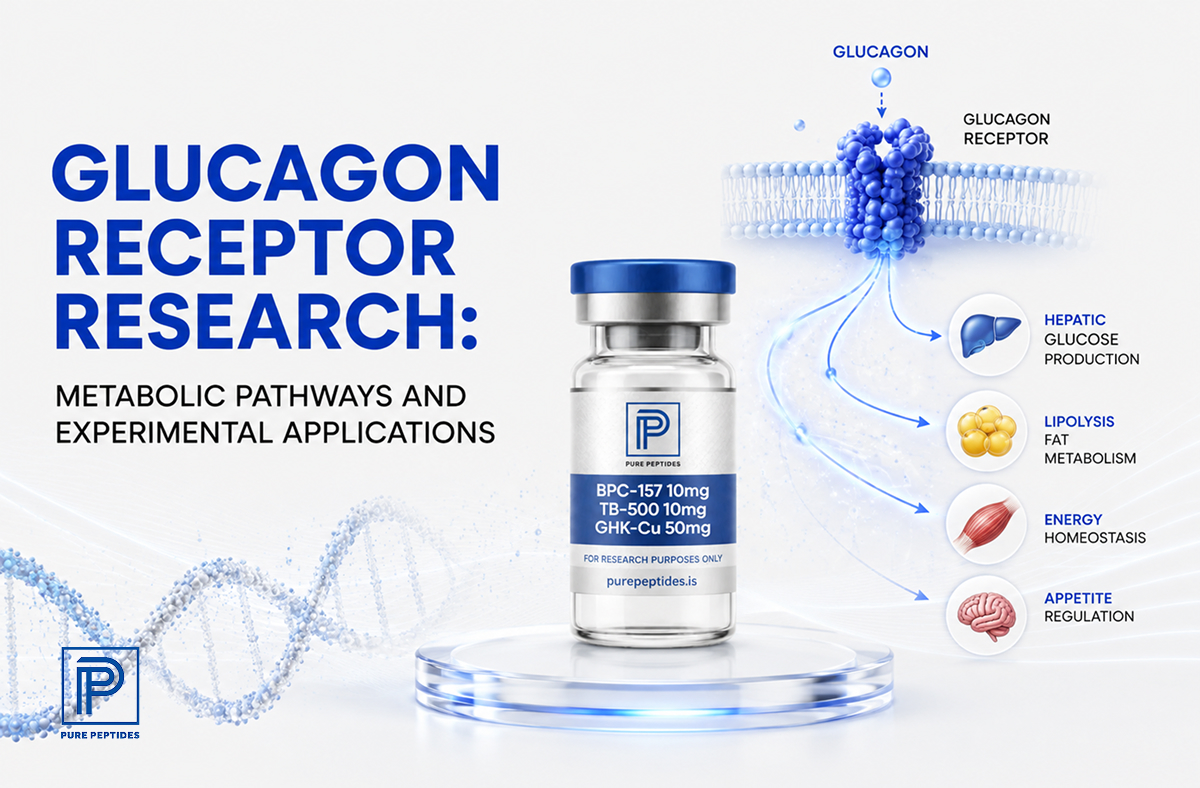
Glucagon receptor research examines how glucagon signalling influences hepatic glucose production, amino-acid metabolism, and energy regulation. In particular, the glucagon receptor (GCGR) is important in the liver, where it helps coordinate metabolic responses to changes in nutrient availability.
More recently, GCGR has gained attention in multi-receptor research involving GLP-1 and GIP pathways. These models allow researchers to examine how glucagon-related hepatic signalling interacts with incretin systems.
For researchers exploring metabolic signalling through Pure Peptides, understanding GCGR biology provides a foundation for evaluating both receptor-specific and multi-agonist research.
What Is the Glucagon Receptor?
The glucagon receptor, abbreviated GCGR, is a class B G-protein-coupled receptor activated by glucagon. Meanwhile, pancreatic alpha cells produce glucagon, while the liver serves as its principal physiological target.
Subsequently, when glucagon binds to GCGR, the receptor primarily activates stimulatory G proteins. This process increases cyclic adenosine monophosphate (cAMP), which subsequently activates protein kinase A (PKA) and other downstream processes.
Therefore, this signalling system helps the liver adjust fuel metabolism according to nutrient availability.
| Feature | Glucagon Receptor |
|---|---|
| Abbreviation | GCGR |
| Receptor family | Class B GPCR |
| Endogenous ligand | Glucagon |
| Major physiological target | Liver |
| Core signalling pathway | Gs → cAMP → PKA |
| Key research areas | Glucose, amino-acid and energy metabolism |
| Multi-agonist relevance | GLP-1R and GIPR research |
However, GCGR biology extends beyond glucose production into several areas of nutrient metabolism.
Explore quality-tested research peptides with clear product information and laboratory-focused standards at Pure Peptides.
Glucagon Receptor Signalling in the Liver
For this reason, the liver remains the central focus of glucagon receptor research because hepatic GCGR activation directly affects fuel availability.
More specifically, the core pathway can be summarized as:
Glucagon → GCGR → Gs → adenylyl cyclase → cAMP → PKA → metabolic response
After receptor activation increases cAMP, PKA modifies enzymes and regulatory proteins involved in hepatic metabolism.
For example, one major process is glycogenolysis, which breaks stored liver glycogen into substrates that support glucose release. This mechanism becomes particularly relevant when external nutrient availability decreases.
In addition, glucagon signalling supports gluconeogenesis, allowing the liver to generate glucose from non-carbohydrate substrates such as lactate, glycerol, and glucogenic amino acids.
However, GCGR signalling is not limited to a single intracellular pathway. Experimental evidence also supports additional signalling mechanisms, including calcium-related processes under certain conditions.
Therefore, researchers need to consider glucagon concentration, exposure duration, metabolic state, and experimental model when evaluating hepatic GCGR activity.
Glucose and Energy Regulation Pathways
GCGR plays an important role in metabolic adaptation between fed and fasting conditions.
During fasting, glucagon signalling promotes hepatic glucose availability through glycogen breakdown and gluconeogenesis. However, modern research shows that glucagon biology extends beyond carbohydrate metabolism.
Moreover, researchers investigate its relationship with:
- amino-acid turnover;
- ureagenesis;
- hepatic lipid metabolism;
- fatty-acid oxidation; and
- broader energy regulation.
In particular, one important concept is the liver–alpha-cell axis.
In this feedback system, glucagon influences hepatic amino-acid metabolism and ureagenesis. Meanwhile, circulating amino acids can stimulate pancreatic alpha cells to release glucagon.
| Metabolic Pathway | Research Focus |
|---|---|
| Glycogenolysis | Mobilization of hepatic glycogen |
| Gluconeogenesis | Production of glucose from metabolic substrates |
| Amino-acid metabolism | Hepatic amino-acid turnover |
| Ureagenesis | Nitrogen disposal |
| Lipid metabolism | Hepatic substrate handling |
| Liver–alpha-cell axis | Liver-pancreas metabolic communication |
Consequently, researchers increasingly view GCGR as part of a broader nutrient-regulatory network rather than solely as a glucose-related receptor.
Glucagon Receptors in Multi-Agonist Research
More recently, GCGR has become an important target in modern multi-receptor metabolic research.
Some experimental compounds combine:
GLP-1R + GCGR
while others investigate:
GIPR + GLP-1R + GCGR
In practice, these combinations bring together different metabolic pathways. GLP-1R and GIPR contribute incretin-related signalling, whereas GCGR introduces hepatic glucose and energy-related mechanisms.
For example, retatrutide activates GIP, GLP-1, and glucagon receptors within one molecule. Research involving this type of compound has increased interest in determining how GCGR activity contributes to integrated metabolic outcomes.
However, targeting three receptors does not mean activating each receptor equally.
Relative receptor potency is particularly important. A compound may display stronger activity at one receptor than another. In addition, tissue exposure and pharmacokinetics influence the duration and location of receptor activation.
| Variable | Research Importance |
|---|---|
| Relative potency | Determines balance among receptor targets |
| Selectivity | Defines receptor activity profile |
| Tissue exposure | Influences where signalling occurs |
| Pharmacokinetics | Determines concentration and exposure duration |
| Signalling behaviour | Influences downstream cellular responses |
Therefore, researchers need to characterize each multi-agonist independently rather than assuming that compounds targeting similar receptors will behave identically.
Explore quality-tested research peptides with clear product information and laboratory-focused standards at Pure Peptides.
Experimental Models and Metabolic Biomarkers
Researchers use several experimental models to investigate GCGR biology.
Receptor and cellular assays help characterize receptor potency, cAMP production, and downstream signalling.
Hepatocyte and liver models allow researchers to examine glucose production, glycogen metabolism, and amino-acid handling.
Animal models provide information about integrated liver-pancreas and whole-body metabolic responses.
Finally, human research evaluates systemic outcomes but provides less ability to isolate individual receptor contributions, particularly when researchers study multi-agonist compounds.
Common research measurements include:
| Biomarker or Endpoint | Research Purpose |
|---|---|
| Plasma glucose | Assess glucose regulation |
| Insulin | Evaluate endocrine responses |
| Glucagon | Examine alpha-cell signalling |
| Liver glycogen | Study hepatic energy storage |
| Amino acids | Evaluate liver–alpha-cell signalling |
| Lipid markers | Assess substrate metabolism |
| HbA1c | Measure longer-term glycaemic changes |
| Energy expenditure | Examine systemic energy regulation |
Researchers select these endpoints according to the experimental question. For example, receptor assays require different measurements from whole-body metabolic studies.
Canada also participates in clinical research involving multi-receptor metabolic compounds. Importantly, authorization to conduct a Canadian clinical trial permits investigation under a defined research protocol and does not represent general market authorization.
Current Evidence and Research Limitations
Current evidence supports GCGR as an important regulator of hepatic glucose and amino-acid metabolism. Nevertheless, several limitations remain.
First, cellular activity does not directly predict whole-body outcomes. Receptor potency measured in vitro may not reflect tissue exposure or interactions with other metabolic hormones.
Second, animal models cannot completely reproduce human metabolism. Differences in receptor expression and metabolic physiology can affect how findings translate between species.
Third, engineered compounds may produce prolonged GCGR activation that differs from endogenous glucagon signalling.
Finally, multi-agonist research makes receptor-specific interpretation difficult. If one compound activates GCGR, GLP-1R, and GIPR simultaneously, researchers cannot determine the exact contribution of GCGR from a whole-body endpoint alone.
Key research questions therefore include:
- How much does GCGR contribute to multi-agonist outcomes?
- How does relative receptor potency affect metabolic responses?
- How does prolonged activation differ from endogenous glucagon signalling?
- Which findings from preclinical models translate reliably to humans?
- How do glucagon and incretin pathways interact during simultaneous activation?
Answering these questions requires evidence from receptor assays, liver models, preclinical studies, and controlled human research.
Explore how key peptides interact with metabolic pathways and signalling systems in our guide: Peptides in Metabolic Signalling Research: Pathways, Compounds, and Evidence.
FAQ About Glucagon Receptor Research
What is the glucagon receptor?
The glucagon receptor, or GCGR, is a class B G-protein-coupled receptor activated by glucagon. The liver represents its major physiological target.
What happens when glucagon activates GCGR?
GCGR primarily activates Gs-mediated signalling, increasing cAMP and downstream PKA activity. These processes influence hepatic glucose and nutrient metabolism.
Does GCGR only regulate glucose?
No. Researchers also investigate its role in amino-acid metabolism, ureagenesis, lipid metabolism, and broader energy regulation.
What is the liver–alpha-cell axis?
The liver–alpha-cell axis describes feedback between hepatic amino-acid metabolism and pancreatic glucagon secretion.
Why is GCGR studied with GLP-1 and GIP receptors?
Combining these receptors allows researchers to examine interactions between hepatic glucagon pathways and incretin signalling within dual- and multi-receptor models.
Can multi-agonist studies determine the exact contribution of GCGR?
Not from whole-body endpoints alone. Researchers need receptor-specific experiments to separate GCGR activity from the effects of other receptor pathways.
Is glucagon receptor research conducted in Canada?
Yes. Canada participates in clinical research involving advanced metabolic compounds relevant to glucagon receptor signalling. However, clinical-trial authorization does not represent general therapeutic approval.
Final Thoughts
Glucagon receptor research has expanded beyond hepatic glucose production to include amino-acid metabolism, liver-pancreas communication, and multi-receptor signalling.
At the same time, the development of dual- and triple-receptor compounds has increased the importance of understanding GCGR potency and pathway interactions. Researchers must therefore consider receptor pharmacology, experimental model, and evidence quality when interpreting metabolic findings.
For researchers exploring metabolic signalling and laboratory-focused compounds, Pure Peptides provides a research-oriented resource for emerging areas of peptide science.
Disclaimer: This content is provided for educational and scientific research purposes only. Research peptides are intended for laboratory research only and are not intended for human consumption or medical use.
Really interesting overview of glucagon receptor research. I liked how the article explains the receptor’s role in metabolic signalling and puts its biological functions into a broader research context. A deeper discussion of how glucagon receptor activity interacts with other metabolic pathways would be fascinating.
I found this article helpful for understanding why the glucagon receptor remains an important area of metabolic research. The explanation of the signalling mechanisms provides useful context without oversimplifying a fairly complex topic. I’d be interested in seeing more about how researchers study glucagon receptor activity in different experimental models.
Appreciate the research-focused approach to this topic. The connection between glucagon receptor signalling and broader metabolic processes is particularly interesting, especially when considering how multiple pathways can influence one another. A follow-up comparing glucagon receptor research with related metabolic receptor targets would make a great read.