
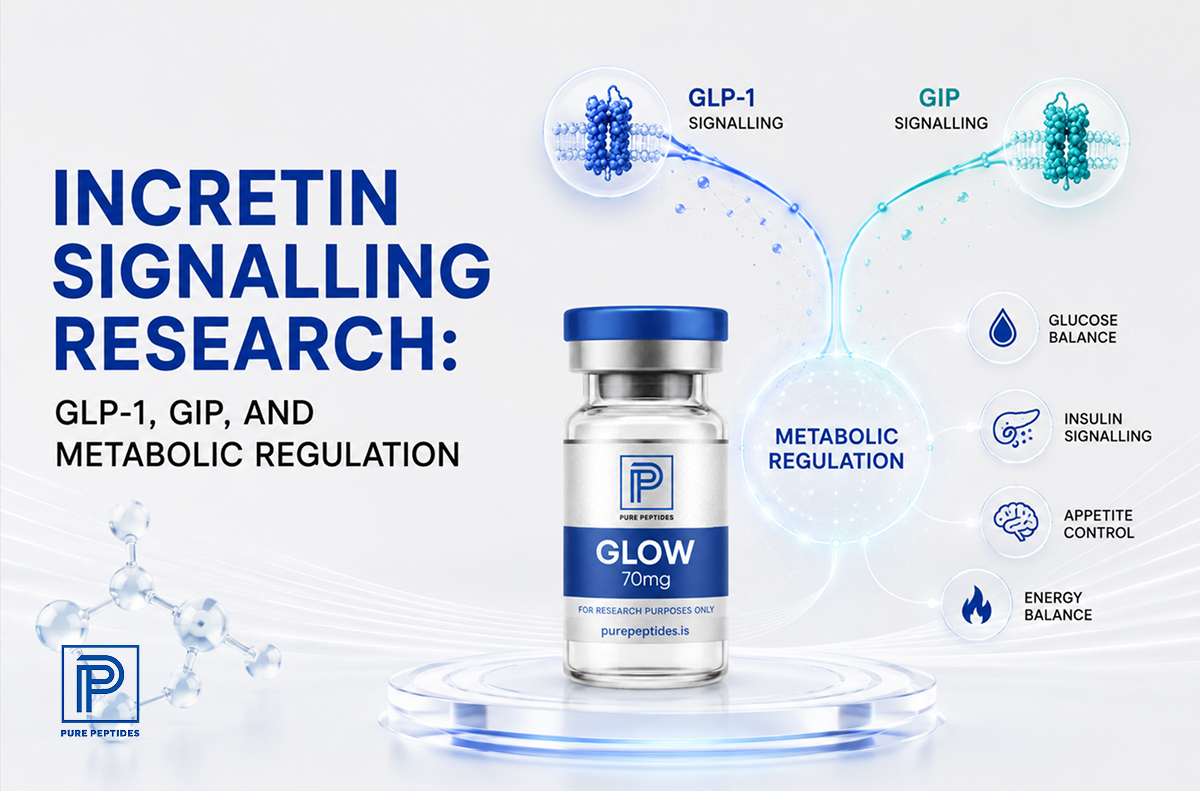
Incretin Signalling Research: GLP-1, GIP, and Metabolic Regulation


Incretin signalling research examines how gastrointestinal hormones connect nutrient intake with pancreatic and metabolic responses. Two hormones dominate this field: glucagon-like peptide-1 (GLP-1) and glucose-dependent insulinotropic polypeptide (GIP).
Both hormones contribute to glucose-dependent insulin regulation. However, they activate different receptors and differ in glucagon signalling and broader metabolic activity. These distinctions have become particularly important as researchers investigate compounds designed to activate one or several metabolic receptors.
For researchers exploring metabolic pathways through Pure Peptides, understanding GLP-1 and GIP provides a foundation for interpreting modern incretin-based research.
What Are Incretin Hormones?
Incretins are gastrointestinal hormones released after nutrient intake. In particular, they help enhance insulin secretion when glucose concentrations are elevated.
Meanwhile, GLP-1 originates mainly from intestinal L cells, whereas GIP is primarily released from K cells. Once released, GLP-1 activates the GLP-1 receptor (GLP-1R), while GIP activates the GIP receptor (GIPR).
Both hormones contribute to the incretin effect. This term describes the greater insulin response generally observed after oral glucose compared with an equivalent intravenous glucose exposure. The difference demonstrates how gastrointestinal signals contribute to post-meal glucose regulation.
| Feature | GLP-1 | GIP |
|---|---|---|
| Receptor | GLP-1R | GIPR |
| Main source | Intestinal L cells | Intestinal K cells |
| Main stimulus | Nutrient intake | Nutrient intake |
| Insulin relationship | Glucose-dependent | Glucose-dependent |
| Glucagon relationship | Generally suppressive at elevated glucose | More dependent on glucose conditions |
| Primary research area | Pancreatic and metabolic signalling | Pancreatic and metabolic signalling |
Although GLP-1 and GIP share some functions, their receptor biology and physiological responses are sufficiently different to make them distinct research targets.
Explore quality-tested research peptides with clear product information and laboratory-focused standards at Pure Peptides.
GLP-1 Receptor Signalling
GLP-1R is a class B G-protein-coupled receptor. In pancreatic beta cells, its activation stimulates Gs-mediated signalling and increases intracellular cyclic adenosine monophosphate (cAMP).
Subsequently, cAMP influences pathways involving protein kinase A (PKA) and Epac proteins. These signals interact with calcium-dependent processes and insulin granule exocytosis.
Importantly, GLP-1R activity depends on the surrounding metabolic environment. Rather than independently triggering insulin secretion, GLP-1 signalling primarily amplifies the beta cell’s response to elevated glucose.
Researchers also investigate GLP-1 signalling in relation to glucagon regulation, gastric emptying, gastrointestinal physiology, and central pathways involved in nutrient and energy regulation.
Therefore, GLP-1 research extends beyond a single pancreatic mechanism. Nevertheless, the strength of evidence varies between tissues and experimental models, making careful interpretation important.
GIP Receptor Signalling
GIPR also belongs to the class B family of G-protein-coupled receptors. Like GLP-1R, its activation can increase cAMP signalling in pancreatic beta cells and amplify glucose-dependent insulin secretion.
However, GIP differs from GLP-1 in several important ways.
One notable difference involves glucagon regulation. GLP-1 generally suppresses glucagon when glucose levels rise. In contrast, GIP can promote glucagon secretion when glucose levels remain lower.
As a result, researchers increasingly examine GIP signalling according to the surrounding metabolic environment rather than treating it exclusively as an insulin-related pathway.
GIPR research also extends to tissues beyond the pancreatic beta cell, including adipose, bone, and neural systems. However, the physiological significance of individual receptor populations remains an active area of investigation.
These characteristics make GIP particularly relevant to experimental models combining GIPR with other metabolic receptor targets.
Incretin Effects on Pancreatic and Metabolic Pathways
The pancreatic islet is central to incretin signalling research, but its response involves more than beta cells alone.
Beta cells integrate glucose signals with GLP-1R and GIPR activity to regulate insulin secretion. Meanwhile, alpha cells contribute glucagon-related signals that influence glucose availability and islet communication.
Consequently, researchers increasingly study incretin biology as part of a coordinated gut-pancreas metabolic axis.
| Pathway | Research Focus |
|---|---|
| GLP-1R | Glucose-responsive endocrine signalling |
| GIPR | Nutrient-responsive endocrine signalling |
| cAMP | Intracellular signal amplification |
| Alpha-cell pathways | Glucagon regulation |
| Gut-pancreas axis | Coordination between nutrients and pancreatic responses |
| Central pathways | Integration of metabolic and energy-related signals |
The duration of signalling also matters. Dipeptidyl peptidase-4 (DPP-4) rapidly inactivates native GLP-1 and GIP, limiting their biological activity.
Therefore, researchers should distinguish normal short-lived incretin signalling from the prolonged receptor activation produced by engineered experimental compounds.
Incretin-Based Compounds in Experimental Research
Modern incretin research increasingly examines compounds designed to modify or combine receptor activity.
Three broad experimental strategies are particularly relevant:
- Single-receptor agonism targets one signalling pathway.
- Dual-receptor agonism can combine GLP-1R and GIPR activity.
- Multi-receptor agonism adds other metabolic targets, such as the glucagon receptor.
These models allow researchers to examine whether coordinated receptor activation produces different metabolic responses from isolated receptor stimulation.
However, the number of receptors targeted does not determine a compound’s complete biological profile. Researchers must also consider relative receptor potency, selectivity, tissue exposure, signalling characteristics, and pharmacokinetics.
| Variable | Why It Matters |
|---|---|
| Receptor potency | Determines relative activity at each target |
| Selectivity | Influences which pathways receive meaningful activation |
| Signalling bias | Can alter downstream cellular responses |
| Tissue exposure | Influences where signalling occurs |
| Pharmacokinetics | Determines concentration and duration of exposure |
For example, two compounds may target GLP-1R and GIPR but display different activity because their relative potency at each receptor differs.
Canada continues to participate in clinical research involving incretin-based compounds. However, authorization to conduct a Canadian clinical trial permits investigation under a specific research protocol and should not be interpreted as general market authorization.
Explore quality-tested research peptides with clear product information and laboratory-focused standards at Pure Peptides.
Evidence Gaps and Research Limitations
Despite major advances, several questions remain unresolved in incretin signalling research.
First, cellular experiments cannot reproduce complete human metabolic physiology. Receptor assays are useful for studying potency and intracellular signalling, while animal models provide information about integrated biological responses. Human studies provide another level of evidence with additional physiological complexity.
Second, species differences remain important. Receptor distribution, neural pathways, and metabolic responses observed in animals may not translate directly to humans.
Third, engineered incretin compounds can produce much longer receptor exposure than native GLP-1 and GIP. Therefore, sustained pharmacological signalling should not automatically be treated as equivalent to endogenous hormone physiology.
Finally, multi-receptor compounds create attribution problems. When a molecule activates several receptors simultaneously, researchers may find it difficult to determine how much each pathway contributes to a whole-body outcome.
Important research questions remain:
- How do GLP-1R and GIPR interact during simultaneous activation?
- How important is relative receptor potency?
- What role does signalling bias play?
- How does prolonged activation change receptor responses?
- Which preclinical mechanisms reliably translate to humans?
- How should different multi-receptor compounds be compared?
Addressing these questions requires evidence across molecular, preclinical, and human research models.
Explore how key peptides interact with metabolic pathways and signalling systems in our guide: Peptides in Metabolic Signalling Research: Pathways, Compounds, and Evidence.
FAQ About Incretin Signalling Research
What are the main incretin hormones?
GLP-1 and GIP are the two principal incretin hormones. Both respond to nutrient intake and contribute to glucose-dependent pancreatic signalling.
What is the incretin effect?
The incretin effect describes the greater insulin response generally observed after oral glucose compared with equivalent intravenous glucose exposure. It demonstrates the contribution of gastrointestinal hormones to glucose regulation.
Do GLP-1 and GIP activate the same receptor?
No. GLP-1 activates GLP-1R, while GIP activates GIPR. However, both receptors can influence some common intracellular pathways in pancreatic beta cells.
What is the main difference between GLP-1 and GIP signalling?
Although both participate in glucose-dependent insulin regulation, they differ in receptor biology and several physiological effects. Their influence on glucagon regulation is one important example.
Why are GLP-1 and GIP studied together?
Researchers study these pathways together to understand coordinated incretin signalling and investigate how simultaneous receptor activation differs from targeting either receptor alone.
What are multi-receptor incretin compounds?
They are experimental molecules designed to activate multiple metabolic receptors. For example, some research models combine GLP-1R and GIPR activity, while others incorporate an additional receptor such as the glucagon receptor.
Is incretin research conducted in Canada?
Yes. Canada participates in research involving incretin biology and experimental metabolic compounds. However, clinical-trial authorization is separate from general market authorization.
Final Thoughts
Incretin signalling research provides an important framework for understanding how GLP-1 and GIP connect nutrient intake with pancreatic and metabolic regulation. Although the two hormones share some signalling characteristics, their distinct receptor biology makes each an important research target.
Meanwhile, dual- and multi-receptor compounds are expanding the field beyond traditional incretin models. Researchers must therefore consider receptor potency, signalling behaviour, pharmacokinetics, experimental model, and evidence quality when interpreting results.
For researchers investigating metabolic signalling and laboratory-focused peptides, Pure Peptides provides a research-oriented resource for exploring emerging areas of peptide science.
Disclaimer: This content is provided for educational and scientific research purposes only. Research peptides are intended for laboratory research only and are not intended for human consumption or medical use.
Really interesting overview of incretin signalling research. I liked how the article explains the role of incretin pathways in metabolic signalling without making the current evidence sound more conclusive than it is. A deeper comparison of the different signalling pathways would be an interesting follow-up.
I found this article helpful for understanding the broader research behind incretin signalling. The explanation of how different pathways are being investigated provides useful context for understanding current metabolic research. I’d be interested in seeing more about how researchers distinguish the roles of individual incretin receptors.
Appreciate the clear, research-focused approach to this topic. Incretin signalling involves several interconnected biological processes, so having the pathways explained in a structured way makes the subject much easier to follow. A follow-up comparing incretin signalling with other metabolic signalling systems would be very informative.