
Limitations of Preclinical Peptide Research: Evidence, Models, and Translation


Understanding the limitations of preclinical peptide research is essential when interpreting evidence involving experimental peptides. Cell cultures, tissue models, and animal studies can reveal molecular mechanisms and biological responses, but they cannot independently establish how a peptide will behave in humans.
For researchers evaluating laboratory materials from Pure Peptides, this distinction matters because experimental outcomes depend on more than the peptide itself. Model selection, species biology, material quality, concentration, and study design can all influence results.
Therefore, preclinical research is most useful for generating hypotheses and characterizing mechanisms that require further investigation.
What Is Preclinical Peptide Research?
Preclinical peptide research investigates experimental compounds before formal human clinical testing. Researchers use these studies to characterize biological activity, identify potential mechanisms, and determine whether further investigation is scientifically justified.
For example, common research endpoints include:
- Receptor interactions
- Cellular signalling
- Migration and proliferation
- Tissue responses
- Pharmacokinetic behaviour
- Dose-response relationships
- Potential toxicity signals
Researchers typically use models of increasing biological complexity:
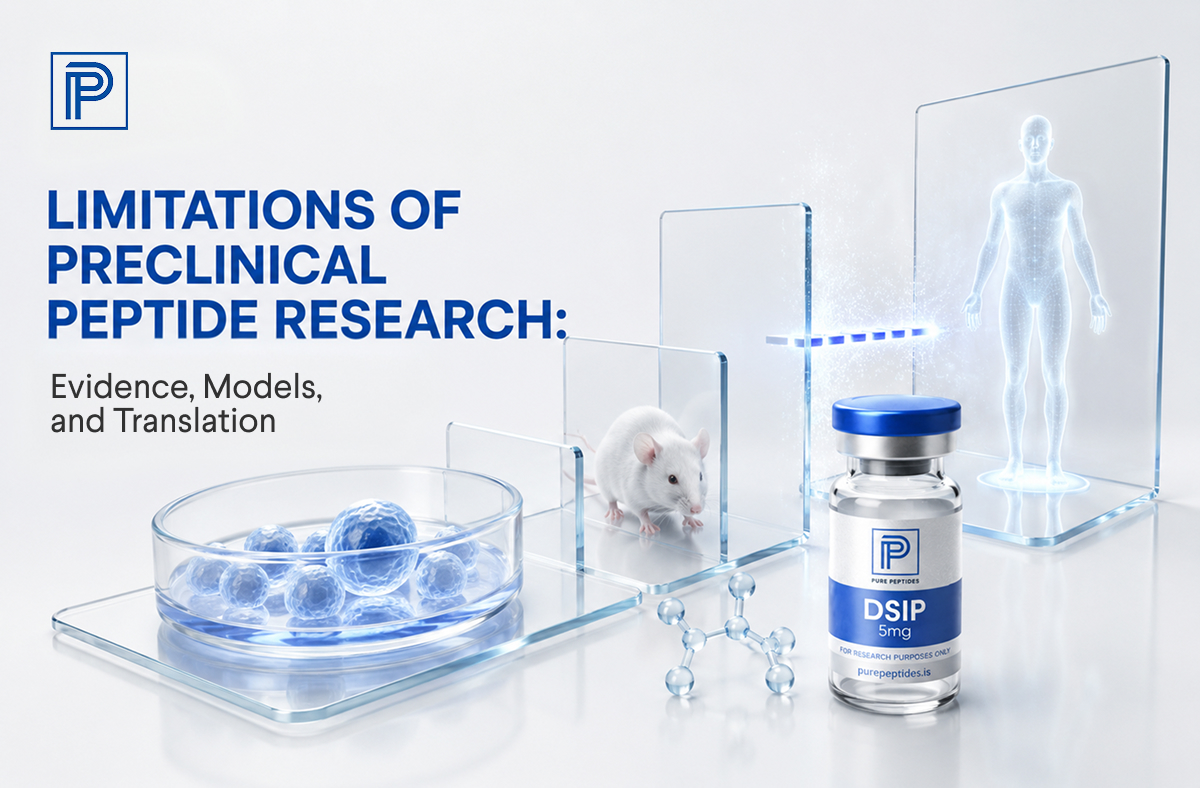
Molecular assay → Cell model → Tissue model → Animal model → Human research
| Research Model | Primary Purpose | Key Limitation |
|---|---|---|
| Molecular assay | Target interaction | Minimal biological complexity |
| Cell culture | Cellular mechanisms | Limited tissue environment |
| Tissue model | Local tissue responses | Lacks systemic interactions |
| Animal model | Whole-organism responses | Species differences |
| Human research | Clinical relevance | Requires rigorous clinical evaluation |
Each model answers a different question. Consequently, researchers should interpret findings within the boundaries of the experimental system rather than extending them directly to human outcomes.
Explore quality-tested research peptides with clear product information and laboratory-focused standards at Pure Peptides
Limitations of In Vitro Research Models
In vitro models allow researchers to investigate peptide activity under highly controlled conditions. For example, cell cultures can measure receptor activation, signalling pathways, gene expression, migration, proliferation, and cytotoxicity.
However, isolated cells cannot fully reproduce the complexity of an intact organism.
Inside living tissue, cells interact continuously with extracellular matrices, immune cells, hormones, vascular networks, neighbouring tissues, and circulating molecules. Removing these interactions makes laboratory experiments easier to control but reduces their biological complexity.
In addition, cell selection also matters. Immortalized cell lines provide consistency, whereas primary cells may better represent normal biology but introduce greater variability.
In addition, experimental concentration can affect interpretation. A cellular response observed at a particular concentration does not demonstrate that comparable exposure will occur in an intact organism.
Therefore, in vitro research works particularly well for identifying mechanisms and experimental hypotheses, but researchers need more complex models before drawing broader biological conclusions.
Limitations of Animal Studies
Animal studies allow researchers to examine peptide behaviour within an integrated biological system. They can provide information about metabolism, tissue distribution, systemic signalling, toxicity, and interactions between organs.
Nevertheless, species differences create an important translational limitation.
Animals and humans may differ in:
- Metabolism
- Receptor expression
- Enzyme activity
- Immune responses
- Organ physiology
- Pharmacokinetics
- Disease progression
Laboratory conditions create another challenge. Researchers often standardize animal strain, age, diet, housing, and environmental exposure to reduce experimental variability.
By contrast, human populations are much more diverse. Genetics, age, medications, lifestyle, environmental factors, and other biological variables can influence responses.
As a result, animal studies provide valuable whole-organism evidence but cannot guarantee that humans will produce the same response. Researchers should instead evaluate how well a particular animal model represents the biological process being investigated.
Differences Between Experimental and Human Biology
The translational gap extends beyond species differences. Experimental models often represent biological conditions that are considerably simpler than those encountered in humans.
For instance, researchers may create a standardized acute injury to examine a specific tissue response. In contrast, human disorders may develop gradually and involve multiple biological pathways simultaneously.
| Experimental Models | Human Biology |
|---|---|
| Controlled genetics | Genetic diversity |
| Standardized environment | Variable environments |
| Defined experimental condition | Complex disease processes |
| Controlled exposure | Variable biological exposure |
| Few confounding factors | Multiple interacting factors |
| Short study periods | Potentially chronic progression |
Importantly, researchers must also distinguish molecular endpoints from meaningful functional outcomes.
For example, increased expression of a growth factor demonstrates a biological response but does not automatically demonstrate improved tissue function. Similarly, increased cell migration does not establish a clinically meaningful effect.
Thus, mechanistic evidence and human outcome evidence answer different scientific questions.
Variability in Peptide Quality and Study Protocols
Biological models are not the only source of uncertainty. Differences in research materials and experimental protocols can also affect peptide-study results.
Important variables include:
- Molecular identity and sequence
- Purity
- Formulation
- Concentration
- Storage conditions
- Exposure duration
- Experimental controls
- Analytical methodology
Peptide quality deserves particular attention. Two studies may report investigating the same peptide while using materials with different purity profiles, formulations, or batch characteristics. Consequently, researchers may have difficulty determining whether differences in outcomes reflect biology or material variability.
Similarly, study protocols create additional challenges. A short-duration cellular experiment and a longer animal study may use the same peptide but investigate entirely different questions.
Researchers can improve reproducibility by clearly documenting experimental materials, controls, concentrations, storage conditions, and analytical methods. Techniques such as HPLC and mass spectrometry can also support characterization of research materials when appropriate.
Explore quality-tested research peptides with clear product information and laboratory-focused standards at Pure Peptides
Why Preclinical Findings May Not Translate to Humans
The limitations of preclinical peptide research become most apparent during translation from laboratory findings to human research.
Several uncertainties can accumulate:
Model limitations + biological differences + protocol variability + material variability → translational uncertainty
For example, a peptide may interact with its intended molecular target in cell culture yet behave differently in an organism because of metabolism, tissue distribution, or interactions with other biological systems.
Likewise, a response observed in an animal may depend on physiological characteristics that differ in humans.
This does not make preclinical evidence unimportant. Instead, it defines what the evidence can support. Preclinical research can help researchers:
- Identify biological mechanisms
- Compare experimental conditions
- Characterize molecular responses
- Detect potential safety signals
- Generate hypotheses for further investigation
More human-relevant systems, including organoids and organ-on-chip platforms, may complement traditional cell and animal models. However, no single experimental system can reproduce every aspect of human biology.
For Canadian research, this distinction is also important from a regulatory perspective. Preclinical findings involving an experimental peptide do not establish therapeutic authorization, clinical effectiveness, or human safety. Researchers should therefore maintain a clear separation between laboratory findings and human health claims.
Explore tissue repair pathways, angiogenesis, and current scientific evidence in Peptides in Tissue Repair Research: Mechanisms, Applications, and Evidence.
FAQ About the Limitations of Preclinical Peptide Research
What can preclinical peptide research demonstrate?
Preclinical studies can investigate molecular mechanisms, cellular responses, tissue effects, pharmacological behaviour, and potential safety signals. Their conclusions remain limited to the models and conditions tested.
Why are in vitro peptide studies limited?
Cell cultures simplify complex biological environments. They cannot fully reproduce metabolism, immune interactions, vascular systems, organ-to-organ communication, and other whole-body processes.
Why can animal studies produce different results from human studies?
Species may differ in metabolism, receptor biology, immune responses, pharmacokinetics, and physiology. Human populations also have considerably greater biological and environmental variability.
Does positive preclinical evidence prove that a peptide works in humans?
No. Positive laboratory findings can justify additional research, but controlled human studies are required to evaluate clinical outcomes.
Why does peptide quality matter?
Differences in molecular identity, purity, formulation, storage, or batch characteristics can affect experimental results and make studies harder to compare.
Can advanced research models improve translation?
Potentially. Human-derived cells, organoids, and organ-on-chip systems can complement conventional models. However, researchers generally need multiple forms of evidence because no individual model captures complete human biology.
Final Thoughts
Understanding the limitations of preclinical peptide research helps researchers interpret experimental findings more accurately. In vitro models can clarify molecular mechanisms, while animal studies provide insight into more complex biological interactions. However, neither can independently predict human outcomes.
Therefore, reliable peptide research depends on well-characterized materials, appropriate experimental models, reproducible protocols, and careful interpretation of the available evidence. Researchers seeking high-quality materials and laboratory-focused information can explore Pure Peptides for their research needs.
Disclaimer: This content is provided for educational and scientific research purposes only. Research peptides are intended for laboratory use only and are not intended for human consumption or medical use.
Really valuable discussion of the limitations of preclinical peptide research. I appreciate that the article highlights the gap between promising laboratory findings and what can eventually be demonstrated in humans. The points around model selection and study design are especially important when interpreting early research.
I found the discussion of translating preclinical findings particularly helpful. It’s easy to assume that encouraging results in cell or animal models will translate directly to humans, so understanding the limitations is essential. A follow-up comparing different preclinical models and their strengths and weaknesses would be very interesting.
Appreciate the balanced approach to discussing preclinical peptide research. The emphasis on sample size, reproducibility and biological differences between models provides useful context for evaluating early evidence. I’d be interested in seeing more about how researchers determine when preclinical findings are strong enough to justify further investigation.