
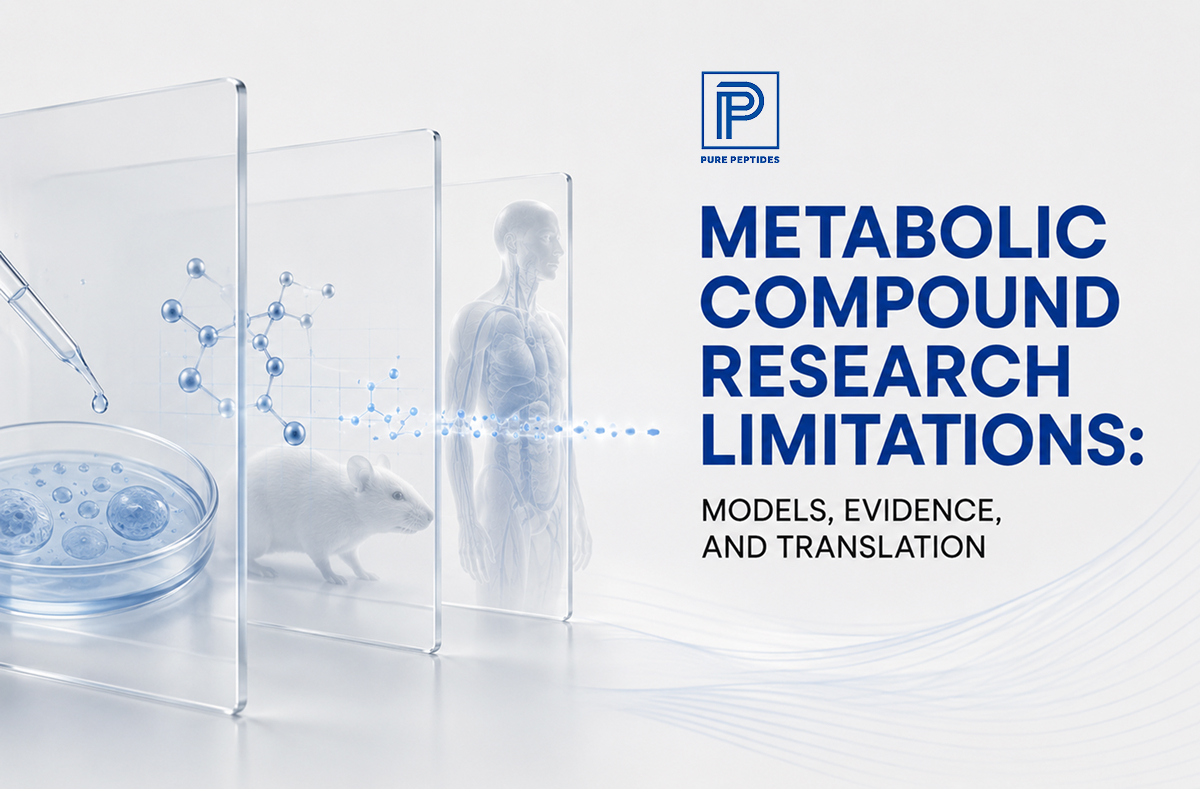
Metabolic Compound Research Limitations: Models, Evidence, and Translation


Metabolic research often examines whether an experimental compound can influence processes such as mitochondrial activity, glucose regulation, energy use, receptor signalling, or cellular metabolism. However, results from laboratory models do not automatically predict human outcomes.
Understanding metabolic compound research limitations is essential when evaluating peptides, small molecules, receptor agonists, and other experimental compounds. Each research model answers a different question, and each has clear boundaries.
For researchers comparing emerging metabolic compounds, Pure Peptides provides research-focused product information to support more informed laboratory investigation and evidence evaluation.
Understanding Metabolic Compound Research
Metabolic compound research investigates how experimental agents affect biological processes involved in energy regulation, nutrient use, mitochondrial function, and signalling.
Researchers usually build evidence progressively. Molecular assays can identify a target or biochemical interaction. Cell models can then reveal cellular mechanisms, while animal studies add whole-body physiology. Human studies are ultimately required to determine whether preclinical findings remain relevant in people.
| Research Stage | Main Purpose | Main Limitation |
|---|---|---|
| Molecular assays | Identify biochemical targets | Limited physiological context |
| Cell models | Study cellular mechanisms | No whole-body interactions |
| Animal studies | Examine systemic effects | Species differences |
| Human studies | Evaluate human relevance | Greater biological variability |
Therefore, researchers should interpret each result according to the model that produced it.
Explore quality-tested research peptides with clear product information and laboratory-focused standards at Pure Peptides.
Limitations of Cell-Based Research Models
Cell-based studies help researchers isolate mechanisms under controlled conditions.
For example, researchers can examine receptor activation, gene expression, glucose transport, mitochondrial respiration, or enzyme activity in a specific cell type.
However, cultured cells cannot reproduce whole-body metabolism.
Metabolism depends on interactions among skeletal muscle, liver, adipose tissue, pancreas, brain, circulation, and hormonal systems. Consequently, a metabolic response observed in one isolated cell type may change substantially when these systems interact.
Experimental conditions can also affect outcomes. Differences in cell type, culture medium, oxygen availability, exposure duration, or compound concentration may lead to different results across laboratories.
Moreover, some in vitro studies use concentrations that may not correspond closely to achievable tissue exposure in vivo.
Therefore, cell models are most useful for identifying mechanisms rather than predicting complete physiological effects.
Limitations of Animal Metabolic Studies
Animal models provide more biological complexity than cell cultures. Researchers can examine tissue interactions and measure endpoints such as energy expenditure, glucose handling, body composition, and mitochondrial function.
Nevertheless, species differences remain a major limitation.
Rodents and humans differ in metabolic rate, receptor expression, enzyme activity, hormone regulation, lifespan, and pharmacokinetics. As a result, a metabolic effect observed in mice may not occur with the same magnitude or significance in humans.
Animal disease models also simplify complex human conditions.
For example, diet-induced obesity in mice may reproduce selected features of metabolic dysfunction. However, it cannot fully reflect human genetic diversity, environmental influences, behaviour, age, and long-term disease progression.
Therefore, animal studies provide valuable mechanistic and systemic evidence, but they should not be treated as direct predictors of human outcomes.
Differences Between Preclinical and Human Outcomes
One of the most important metabolic compound research limitations is the gap between preclinical findings and human results.
A compound may show receptor activity in molecular assays, alter cellular metabolism, and produce measurable effects in animals. However, those findings may become weaker, different, or absent in humans.
Several factors contribute to this gap.
| Translational Factor | Why It Matters |
|---|---|
| Pharmacokinetics | Absorption, distribution, metabolism, and elimination may differ |
| Receptor biology | Target expression can vary across species |
| Population variability | Genetics, age, sex, diet, and metabolic status affect responses |
| Study duration | Short studies may not predict long-term effects |
| Exposure | Experimental concentrations may not translate directly |
| Safety | Biological activity does not establish acceptable safety |
For example, strong receptor activation confirms that a compound can interact with a target under defined conditions. However, it does not prove that the same target will receive sufficient exposure in humans.
Therefore, preclinical findings should guide further investigation rather than serve as evidence of established human effectiveness.
Canadian Research Context
In Canada, researchers should also distinguish experimental evidence from regulatory status.
Health Canada can authorize specific clinical trials involving investigational health products. However, clinical-trial authorization does not equal general market authorization.
Consequently, a compound may enter clinical research without becoming an approved therapeutic product in Canada.
Explore quality-tested research peptides with clear product information and laboratory-focused standards at Pure Peptides.
Variability in Compounds, Protocols, and Study Endpoints
Differences between studies do not always indicate contradictory biology. Often, the research conditions differ.
Compound quality represents one important variable. Researchers need to consider identity, purity, concentration, stability, and analytical confirmation.
For peptide-based compounds, sequence integrity and degradation may influence activity. Small molecules require different characterization methods. Therefore, analytical methods should match the chemical class being studied.
Protocol differences also matter. Researchers may use different cell types, animal strains, concentrations, exposure periods, diets, or control groups.
As a result, direct comparisons between studies may be misleading if these factors differ substantially.
Endpoints create another challenge.
One study may measure mitochondrial oxygen consumption, while another evaluates gene expression, glucose regulation, or energy expenditure. These endpoints reflect different levels of biological activity.
For example, increased expression of oxidative genes may indicate pathway activation, but it does not automatically demonstrate improved whole-body metabolism.
Therefore, researchers should interpret each endpoint within the specific question the study was designed to answer.
Challenges in Interpreting and Translating Evidence
The main challenge in metabolic research is determining what a result actually demonstrates.
First, researchers should separate mechanistic evidence from physiological evidence. A compound may activate a receptor without producing a meaningful systemic effect.
Second, reproducibility matters. Confidence increases when independent studies and different models produce similar findings.
Moreover, researchers should evaluate whether the chosen model fits the research question. A cell assay may provide strong evidence for receptor activity while offering limited information about long-term metabolism.
Terminology also requires caution.
Labels such as “metabolic enhancer,” “mitochondrial activator,” or “exercise mimetic” can make a compound sound more broadly effective than the evidence supports.
For example, an experimental compound may increase selected oxidative pathways in an animal model. However, this does not mean it reproduces the cardiovascular, neurological, endocrine, and mechanical effects of exercise.
Finally, biological plausibility should remain separate from demonstrated human relevance.
A promising mechanism may justify further research. Nevertheless, meaningful human conclusions require appropriately designed human studies.
Therefore, the strongest interpretation considers molecular data, cell research, animal findings, reproducibility, pharmacology, and human evidence together.
Explore how key peptides interact with metabolic pathways and signalling systems in our guide: Peptides in Metabolic Signalling Research: Pathways, Compounds, and Evidence.
FAQ About Metabolic Compound Research Limitations
Why are cell studies limited in metabolic research?
Cell models isolate specific mechanisms but cannot reproduce whole-body interactions involving organs, hormones, circulation, and neural signalling.
Why do animal findings sometimes differ from human outcomes?
Species differ in metabolic rate, receptor biology, enzyme activity, physiology, and pharmacokinetics. Therefore, animal findings may not translate directly to humans.
Are animal models still useful?
Yes. They allow researchers to examine systemic physiology and tissue interactions that cell models cannot reproduce.
Why does compound quality matter?
Purity, stability, concentration, and correct identification can influence experimental results. Consequently, well-characterized research materials improve reproducibility.
Can two studies using the same compound be compared directly?
Not always. Researchers should first compare model type, protocol, exposure, controls, compound characterization, and study endpoints.
Does successful preclinical research prove effectiveness in humans?
No. Preclinical research can demonstrate biological activity, but it cannot establish equivalent human outcomes.
Does Health Canada clinical-trial authorization mean approval?
No. Authorization applies to a specific clinical study and does not represent general market approval.
Final Thoughts
Understanding metabolic compound research limitations helps researchers avoid conclusions that extend beyond the available evidence.
Cell studies are useful for mechanisms, while animal models provide systemic context. However, neither perfectly predicts human outcomes. Species differences, pharmacokinetics, compound quality, protocol design, and endpoint selection can all influence translation.
Therefore, researchers should evaluate emerging metabolic compounds through an evidence hierarchy rather than relying on one isolated result.
For laboratories investigating peptides and other metabolic research compounds, Pure Peptides provides research-focused information designed to support informed experimental planning and evidence evaluation.
Disclaimer: This content is provided for educational and scientific research purposes only. Research peptides are intended for laboratory research only and are not intended for human consumption or medical use.