
Retatrutide Mechanism of Action: GLP-1, GIP, and Glucagon Receptor Signalling


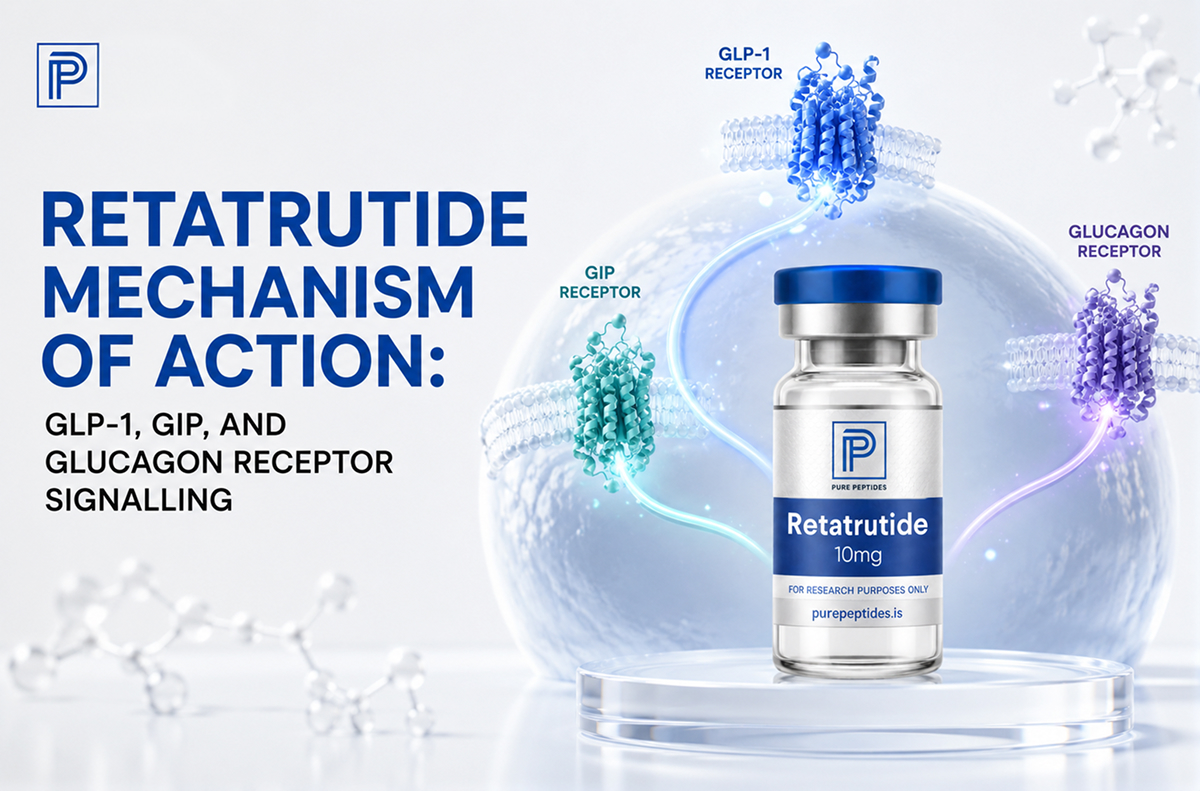
The retatrutide mechanism of action centres on simultaneous activity at three metabolically important receptors: glucose-dependent insulinotropic polypeptide (GIP), glucagon-like peptide-1 (GLP-1), and glucagon receptors. Retatrutide, also known as LY3437943, is a single engineered peptide rather than a mixture of three separate receptor agonists.
For researchers exploring metabolic compounds through Pure Peptides, this triple-receptor design provides an interesting model for studying how incretin and glucagon pathways interact. Each receptor contributes a different component to metabolic signalling, while the complete molecule produces an integrated biological response.
Although researchers have characterized the three receptor targets, an important question remains: how much does each pathway contribute to the effects observed with the complete molecule? Understanding that distinction is essential when interpreting current mechanistic and clinical evidence.
Understanding Retatrutide’s Triple-Receptor Activity
Researchers engineered retatrutide to activate three G-protein-coupled receptors (GPCRs): GIP, GLP-1, and glucagon receptors. This design distinguishes it from compounds that primarily target one or two metabolic receptor systems.
Importantly, triple-receptor activity does not mean equal activity at all three receptors. Published pharmacological characterization has shown different relative potencies across the individual receptor targets.
| Receptor | Main Research Context | Relevant Signalling Role |
|---|---|---|
| GLP-1 receptor | Incretin biology | Nutrient-responsive and insulin-related signalling |
| GIP receptor | Incretin biology | Postprandial endocrine signalling |
| Glucagon receptor | Hepatic metabolism | Glucose and energy-related signalling |
| Combined activity | Multi-receptor research | Integrated metabolic response |
This distinction matters because receptor potency, tissue exposure, receptor distribution, and downstream signalling can all influence biological outcomes.
Therefore, researchers study retatrutide as one integrated pharmacological system rather than treating it as three independent mechanisms operating side by side.
Explore quality-tested research peptides with clear product information and laboratory-focused standards at Pure Peptides
GLP-1 Receptor Signalling
GLP-1 is an endogenous incretin hormone released in response to nutrient intake. Its receptor belongs to the class B family of G-protein-coupled receptors and plays an established role in metabolic signalling.
When an agonist activates the GLP-1 receptor, intracellular signalling commonly involves Gs proteins, adenylyl cyclase, and increased cyclic AMP (cAMP). These signals can then influence downstream cellular responses.
In pancreatic beta cells, GLP-1 receptor activation contributes to glucose-dependent insulin secretion. In addition, GLP-1 pathways participate in broader physiological processes related to nutrient intake and gastrointestinal signalling.
This pathway helps explain one component of the retatrutide mechanism of action. However, findings from selective GLP-1 receptor agonists cannot fully predict retatrutide activity because the molecule simultaneously engages GIP and glucagon receptors.
As a result, GLP-1 signalling provides an important mechanistic foundation, but it represents only one part of retatrutide’s pharmacology.
GIP Receptor Signalling
GIP is another endogenous incretin hormone released following nutrient intake. Its receptor also belongs to the G-protein-coupled receptor family and can activate intracellular cAMP-related signalling.
In pancreatic beta cells, GIP receptor activation contributes to glucose-dependent insulin responses. Researchers also investigate GIP signalling in other metabolically active tissues, where its effects may extend beyond pancreatic function.
GIP is particularly relevant to retatrutide because published receptor assays demonstrate substantial activity at this target. Nevertheless, receptor potency measured under controlled experimental conditions does not directly reveal how much GIP signalling contributes to a whole-body outcome.
For example, receptor density and peptide exposure may vary across tissues. Moreover, simultaneous GLP-1 and glucagon receptor activity can modify the overall metabolic response.
Thus, researchers evaluate GIP as a complementary component of retatrutide’s multi-receptor design rather than as an isolated explanation for its observed effects.
Glucagon Receptor Signalling
Glucagon receptor activity gives retatrutide a mechanistic feature that differs from approaches focused only on incretin receptors.
The glucagon receptor plays an important role in hepatic metabolism. Endogenous glucagon helps regulate glucose availability, particularly by signalling processes in the liver that support circulating glucose during periods of metabolic demand.
However, glucagon biology extends beyond glucose regulation. Experimental research has also examined glucagon signalling in relation to lipid metabolism, substrate utilization, food intake, and energy expenditure.
These broader effects help explain why researchers are interested in combining glucagon receptor activity with GLP-1 and GIP signalling. Rather than studying glucagon as an independent pathway, investigators can examine whether it complements incretin-related metabolic responses.
Still, researchers should avoid assuming that every outcome observed with retatrutide results directly from glucagon receptor activation. Clinical endpoints reflect the activity of the complete molecule and cannot independently establish the contribution of one receptor.
How the Three Pathways Interact
The most distinctive aspect of the retatrutide mechanism of action is the coordinated activation of GIP, GLP-1, and glucagon receptors.
GLP-1 receptor signalling contributes to nutrient-responsive endocrine activity and glucose-dependent insulin responses. Meanwhile, GIP adds another incretin pathway involved in postprandial metabolic regulation. Glucagon receptor signalling introduces a different component associated with hepatic and energy metabolism.
Together, these pathways create a multi-receptor system that researchers can evaluate at both molecular and physiological levels.
| Pathway | Role Within the Combined Mechanism |
|---|---|
| GLP-1 | Supports incretin and glucose-responsive signalling |
| GIP | Adds complementary nutrient-responsive signalling |
| Glucagon | Adds hepatic and energy-related signalling |
| Triple agonism | Integrates all three receptor pathways |
Human clinical studies demonstrate that the complete molecule can produce measurable metabolic outcomes. However, those results do not reveal a precise contribution from each receptor.
For instance, researchers cannot conclude that a specific percentage of an observed outcome comes from GLP-1 and another percentage from glucagon activity. Instead, receptor potency, pharmacokinetics, tissue distribution, and pathway interactions collectively shape the final response.
This integrated interpretation is more scientifically appropriate than simply adding together known effects of the three endogenous hormones.
Explore quality-tested research peptides with clear product information and laboratory-focused standards at Pure Peptides

Limitations of Current Mechanistic Evidence
Although researchers have established retatrutide’s receptor targets, important mechanistic uncertainties remain.
First, receptor assays cannot reproduce the complexity of whole-body metabolism. They can measure binding, potency, or intracellular responses under controlled conditions, but they do not capture communication among the pancreas, liver, gastrointestinal tract, brain, adipose tissue, and skeletal muscle.
Second, clinical studies evaluate the complete molecule. Consequently, an observed physiological change cannot precisely determine which receptor produced that response.
Another limitation involves the difference between a proposed mechanism and a demonstrated outcome. For example, glucagon receptor signalling has been investigated in relation to energy expenditure. However, observing a metabolic change with retatrutide does not independently prove how strongly that pathway contributed.
Longer-term clinical research also remains important. Phase 3 programs continue to investigate retatrutide across different metabolic populations and endpoints, including studies relevant to Canadian clinical research.
Key unanswered questions include:
- How much does each receptor contribute to specific outcomes?
- Do receptor interactions change across different tissues?
- How does metabolic state influence triple-receptor signalling?
- Are some effects primarily driven by one pathway?
- How does the mechanism change with different levels of exposure?
Therefore, current evidence supports the triple-receptor mechanism while leaving important questions about receptor-specific contributions unresolved.
Explore how key peptides interact with metabolic pathways and signalling systems in our guide: Peptides in Metabolic Signalling Research: Pathways, Compounds, and Evidence.
FAQ About the Retatrutide Mechanism of Action
What is the retatrutide mechanism of action?
Retatrutide acts as an agonist at GIP, GLP-1, and glucagon receptors. This allows one peptide to engage three interconnected metabolic signalling systems.
Is retatrutide a combination of three peptides?
No. Retatrutide is a single engineered peptide designed to activate three different receptor targets.
Does retatrutide activate all three receptors equally?
No. Pharmacological studies indicate different relative activity across GIP, GLP-1, and glucagon receptors. Triple agonism refers to the number of receptor targets rather than equal potency.
What role does GLP-1 signalling play?
GLP-1 receptor signalling contributes to nutrient-responsive endocrine activity, including glucose-dependent insulin responses and other metabolic processes.
Why is glucagon receptor activity included?
Glucagon receptor signalling provides an additional pathway associated with hepatic metabolism, substrate utilization, and energy-related processes. Researchers are studying how this activity interacts with the two incretin pathways.
Do researchers know which receptor produces each clinical outcome?
Not precisely. Because retatrutide activates all three receptors simultaneously, observed outcomes reflect the integrated pharmacology of the complete molecule.
Final Thoughts
The retatrutide mechanism of action differs from single-pathway approaches because one engineered peptide activates GIP, GLP-1, and glucagon receptors. Each target contributes distinct metabolic signalling, while their interaction creates the broader mechanism researchers are investigating.
Current evidence establishes retatrutide’s triple-receptor pharmacology, but the precise contribution of each pathway remains an active research question. Therefore, receptor-level findings and whole-body outcomes should be interpreted separately rather than assuming that one directly explains the other.
For researchers investigating metabolic signalling, receptor pharmacology, and laboratory-focused peptide compounds, Pure Peptides provides a research-oriented resource for exploring peptides across different molecular pathways.
Disclaimer: This content is provided for educational and scientific research purposes only. Research peptides are intended for laboratory research only and are not intended for human consumption or medical use.
Really interesting explanation of retatrutide’s proposed mechanism of action. I liked how the article breaks down the role of multiple receptor pathways and makes the underlying biology easier to follow. A comparison of how each pathway contributes to the overall research findings would be an interesting follow-up.
I found the discussion of retatrutide’s multi-receptor activity particularly helpful. Understanding how the different signalling pathways are being investigated provides useful context for interpreting the research. I’d be interested in seeing more about how researchers distinguish the effects associated with each receptor.
Really clear explanation of retatrutide’s proposed mechanism of action. I found the discussion of its multi-receptor activity particularly interesting because it helps explain why researchers are studying this approach. A deeper look at how the individual receptor pathways interact would be a great follow-up.