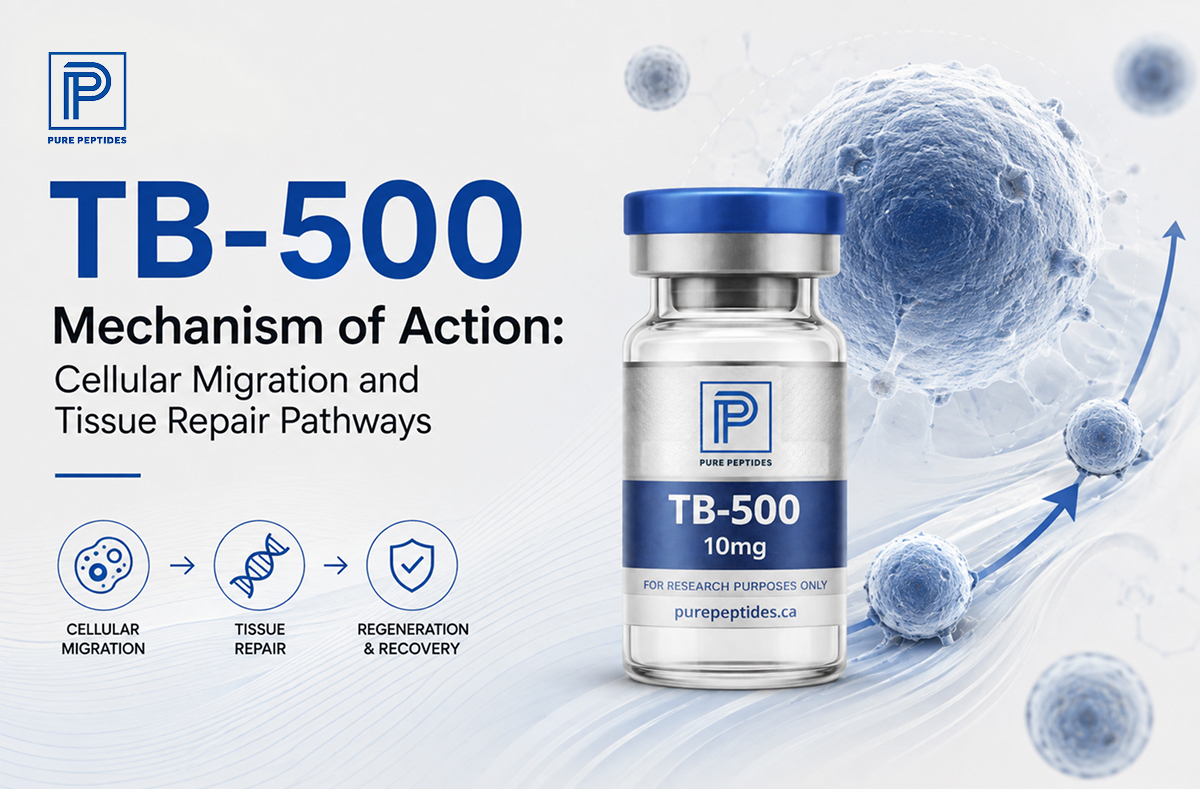
The proposed TB-500 mechanism of action is closely connected to thymosin beta-4 (Tβ4), a naturally occurring 43-amino-acid peptide involved in actin regulation and cytoskeletal organization. Because actin helps control cell structure and movement, Tβ4 has become an important research target in studies of cellular migration, angiogenesis, and tissue remodelling.
However, much of the available mechanistic evidence comes from studies of full-length Tβ4 or defined Tβ4-derived sequences rather than TB-500 directly. Therefore, researchers should consider molecular identity when interpreting these findings.
Overall, this article examines the major pathways associated with TB-500-related research and where current mechanistic evidence remains incomplete.
Understanding the Proposed Mechanism of TB-500
The proposed TB-500 mechanism of action involves several interconnected processes rather than one isolated pathway.
Research interest primarily focuses on:
Actin regulation
Cytoskeletal organization
Cellular migration
Angiogenesis
Cell-matrix interactions
Inflammatory and survival signalling
In particular, actin regulation provides the strongest mechanistic foundation. Tβ4 binds monomeric globular actin (G-actin), helping regulate the pool of actin available for filament formation.
As a result, this interaction may influence cytoskeletal dynamics required for cells to change shape and move.
Mechanism
Research Significance
G-actin binding
Regulates available actin monomers
Cytoskeletal dynamics
Supports cell structure and movement
Cell migration
Relevant to tissue-response models
Angiogenesis
Involved in vascular research
Matrix interactions
Relevant to tissue organization
Cellular signalling
Studied in stress and inflammatory models
These processes overlap considerably, which is why researchers often examine several endpoints within the same experiment.
Looking for TB-500 for laboratory research? Explore TB-500 10mg.
Thymosin Beta-4 and Actin Regulation
Understanding Tβ4-actin interactions helps explain much of the biological rationale behind TB-500 research.
Tβ4 acts as a major G-actin-sequestering peptide. By binding actin monomers, it contributes to the balance between G-actin and filamentous actin (F-actin).
For example, this balance matters because cells continuously assemble and disassemble actin filaments during movement and structural reorganization.
The relationship can be simplified as:
G-actin regulation → cytoskeletal organization → cellular movement
Moreover, researchers have identified the LKKTETQ region within the central actin-binding domain of Tβ4. Experimental studies have connected this region with actin interactions and migration-related biological activity.
Importantly, these findings primarily characterize Tβ4 and defined Tβ4 sequences. Consequently, researchers should confirm the structure of TB-500 material before assuming identical molecular behaviour.
Cellular Migration and Tissue Remodelling
Consequently, cell migration represents a logical extension of actin regulation.
For instance, during experimental tissue responses, fibroblasts, endothelial cells, and other cell populations may migrate and reorganize. Because this movement requires continuous cytoskeletal changes, researchers investigate how Tβ4-related activity affects migration.
In addition, another important component is the extracellular matrix (ECM). In turn, cells interact with this structural network through adhesion, migration, and matrix-associated signalling.
Therefore, experimental studies may measure:
Cellular migration
Cell adhesion
Cytoskeletal organization
Matrix-associated activity
Structural remodelling
Together, these endpoints help researchers examine individual components of tissue response without treating any single marker as evidence of complete tissue regeneration.
Angiogenesis and Blood Vessel Formation
Another proposed component of the TB-500 mechanism of action involves angiogenesis—the formation of new vascular structures from existing blood vessels.
In addition, research involving thymosin beta-4 has examined endothelial-cell migration, adhesion, vascular sprouting, and capillary-like structure formation.
Similarly, these processes also depend partly on cytoskeletal dynamics. For example, endothelial cells must reorganize actin structures before they can migrate and form new vascular networks.
As a result, angiogenesis is particularly relevant to tissue models because vascular structures help provide oxygen and nutrients to surrounding cells.
Nevertheless, experimental changes in angiogenic markers represent mechanistic evidence rather than proof of therapeutic tissue repair.
Looking for TB-500 for laboratory research? Explore TB-500 10mg.
Inflammation and Cellular Recovery Pathways
Tβ4 research extends beyond actin and vascular biology.
Furthermore, scientists have investigated Tβ4 and related sequences in models involving inflammatory signalling, apoptosis, cellular survival, and fibrotic responses.
For example, one important example is Ac-SDKP, a naturally occurring N-terminal tetrapeptide derived from Tβ4. Researchers have studied this sequence separately in relation to inflammatory and fibrotic pathways.
This illustrates an important point: different regions or metabolites of Tβ4 may have distinct biological activities.
Consequently, the broader mechanistic picture includes several related but separate processes:
Process
Research Focus
Actin regulation
Cytoskeletal dynamics
Migration
Cellular movement
Angiogenesis
Endothelial and vascular responses
Inflammation
Cellular signalling
Cell survival
Stress and apoptosis pathways
Matrix activity
Structural remodelling
Rather than describing TB-500 simply as a “repair peptide,” researchers can gain more useful information by studying these mechanisms individually.
Current Experimental Applications
Researchers use several model types to investigate mechanisms associated with TB-500 and Tβ4 biology.
Cell-Based Models
For instance, cell cultures allow scientists to examine migration, cytoskeletal organization, adhesion, and signalling under controlled conditions.
For instance, endothelial-cell models can evaluate angiogenic mechanisms, while other cellular systems can help characterize actin-related responses.
Tissue and Biomaterial Models
By comparison, more complex systems allow researchers to investigate interactions between cells, extracellular matrices, and peptide delivery.
Canadian researchers affiliated with the University of Toronto, for example, have studied thymosin beta-4 delivery through collagen-chitosan hydrogels in experimental vascularization models.
Animal Models
Animal studies introduce interactions among vascular, inflammatory, structural, and cellular systems.
However, each model provides different information. Therefore, researchers should consider experimental design and molecular identity when comparing findings across studies.
Limitations of Current Mechanistic Evidence
Several limitations prevent researchers from defining a complete TB-500 mechanism of action.
Limited TB-500-Specific Evidence
Above all, the primary challenge is compound identity. Much of the mechanistic literature investigates full-length Tβ4 or defined Tβ4-derived sequences rather than clearly characterized TB-500.
Therefore, Tβ4 findings provide biological context but should not automatically serve as direct TB-500 evidence.
Predominantly Preclinical Research
Consequently, most mechanistic findings come from biochemical assays, cell cultures, and animal models.
These approaches help researchers identify biological pathways. However, they cannot independently establish clinical effectiveness or human safety.
Need for Better Characterization
Future TB-500 research would benefit from:
Clearly defined peptide sequences
Verified molecular identity
Analytical purity data
Batch-specific documentation
Standardized experimental protocols
Independent replication
Better characterization would make it easier to compare studies and determine which mechanisms specifically apply to TB-500
TB-500 Mechanism Research in Canada
Canadian researchers should distinguish experimental mechanisms from therapeutic authorization.
Health Canada has identified TB-500 among unauthorized injectable peptide products marketed for human use. Therefore, laboratory findings involving actin regulation, angiogenesis, or cellular migration do not establish Health Canada authorization, clinical effectiveness, or safety.
Accordingly, for legitimate research applications, investigators should focus on molecular identity, analytical characterization, experimental design, and applicable Canadian requirements.
Researchers can explore Pure Peptides for laboratory-focused peptide information.
The proposed mechanism is largely based on thymosin beta-4 research involving actin regulation, cytoskeletal organization, cell migration, angiogenesis, and cellular signalling.
How does thymosin beta-4 interact with actin?
Tβ4 binds monomeric G-actin and helps regulate the pool of actin available for filament assembly. This interaction contributes to cytoskeletal dynamics and cellular movement.
Why is cell migration relevant to TB-500 research?
Cell migration contributes to processes involving connective tissue, endothelial activity, and tissue remodelling. Because actin drives cellular movement, migration is closely connected to Tβ4 biology.
How is TB-500 associated with angiogenesis?
The biological rationale comes mainly from Tβ4 studies involving endothelial migration and vascular formation. Direct TB-500-specific evidence remains less developed.
Does TB-500 have anti-inflammatory activity?
Tβ4 and some of its derived sequences have been investigated in inflammatory pathways. However, this evidence does not establish a clinically proven anti-inflammatory effect for TB-500.
Is the TB-500 mechanism fully understood?
No. Actin regulation is well characterized for Tβ4, but the complete mechanism specifically attributable to TB-500 remains uncertain.
Is TB-500 approved for therapeutic use in Canada?
Research status does not establish therapeutic authorization. Health Canada has warned about unauthorized TB-500 products marketed for human use.
Final Thoughts
The proposed TB-500 mechanism of action is primarily associated with actin regulation, cytoskeletal dynamics, cellular migration, angiogenesis, and related signalling pathways.
In summary, thymosin beta-4 research provides much of the biological foundation for these mechanisms. However, TB-500-specific evidence remains more limited.
For this reason, researchers should prioritize clearly characterized materials and distinguish direct TB-500 evidence from findings involving full-length Tβ4 or its derived sequences.
For laboratory-focused peptide information, visit Pure Peptides.
Disclaimer:This content is provided for educational and scientific research purposes only. Research peptides are intended for laboratory use only and are not intended for human consumption or medical use.
4 Responses
Really interesting explanation of the proposed mechanism of action behind TB-500. I liked how the article breaks down the biological processes into a more understandable format while keeping the discussion focused on research. It would be interesting to see how much of this proposed mechanism is supported by current experimental evidence.
I found this article helpful for understanding TB-500 beyond the basic research overview. The explanation of the biological pathways gives useful context for why researchers are interested in studying the compound. I’d be interested in seeing a comparison between findings from laboratory models and any available human research.
Appreciate the research-focused approach to explaining how TB-500 is thought to work. There is a lot of simplified information about peptides online, so understanding the proposed biological mechanism helps put different claims into perspective. A follow-up discussing the current limitations and unanswered questions would be valuable.
Start your journey to a healthier lifestyle today! Subscribe to our newsletter for wellness tips, fitness inspiration, and exclusive member-only offers.



Really interesting explanation of the proposed mechanism of action behind TB-500. I liked how the article breaks down the biological processes into a more understandable format while keeping the discussion focused on research. It would be interesting to see how much of this proposed mechanism is supported by current experimental evidence.
I found this article helpful for understanding TB-500 beyond the basic research overview. The explanation of the biological pathways gives useful context for why researchers are interested in studying the compound. I’d be interested in seeing a comparison between findings from laboratory models and any available human research.
Appreciate the research-focused approach to explaining how TB-500 is thought to work. There is a lot of simplified information about peptides online, so understanding the proposed biological mechanism helps put different claims into perspective. A follow-up discussing the current limitations and unanswered questions would be valuable.